

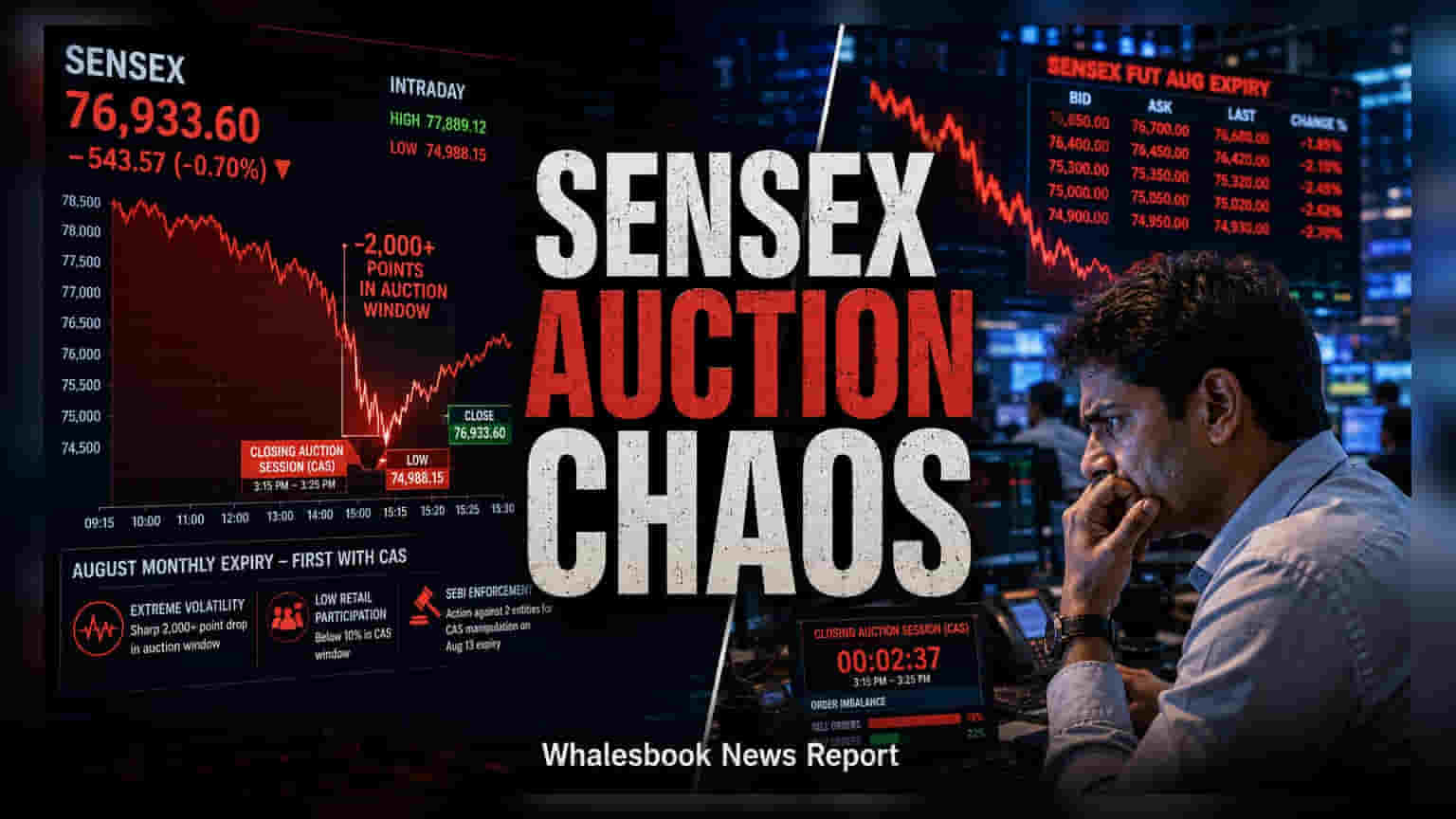
The BSE Sensex saw sharp volatility during the Closing Auction Session on August 27, 2026, dropping over 2,000 points before recovering. SEBI has dismissed calls to reverse the new policy, confirming the auction mechanism will remain. Investors faced significant price swings in derivatives, raising concerns about market stability during expiry days.
The BSE Sensex experienced extreme instability on August 27, 2026, during the monthly derivatives expiry. This was the first monthly expiry to feature the newly introduced Closing Auction Session (CAS), which replaced the previous 30-minute volume-weighted average price (VWAP) calculation method. The index witnessed a sharp drop of over 2,000 points within the auction window that began at 3:15 PM, reaching a low of 74,988, before recovering to close 0.70 percent lower at 76,933.6.
The Closing Auction Session, launched by the Securities and Exchange Board of India (SEBI) on August 3, 2026, aims to determine closing prices through an auction mechanism. However, the mechanism has sparked debate among traders and investors. Many participants reported that the final ten minutes of trading have become disproportionately volatile, causing rapid and erratic price changes for both call and put options. Data suggests that retail participation in this specific auction window has remained below 10 percent, with institutional traders dominating the flow.
Despite the backlash and outcry from the trading community regarding potential market distortion, SEBI Chairman Tuhin Kanta Pandey has explicitly confirmed that the regulator has no plans to scrap or reverse the policy. SEBI intends to maintain the current CAS framework, viewing it as a necessary step to align Indian markets with global standards, improve price discovery, and discourage late-day manipulation.
For investors, the recent session highlights significant risks related to expiry-day volatility. The auction mechanism can lead to sudden, sharp price movements that may be difficult for traditional risk management tools to track. Furthermore, the potential for market manipulation remains a point of scrutiny. SEBI itself recently took enforcement action on August 19 and 20, 2026, against two entities—Mansi Share & Stock Broking and Copthall Mauritius Investment—for their alleged roles in manipulating the CAS during the August 13 Sensex expiry. These enforcement actions underscore the regulator’s awareness of the risks associated with the new format.
Going forward, the primary concern for market participants is the unpredictability of settlement prices. Because the auction creates a concentrated window of activity, the risk of slippage—where a trade is executed at a price different from what the trader expected—is higher during these final minutes. Investors, particularly those active in derivatives, may need to exercise caution during the final auction window on expiry days. Monitoring the liquidity and stability of the auction process will be an important task for traders until the market adjusts to this new method of determining closing prices.