

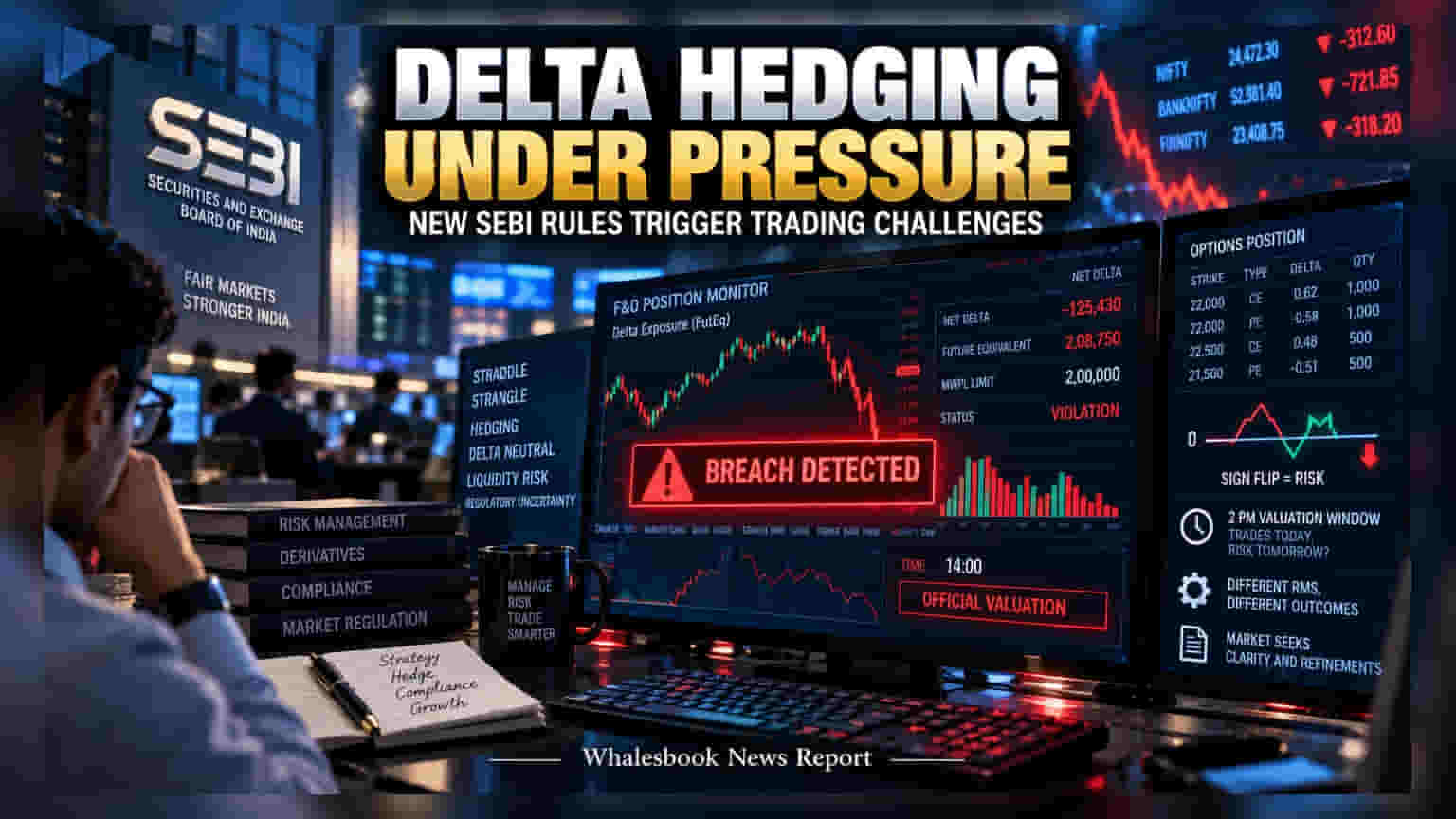
SEBI’s transition to measuring derivatives bans via delta-adjusted 'Future Equivalent' exposure is causing operational friction for traders. While intended to modernize risk management, the rigid rules often penalize standard hedging strategies. Traders are now facing unintended execution risks, struggling to close out multi-leg positions without triggering potential regulatory breaches.
The Securities and Exchange Board of India (SEBI) has transitioned its approach to monitoring Market Wide Position Limit (MWPL) and derivatives (F&O) ban triggers. The regulator moved from the traditional, straightforward method of counting the total number of open contracts to a more complex, delta-based system known as 'Future Equivalent' (FutEq) exposure. While this change aims to provide a more accurate picture of market concentration, it has introduced technical and operational challenges for traders who utilize multi-leg hedging strategies.
The 'Sign-Flip' Problem in Hedging
The primary challenge for market participants lies in how the new system interprets complex strategies like straddles and strangles. These positions are typically constructed to be delta-neutral, meaning they are balanced to offset directional risk. However, the current enforcement framework classifies any trade that causes a 'sign flip'—shifting from net-long to net-short delta, or the reverse—as a potential regulatory violation.
This creates a dilemma when a trader attempts to manage a position by exiting one of the legs. If closing that specific option leg causes the net delta of the remaining open position to cross the zero threshold, the system may register it as a breach. As a result, traders are often forced to close the entire multi-leg structure simultaneously rather than adjusting individual parts. This creates liquidity risk, as traders are compelled to square off positions even in stressed, low-volume environments to avoid the risk of regulatory fines.
The 2 PM Regulatory Gap
Adding to these concerns is the 2 PM valuation window used by the Clearing Corporation. Traders execute orders throughout the day, but the delta values used to calculate compliance are only finalized at 2 PM. This disconnect creates a regulatory uncertainty: a trade that appears compliant based on live market data earlier in the day could be deemed a violation once the official 2 PM delta numbers are published.
This gap has led to inconsistent experiences across the brokerage industry. Because different brokerage Risk Management Systems (RMS) interpret and apply these rules differently, traders are encountering an uneven playing field. Some platforms might permit trades that reduce net delta, while others have adopted a blanket restriction on all activity to prevent the possibility of a regulatory breach.
Potential Refinements
To address these friction points, market observers have suggested several refinements to the framework. Key recommendations include establishing a neutral 'delta band' around zero to ignore minor sign flips, introducing a 'cure window' for minor infractions, and specifically exempting any trade that closes an existing position from being classified as a violation. The market will continue to monitor whether the regulator adopts these adjustments to improve the ease of executing risk management strategies.