

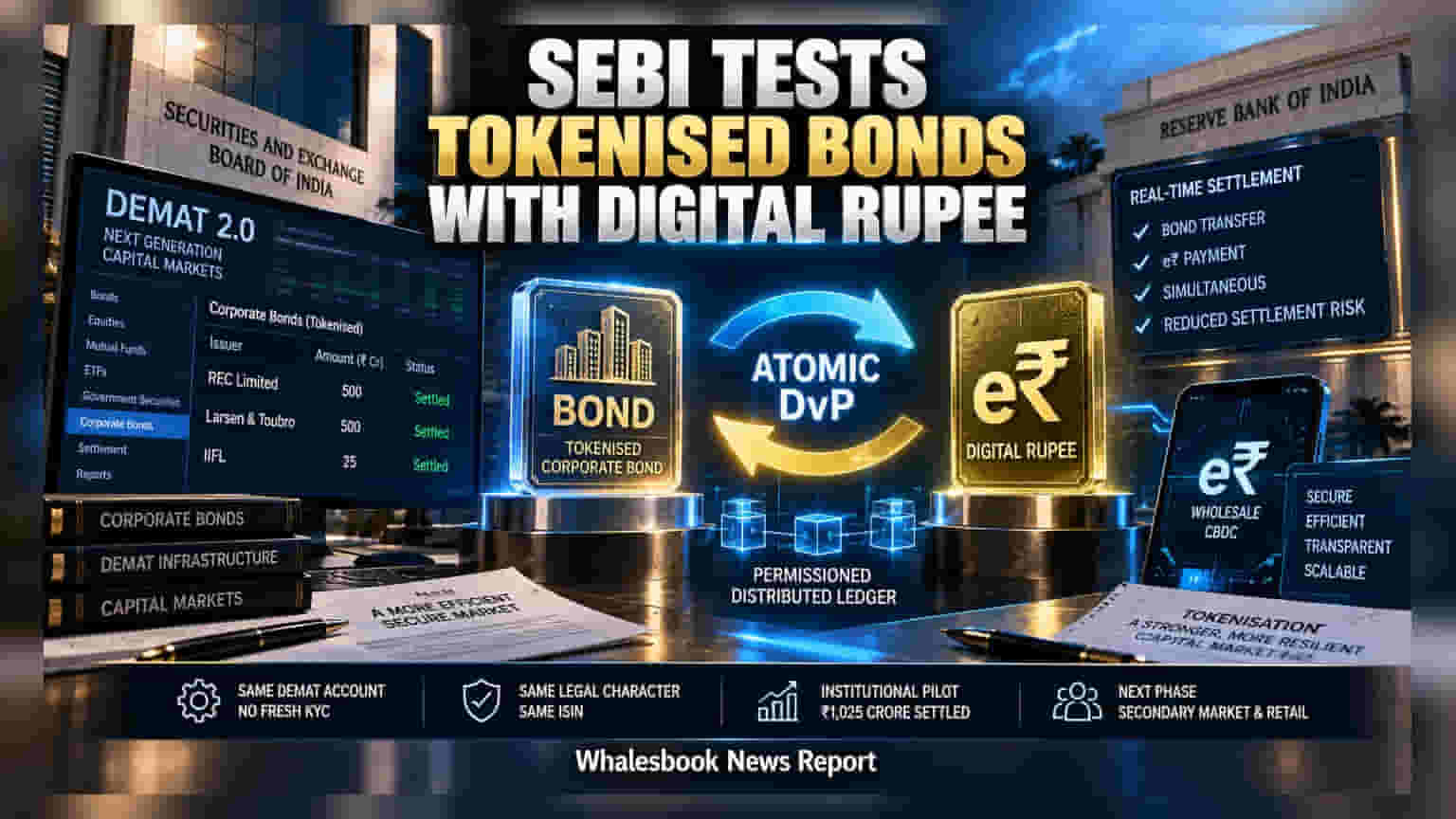
The Securities and Exchange Board of India (SEBI) has successfully tested its 'Demat 2.0' framework, settling ₹1,025 crore in corporate bonds using tokenised assets. Major issuers including REC Limited, Larsen & Toubro, and IIFL participated in the pilot, which leverages the digital rupee (e₹) for instant atomic settlement. Investors will not require new demat accounts, as the system focuses on backend infrastructure efficiency.
The Securities and Exchange Board of India (SEBI) has successfully conducted a pilot test for 'Demat 2.0,' a new infrastructure framework for corporate bonds that uses tokenised assets. As of September 10, 2026, the pilot facilitated the settlement of ₹1,025 crore in tokenised corporate bonds, marking a significant step toward modernizing settlement processes.
Three major corporate entities participated in this initial phase. REC Limited and Larsen & Toubro each issued ₹500 crore in tokenised bonds, while IIFL participated with an issuance of ₹25 crore. These transactions utilized the Reserve Bank of India's (RBI) wholesale Central Bank Digital Currency (e₹) to complete the payment and settlement process.
The core technological change involves moving from traditional depository databases to a permissioned Distributed Ledger Technology (DLT) network. This system is designed to achieve 'atomic' delivery-versus-payment. In standard market terms, this means the bond transfer and the corresponding payment occur simultaneously. If the funds are not successfully transferred, the security transfer does not occur. This process aims to eliminate the settlement risks that exist in traditional cycles where delivery and payment occur at different times.
For investors, the transition to Demat 2.0 is designed to be seamless. There is no requirement for a new demat account or fresh Know Your Customer (KYC) verification. The tokenised bonds operate within the existing depository infrastructure, meaning the legal character, International Securities Identification Number (ISIN), and investor protections remain unchanged. The system is intended to function as an underlying infrastructure upgrade rather than the creation of a new, separate class of assets.
While the pilot focuses on operational efficiency, there are factors for the market to consider. As this is a new system, it introduces specific technical dependencies. The reliance on permissioned DLT networks and smart contracts requires high security and technical compatibility between depository systems and CBDC wallets. Operational resilience regarding DLT integration will remain a key focus for regulators as they continue to refine the framework.
The current implementation is in its first stage, focusing on the issuance and servicing of corporate bonds by institutional entities. Future phases are expected to introduce secondary-market trading and potentially include retail investors, alongside a broader integration of credit-rating agencies and other regulated market participants.