

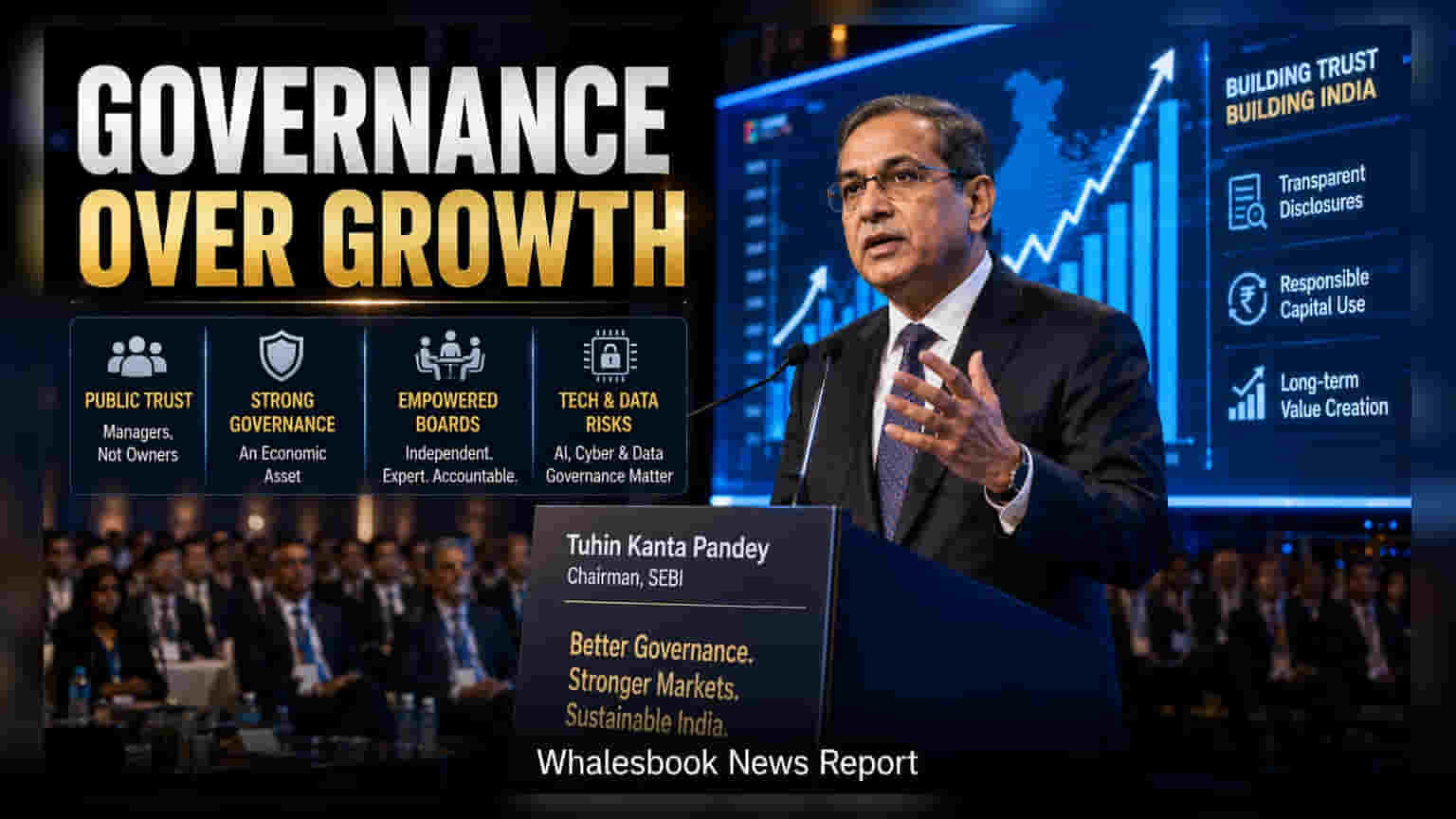
SEBI Chairman Tuhin Kanta Pandey has called for a major change in corporate culture, urging founders to treat public capital as a responsibility rather than personal control. He emphasized that robust governance is an economic asset, not a regulatory burden. The regulator is currently reviewing disclosure rules for IPO proceeds to protect minority shareholders and is working on training independent directors to handle modern risks.
Securities and Exchange Board of India (SEBI) Chairman Tuhin Kanta Pandey has set a new tone for corporate leadership in India. Speaking at the Fortune India 40 Under 40 summit, he urged founders to move away from a 'control-based' mindset and instead embrace a 'stewardship' model. As Indian companies expand and raise money from public markets, the regulator is signaling that the era of treating a public company like a private family business must come to an end.
Accountability to Public Shareholders
For investors, the core message is about trust and accountability. Pandey pointed out that when a company raises money from the public, it is holding third-party capital. Founders must view themselves as managers of this public trust rather than just owners. The regulator argues that genuine corporate governance is not a chore to be completed for compliance; it is an economic asset that strengthens a business in the long run.
SEBI is taking active steps to reinforce this. Beyond speeches, the regulator is currently reviewing how companies disclose the usage of money raised through IPOs. By tightening rules around the utilization of issue proceeds and related-party transactions, SEBI aims to close gaps that can sometimes hide poor financial decision-making from retail investors.
Strengthening the Boardroom
One of the biggest risks identified by the regulator is the 'ceremonial' board. This occurs when directors are appointed just to tick a box on a regulatory form. Pandey highlighted that independent directors must be empowered to challenge internal assumptions and should possess the expertise to ask difficult questions.
To address this, SEBI is looking into capacity-building initiatives, often in partnership with bodies like the National Institute of Securities Markets (NISM). The goal is to ensure that board members have the domain-specific knowledge to oversee complex areas, particularly as the business environment changes.
Tech and Data Governance Risks
Governance is no longer limited to finance and legal matters. The SEBI chief explicitly highlighted that artificial intelligence and data dependency are now major operational risks. If a company relies heavily on foreign technology or AI systems without proper safeguards, it invites significant cyber and operational threats.
Pandey also challenged the younger generation of entrepreneurs to move beyond merely using foreign technology. He pointed out that India’s research and development spending remains low, hovering between 0.6% and 0.8% of GDP. He noted that long-term business success for the next generation of Indian industry will be defined by owning intellectual property and creating national capability, rather than just scaling operations.
What Investors Should Track
Investors may watch for how companies adapt to these evolving expectations. When reviewing annual reports or investor presentations, it is worth observing whether boards are genuinely independent and how transparent a company is regarding the use of capital raised from the public. As SEBI continues to streamline disclosure frameworks and work toward reducing redundant compliance, companies that prioritize transparency and robust data governance are likely to build more sustainable value for shareholders over time.