

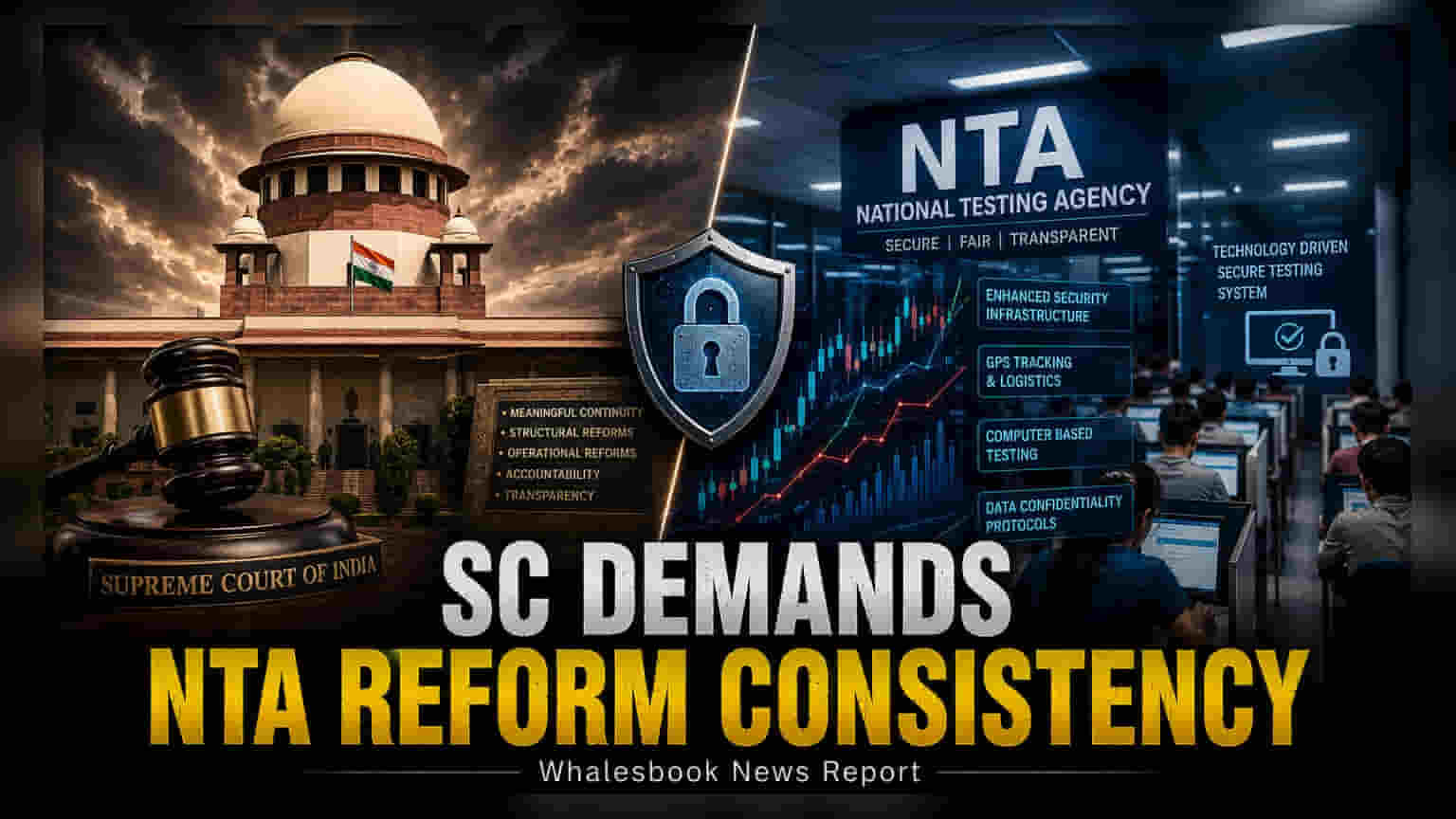
The Supreme Court has ordered the National Testing Agency (NTA) to submit an affidavit within three weeks regarding the implementation of key reforms proposed by the K. Radhakrishnan and Nandan Nilekani committees. This directive aims to address ongoing governance and security concerns in major competitive exams. For the broader education sector, this move toward a stable, technology-driven system is essential for maintaining institutional trust and operational reliability.
The Supreme Court of India has issued a firm directive to the National Testing Agency (NTA), calling for a sustained approach to structural and operational reforms. In a recent hearing, the court ordered the agency to file a detailed affidavit within three weeks, outlining the specific steps taken to implement the recommendations of the K. Radhakrishnan committee and the Nandan Nilekani-led task force. The court emphasized that the NTA must focus on 'meaningful continuity' in its reform efforts rather than relying on temporary or ad-hoc measures.
The core of the court's concern lies in the need for a stable and predictable examination environment. Following recent controversies involving major tests like the NEET-UG, the agency is under pressure to modernize its operations. The recommendations provided by the expert panels, including those from the Nandan Nilekani-led task force, are intended to overhaul the agency’s testing infrastructure. This includes improving the confidentiality of question papers, enhancing logistics through technology-driven solutions like GPS tracking, and potentially transitioning to more secure, computer-based testing models to prevent paper leaks and technical failures.
While the NTA is an autonomous society operating under the Ministry of Education and is not a publicly listed company, its operational health is vital to the wider education ecosystem. Coaching centers, EdTech platforms, and thousands of private educational institutions depend heavily on a reliable and predictable exam calendar. The uncertainty caused by repeated administrative challenges and examination irregularities often creates ripple effects across these sectors, affecting student preparation cycles and business planning. Consequently, the push for institutional stability is a development that many stakeholders in the education and coaching industry are following closely.
Financially, the agency has faced scrutiny regarding the reinvestment of its resources. Data indicates that the NTA, which functions as a self-sustained entity funded through examination fees, has accumulated a surplus of approximately ₹448 crore over its first six years of operation. The parliamentary and judicial focus is now on ensuring that this surplus is effectively utilized to upgrade security infrastructure and build a permanent, specialized workforce, rather than remaining underutilized. Currently, the agency’s reliance on contractual and deputed staff has been identified as a significant operational risk, with experts calling for the recruitment of permanent, specialized professionals to handle sensitive examination processes.
Looking ahead, the next important update will be the submission of the NTA’s affidavit to the Supreme Court. This filing is expected to provide clarity on the timeline for implementing the recommended security protocols and the agency’s long-term plan for organizational restructuring. The ability of the NTA to transition from a reactive model to a robust, technology-driven testing system will be the primary metric for determining the success of these reforms.