

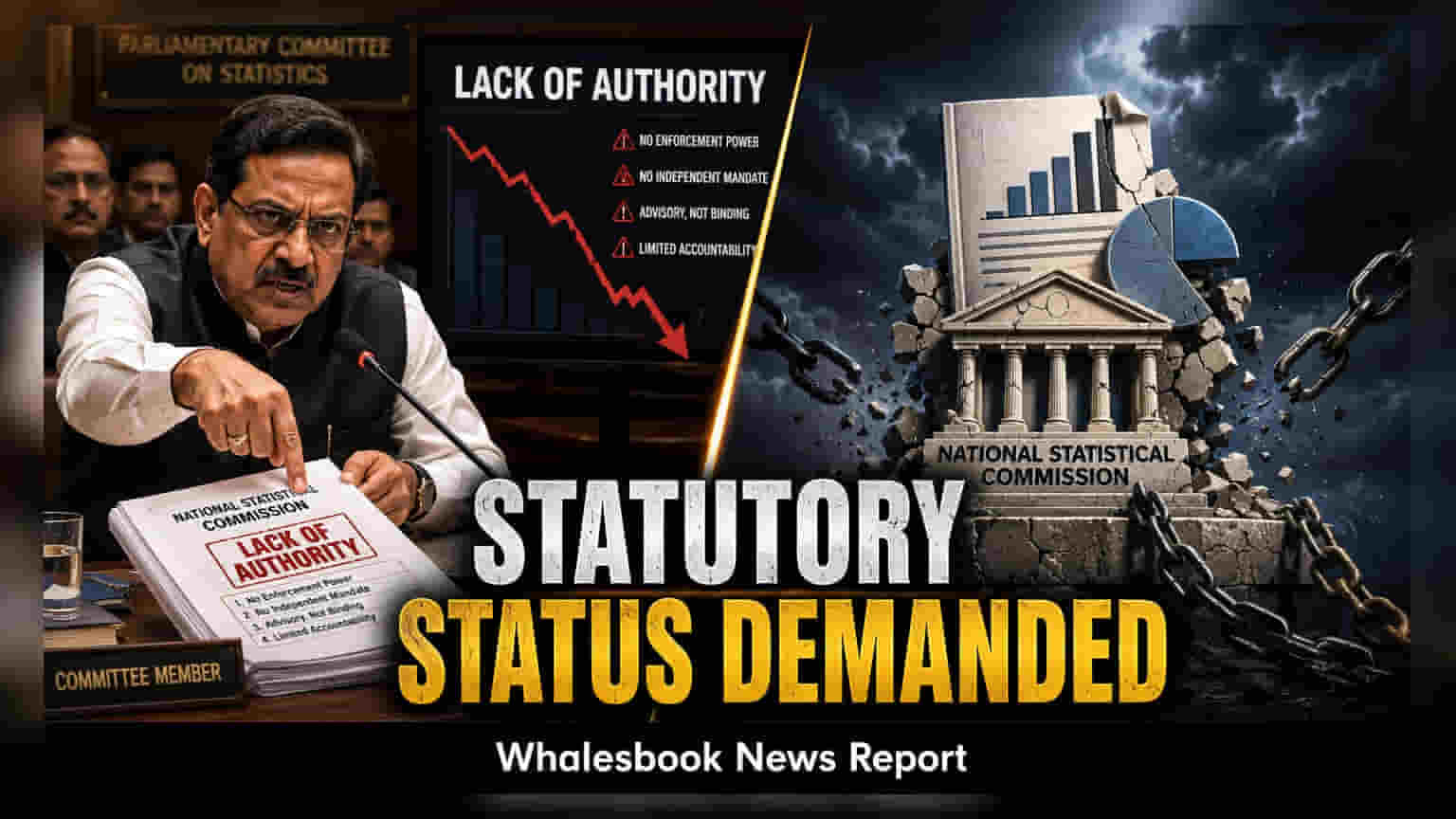
A parliamentary committee has again urged the government to grant statutory status to the National Statistical Commission (NSC) to improve India's data standards. This matters for investors as official economic data drives market sentiment, and a lack of unified oversight often causes confusion. The Ministry of Statistics remains opposed, maintaining that the commission’s current autonomy is sufficient.
The Standing Committee on Finance has intensified its request for the government to provide formal legal status to the National Statistical Commission (NSC). In reports tabled in Parliament on August 10, 2026, the committee expressed dissatisfaction with the current framework, which operates without a dedicated legislative mandate. This ongoing disagreement highlights a governance gap that, while not immediately affecting stock prices, is vital for the long-term reliability of India's macroeconomic data.
The committee, led by Bhartruhari Mahtab, argued that the NSC requires statutory backing to effectively lead and coordinate the country's vast statistical infrastructure. The current model relies on a government resolution from 2005. The committee believes that without a formal legal framework, the NSC lacks the necessary enforcement power to standardize data across different agencies. This, the panel suggests, leads to discrepancies in figures, which can weaken public and institutional trust in official statistics.
From the government's perspective, the Ministry of Statistics and Programme Implementation (MoSPI) has consistently resisted the demand. The ministry maintains that the existing setup is effective. It points out that the commission is already led by experts and functions with sufficient autonomy to perform its duties. The government views the current resolution-based model as flexible and sufficient, arguing that statutory status is not a requirement for the commission to function efficiently.
For investors, the debate over the NSC's status is significant due to its impact on data credibility. Markets rely heavily on official reports regarding GDP, inflation, and employment to make investment decisions. When there are gaps or discrepancies between government data and private sector estimates, it creates uncertainty. A statutory body with clear, legally mandated powers could theoretically ensure better data quality and uniformity, which would lead to more stable economic tracking for analysts and investors.
The risk for the broader market lies in the potential for continued data discrepancies. When the statistical system lacks a strong, independent legal mandate, it becomes harder to enforce uniform standards across diverse data-producing entities. This can result in conflicting reports that confuse the market and affect business planning. As the parliamentary panel continues to press for these reforms, the core monitorable for investors will be how the government eventually addresses these concerns to ensure higher data reliability. The standoff indicates that this issue will likely remain a topic of policy discussion in upcoming parliamentary sessions.