

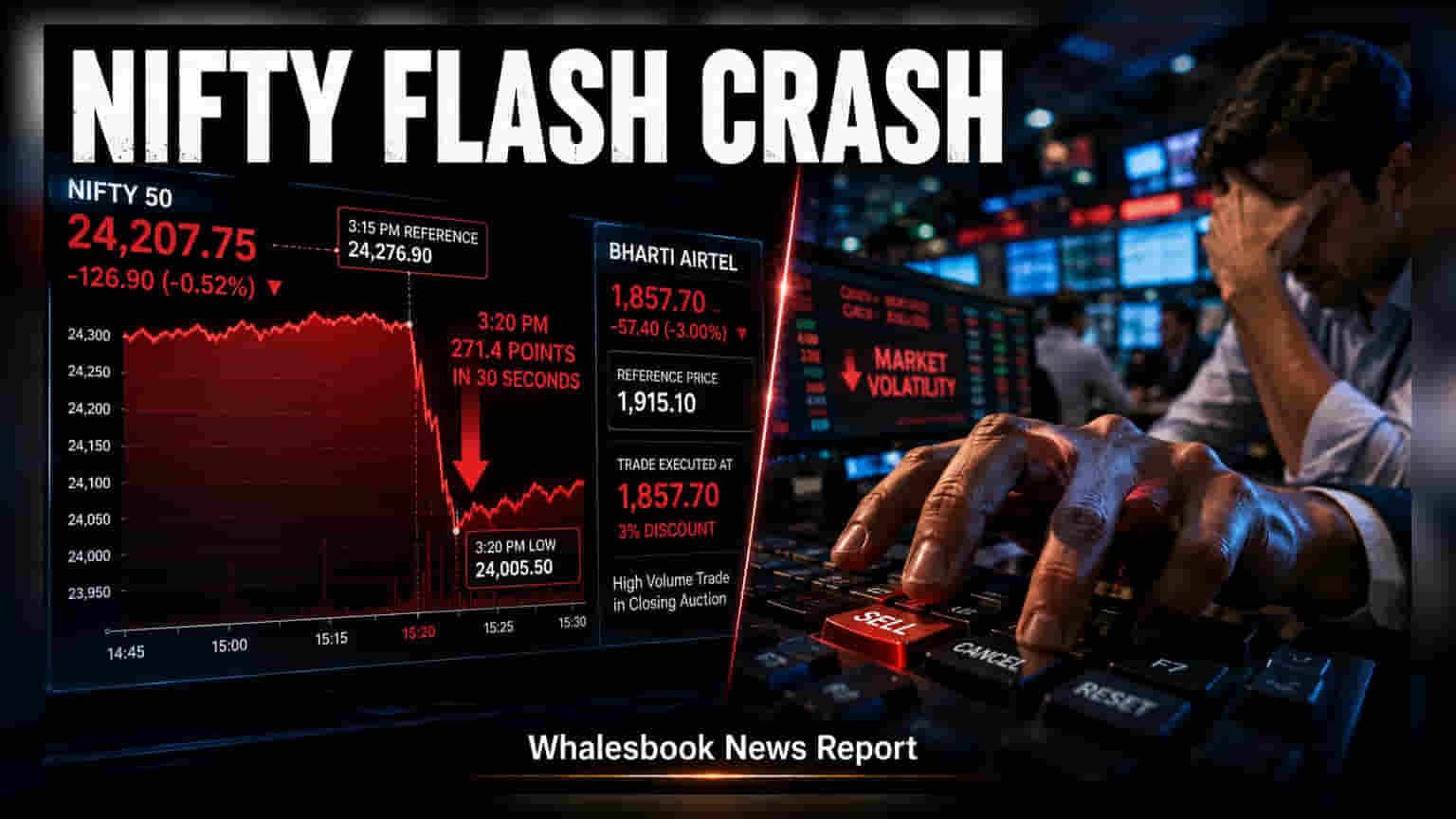
The Nifty 50 index saw a brief 271-point drop during the closing auction on August 26, 2026, triggered by a sudden, low-price trade in Bharti Airtel. The incident, suspected to be a human input error, highlights ongoing liquidity challenges in the newly introduced closing auction mechanism.
On Wednesday, August 26, 2026, the Nifty 50 index experienced a sudden, sharp decline of 271.4 points within thirty seconds of the start of the closing auction session (CAS) at 3:20 PM. The benchmark index fell from its 3:15 PM reference level of 24,276.9 to a low of 24,005.5, catching many market participants off guard. The index managed to recover most of these losses by the end of the day, finishing at 24,207.75, which was a decline of 0.52% from the previous session.
The volatility was primarily caused by a significant, high-volume trade in the shares of Bharti Airtel. Data indicates that a sell order for the stock was matched at ₹1,857.7, which was a 3% discount to the stock's reference price of ₹1,915.1. SEBI regulations currently allow investors to place limit orders within a 3% band of the reference price, meaning this transaction was technically compliant with market rules. However, the market was surprised that a seller accepted a price at this lower limit, which created immediate downward pressure on the stock and, by extension, the broader Nifty index.
The Impact of the New Closing Auction
The closing auction session was introduced on Indian exchanges on August 3, 2026, to replace the previous method of calculating the closing price. The goal of this change is to create a more stable and transparent benchmark for the final trading price. However, since the system is still new, it has faced teething issues. Because participation from retail investors and certain arbitrage funds has been thin during these final minutes, the system remains sensitive to large, concentrated orders in heavy-weight stocks.
Risks and Market Monitorables
Market analysts and proprietary traders have suggested that the incident was likely a 'fat-finger' error—a manual input mistake where a trader accidentally enters the wrong price or quantity. While such errors occur occasionally in trading, they become more visible when they happen in the closing auction, where liquidity is lower and the impact on the index is magnified.
For investors, this event illustrates the structural risks inherent in the current closing auction setup. When large trades hit a market with limited participants, they can lead to disproportionate price swings. This volatility can impact index-based derivatives and daily portfolio valuations. Investors should track any further updates or clarifications from the National Stock Exchange (NSE) regarding the functioning of the auction window, particularly if there are measures taken to improve order-matching liquidity and prevent extreme price swings in large-cap stocks.