

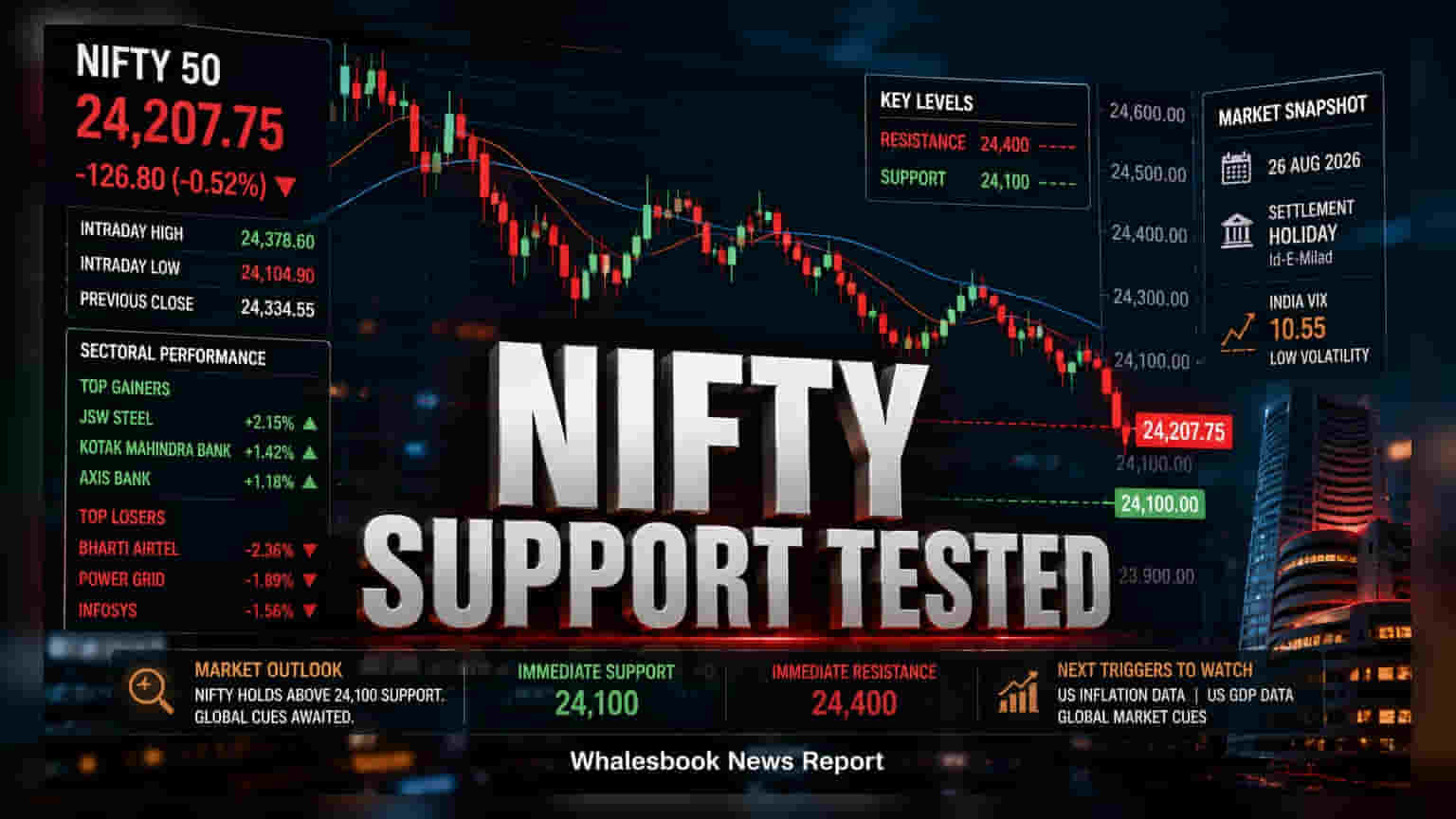
The Nifty 50 declined 0.52% to close at 24,207.75 on August 26, 2026, as gains in banking and metal stocks were countered by selling in IT, FMCG, and auto shares. The index is currently navigating a range-bound phase with support levels at 24,100 under close watch. Traders remain cautious ahead of global economic data, with volatility indicators staying subdued.
The Nifty 50 index struggled to maintain momentum on August 26, 2026, retreating from its intraday high of 24,378.60 to close at 24,207.75. This drop of 126.80 points, or 0.52%, highlights the ongoing cautious sentiment among investors as the market consolidates within a specific range. A notable feature of the day’s trading was the distinct sectoral rotation, where strength in specific areas was unable to lift the overall index.
Sectoral Divergence and Market Moves
The market narrative was defined by a tug-of-war between different sectors. Banking, financial services, and metal stocks showed relative resilience and provided support to the index throughout the session. Notable gainers included JSW Steel, Kotak Mahindra Bank, and Axis Bank. In contrast, heavy selling pressure in the IT, FMCG, and auto sectors acted as a drag on performance. Shares such as Bharti Airtel, Power Grid, and Infosys faced notable downward pressure, which limited the Nifty’s ability to sustain its early gains.
This behavior suggests that investors are shifting focus between sectors rather than making a broad-based move. When one sector draws capital, another faces profit-booking, keeping the index trapped in a relatively tight band. Furthermore, August 26, 2026, was designated as a settlement holiday due to the Id-E-Milad observance, which meant that market settlements were deferred to the following day. This often contributes to a more measured pace of trading as participants account for the holiday schedule.
Technical View and Market Volatility
From a technical perspective, market participants are keeping a close watch on the 24,100 level. This serves as an immediate support zone—a level where buyers have historically stepped in to prevent further declines. If the index fails to sustain above this mark, it may invite further downward movement. On the upside, the index is struggling to clear hurdles near the 24,400 range, which continues to act as a point of resistance.
Despite the decline, market volatility remains surprisingly low. The India VIX, a gauge of market expectation for volatility, hovered near the 10.5 to 10.6 level. This suggests that while there is uncertainty, there is no sign of panic among market participants. Investors are currently waiting for a fresh trigger to set the next trend, with major global cues—specifically upcoming US economic data such as inflation and GDP figures—likely to influence market direction in the coming sessions. The lack of broad-based participation means the index currently relies on selective heavyweight stocks to maintain its range, making the next few trading days critical for determining if the support levels will hold.