

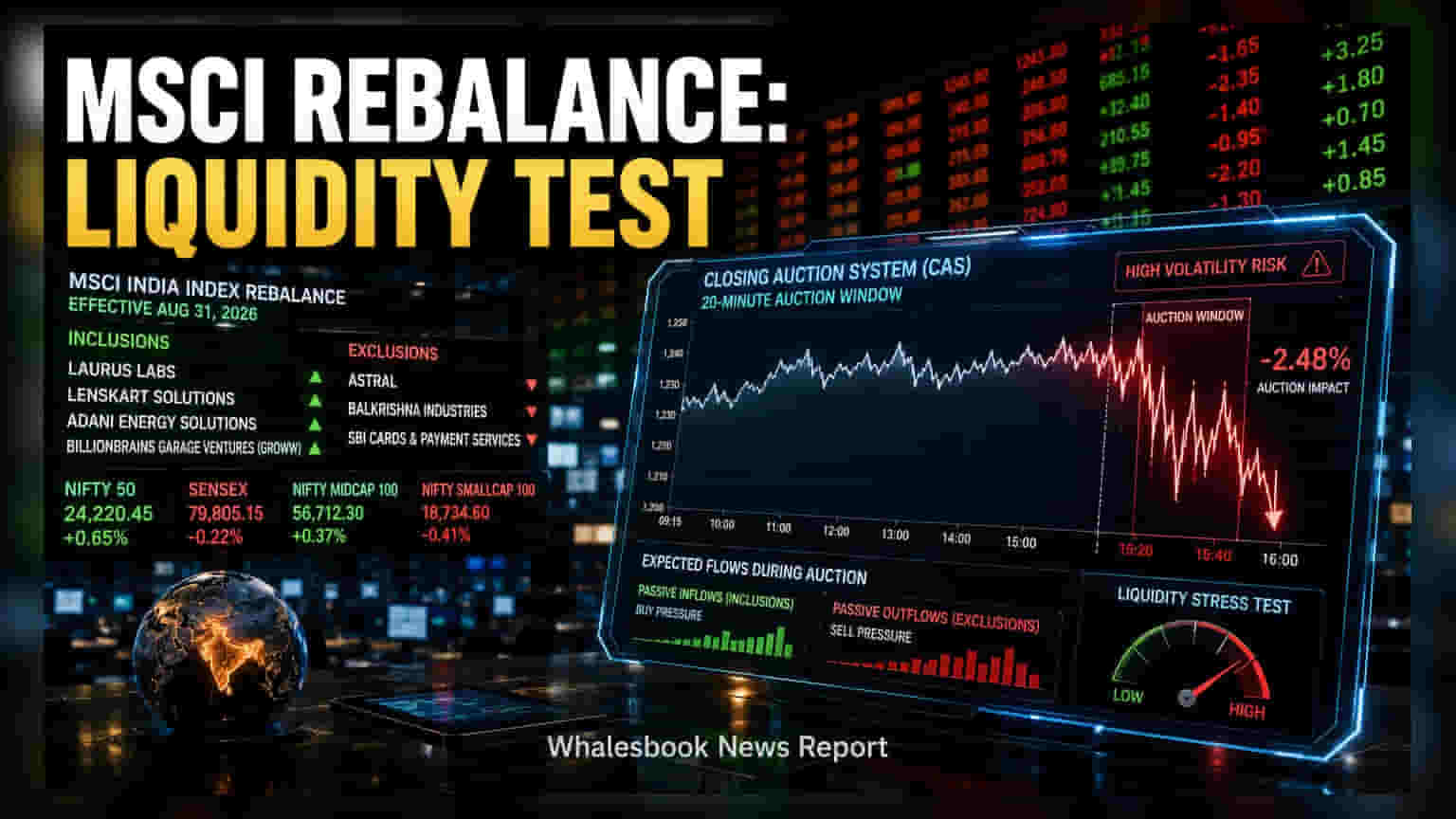
The MSCI India Index rebalancing on August 31 will test the market's new 20-minute closing auction system. With passive investment funds adjusting portfolios—adding names like Laurus Labs and removing others like SBI Cards—the concentrated trading could trigger price volatility. Investors are watching to see how the system handles large institutional order flows in a short timeframe.
The upcoming MSCI India Index rebalancing, scheduled to take effect at the market close on August 31, 2026, has become a focal point for market participants. While index rebalancing is a routine administrative process, this particular update acts as a significant stress test for India’s recently implemented Closing Auction System (CAS). The CAS is a 20-minute window designed to consolidate trading activity and set a single official closing price for stocks. However, because large global index funds and passive investors must execute their trades during this specific period, the system is expected to absorb a surge of institutional buying and selling at once.
Impact on Specific Stocks
The rebalancing involves changes to the constituent list, which inevitably leads to fund managers shifting their holdings to match the index. On the inclusion side, Laurus Labs, Lenskart Solutions, Adani Energy Solutions, and Billionbrains Garage Ventures—the parent company behind the investment platform Groww—will be added to the index. Conversely, Astral, Balkrishna Industries, and SBI Cards and Payment Services will be removed. These changes typically force passive funds, which track these indices, to buy or sell large quantities of shares. When this activity is forced into the condensed 20-minute auction window, it creates a high-pressure environment for the exchange’s trading infrastructure.
The Risk of Price Volatility
Market observers have raised concerns about how efficiently the auction mechanism will manage these concentrated flows. In theory, the auction is meant to provide stability, but in practice, it can become a point of friction if liquidity—the ease with which shares can be bought or sold—is thin. If a large buy or sell order arrives during the auction when there is not enough matching interest on the other side, it can lead to temporary price distortions. Analysts point to recent derivatives expiry days as examples of how erratic price movements can occur when large trades are compressed into short timeframes.
For investors, the primary risk is not necessarily the long-term value of these companies, but the potential for rapid, artificial price fluctuations during the auction period. Such "price dislocations" can sometimes cause a stock’s closing price to diverge from its trading value earlier in the day, a phenomenon that can catch unprepared traders off guard. While the Securities and Exchange Board of India (SEBI) has maintained the current regulatory framework without immediate revisions, the event serves as a practical assessment of the system's capacity to maintain orderly trading under heavy institutional pressure.
What Investors Should Monitor
As the market heads into the weekend following the rebalancing, the key focus for market participants will be the execution quality of the auction. Investors may monitor how quickly and effectively the exchange handles the volume spike for the incoming and outgoing stocks. Signs of smooth execution would indicate that the current infrastructure is well-equipped to handle future rebalancing events, whereas significant gaps in price or liquidity could renew calls for adjustments to the auction mechanism. Ultimately, while the rebalancing is an administrative change, the mechanics of the trade on August 31 will provide valuable insight into the resilience of the market’s new closing procedure.