

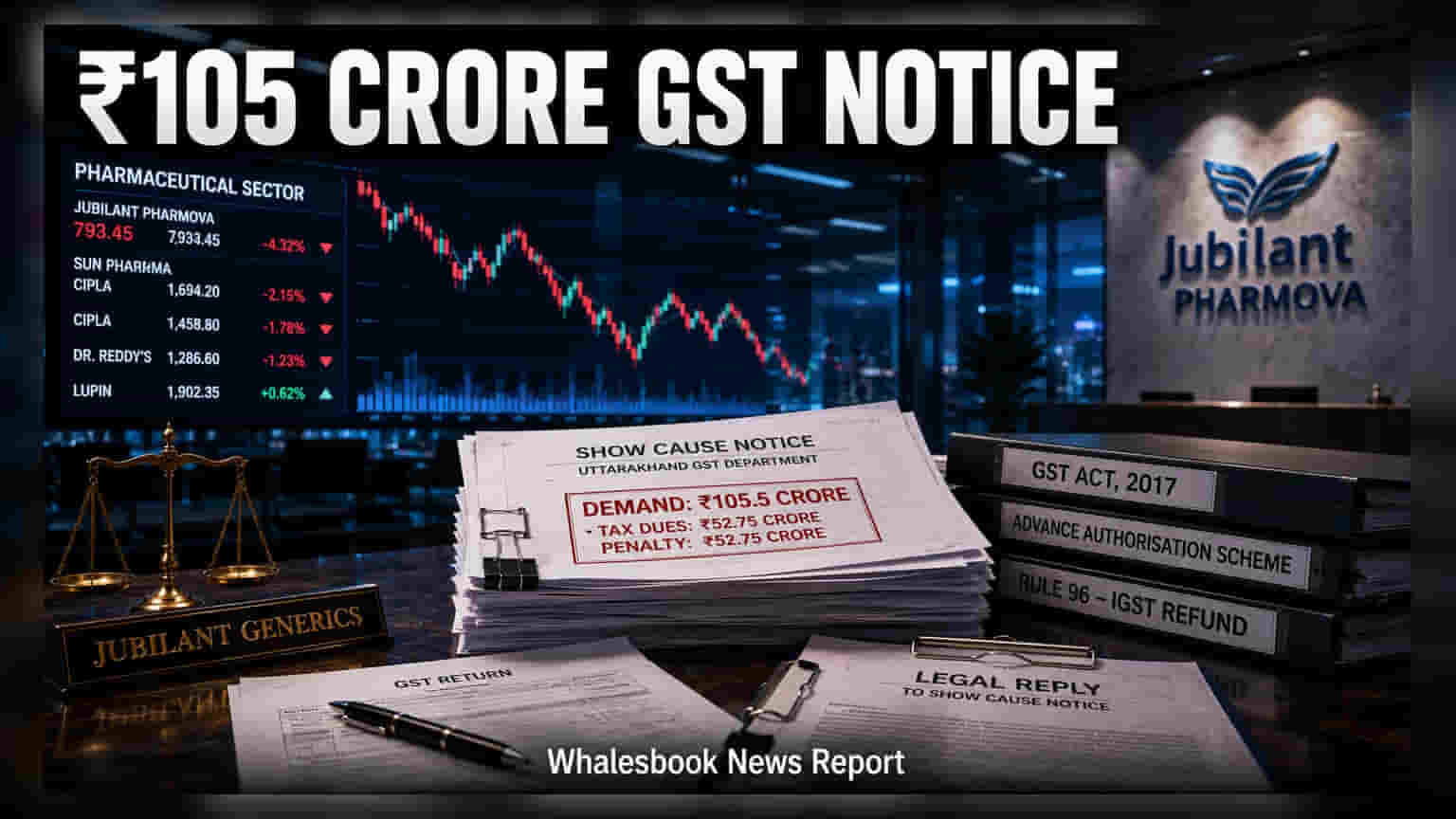
Jubilant Pharmova’s subsidiary, Jubilant Generics, has received a ₹105.5 crore show-cause notice from GST authorities regarding alleged dual tax benefits for FY21-FY22. While the company is contesting the claim, this adds a layer of uncertainty for investors already tracking a 45% year-on-year profit decline in the June quarter.
Jubilant Pharmova’s subsidiary, Jubilant Generics, has received a show-cause notice from the Uttarakhand GST authorities demanding ₹105.5 crore. This amount includes ₹52.75 crore in tax dues and a matching penalty of ₹52.75 crore, relating to the fiscal years 2020-21 and 2021-22.
The tax department alleges that the subsidiary incorrectly claimed dual benefits by simultaneously using IGST refunds under Rule 96 and the Advance Authorisation Scheme. The Advance Authorisation Scheme is a policy that allows companies to import inputs without paying duties if those materials are used for export-oriented production. Tax authorities claim that utilizing both the refund mechanism and the duty-free import scheme at the same time is not permitted under the existing trade rules.
The company has formally rejected these allegations. In an official communication, Jubilant Pharmova stated that the notice is legally and factually flawed. The management confirmed that they intend to challenge the findings before the Joint Commissioner of the CGST Division. The firm maintained that it does not expect this development to result in any material financial or operational disruption to its ongoing business activities.
For investors, this legal dispute adds to the current list of monitorables for the company. Jubilant Pharmova recently reported a 45.09% decline in net profit for the quarter ending June 2026 (Q1 FY27) compared to the same period in the previous year. Alongside the profit drop, the company has seen compressed profit margins, which are often sensitive to cost fluctuations and tax liabilities.
Financial data also indicates that the company is managing a net debt-to-EBITDA ratio of approximately 1.3x. When a company faces margin pressure and has existing debt obligations, additional tax demands—even when contested—can create unease among market participants. Investors typically keep a close watch on how such disputes affect cash flow and legal expenses over the coming quarters.
The next step for stakeholders will be the outcome of the proceedings with the GST authorities. The key point to track will be whether the company can successfully resolve the matter without having to set aside significant cash for tax liabilities, which would further impact its financials.