

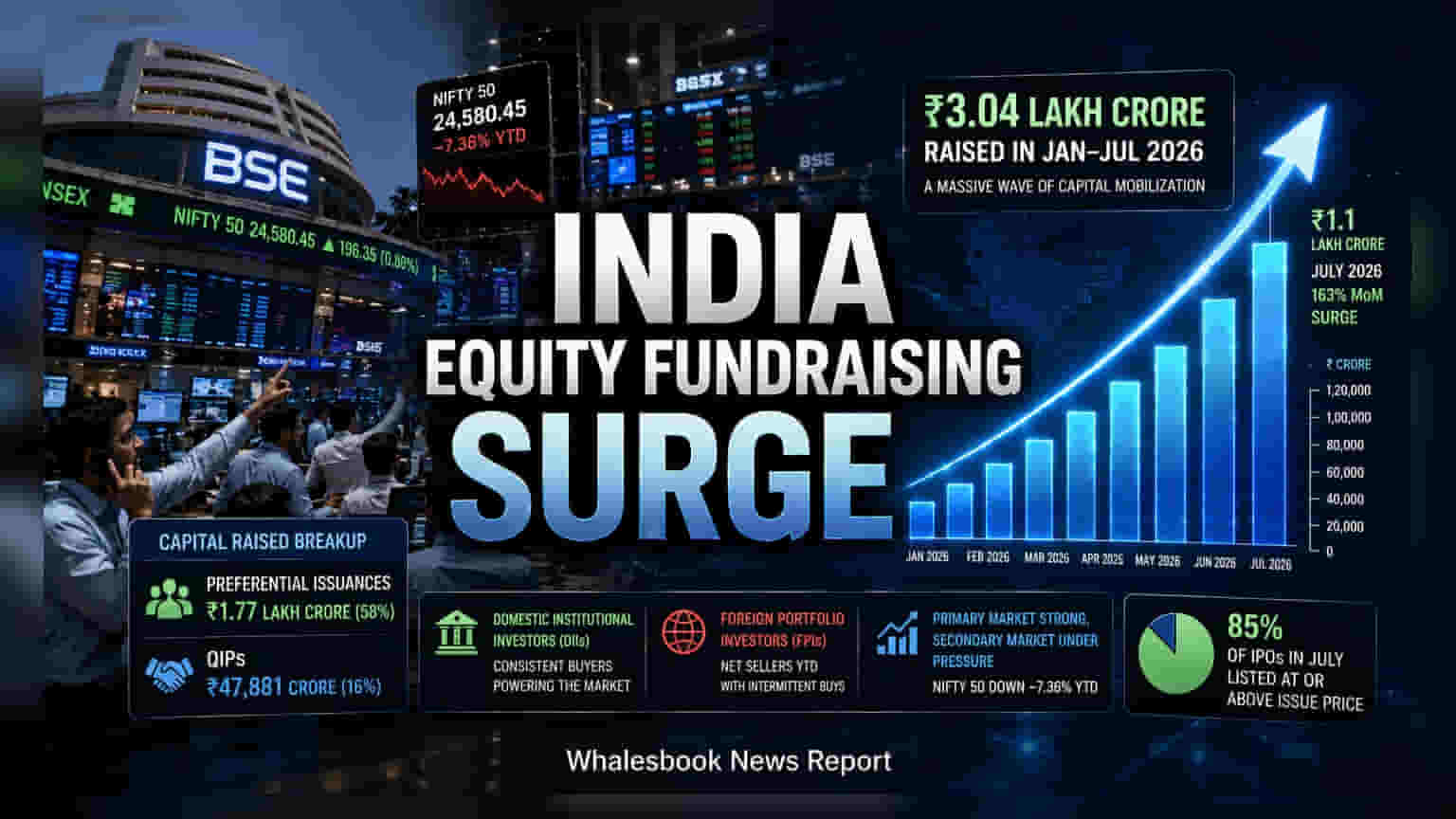
Indian companies raised ₹3.04 lakh crore in equity capital between January and July 2026, primarily through preferential issues and QIPs rather than IPOs. This primary market surge highlights a divergence from the secondary market, where benchmark indices have struggled with a decline of over 7% year-to-date.
Indian equity markets have seen a massive wave of capital mobilization in the first seven months of 2026, with companies raising a total of ₹3.04 lakh crore. This fundraising activity, recorded between January and July, marks a significant shift in corporate strategy. Unlike the previous year, which was dominated by Initial Public Offerings (IPOs), the current year is defined by secondary market capital raising tools like preferential issuances and Qualified Institutional Placements (QIPs).
Preferential issuances have emerged as the dominant route, accounting for ₹1.77 lakh crore, or nearly 58% of the total capital raised during this period. QIPs contributed an additional ₹47,881 crore. These methods are often faster and involve less regulatory preparation than a full-scale IPO, allowing companies to tap into institutional interest more quickly when market conditions permit. The momentum reached a peak in July, with a 163% month-on-month increase in total mobilization to ₹1.1 lakh crore.
Despite this strong primary market activity, the secondary market presents a contrasting picture. Benchmark indices such as the Nifty 50 have faced pressure in 2026, with the index down approximately 7.36% year-to-date as of late August. This divergence between the robust appetite for new issuances—where nearly 85% of IPOs in July debuted at or above their issue price—and the weakness in the broader market is a notable trend for shareholders to track.
The capital infusion has been largely supported by Domestic Institutional Investors (DIIs), who have remained consistent buyers in the market. In contrast, Foreign Portfolio Investors (FPIs) have shown inconsistency, acting as net sellers for the year despite intermittent periods of buying. This dynamic suggests that domestic capital is currently the primary stabilizer for Indian equity valuations.
For investors, the key takeaway is the decoupling of primary and secondary market performance. While companies are successfully raising funds to strengthen balance sheets or support expansion, the wider market remains sensitive to global economic factors, such as concerns over US import tariffs and geopolitical tensions. The sustained volume of fundraising indicates corporate confidence, yet the performance of existing stocks in the secondary market remains tied to broader macro conditions and FPI sentiment. Moving forward, observers may watch whether this primary market success continues to draw domestic liquidity or if secondary market volatility begins to dampen the pace of new capital raises.