

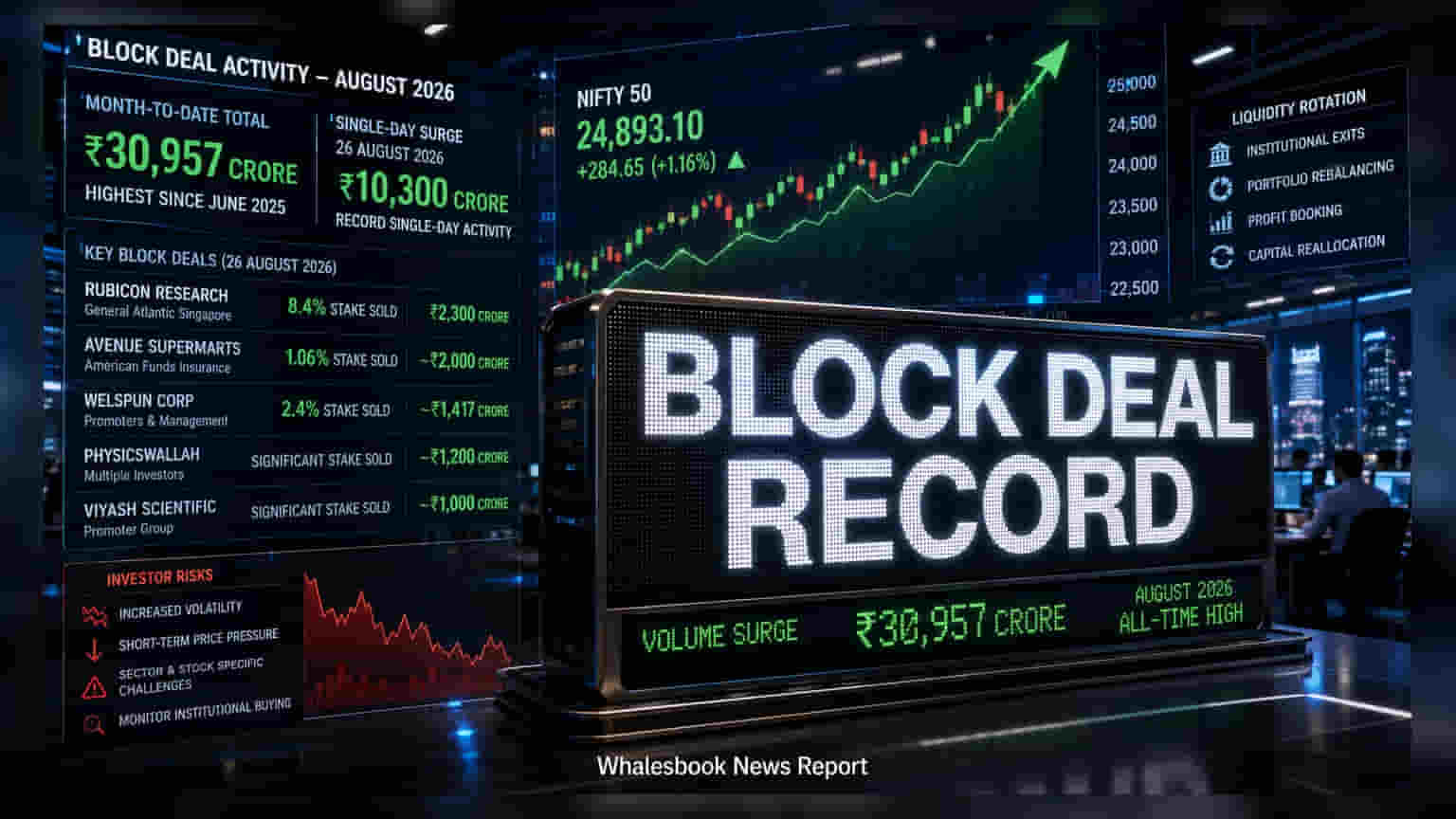
Block deal activity on Indian stock exchanges soared to a 14-month high this August, with total transactions reaching ₹30,957 crore. Major institutional investors and private equity firms have been actively rebalancing portfolios, leading to significant liquidity shifts. For individual investors, this high volume of trading can cause temporary stock price volatility, as large-scale supply often impacts demand-supply dynamics in the secondary market.
August 2026 has emerged as a landmark month for block deal activity in the Indian stock market. Total transactions for the month have climbed to ₹30,957 crore, the highest level recorded since June 2025. A significant portion of this activity occurred on Wednesday, August 26, when single-day transactions surged to ₹10,300 crore. This surge highlights a period of intense liquidity movement as large investors reshuffle their holdings.
Portfolio Rebalancing Drivers
This flurry of activity is primarily driven by institutional investors and private equity funds looking to exit or reduce their positions in various companies. This process, known as portfolio rebalancing, allows large investors to lock in profits after significant stock price rallies or to shift capital toward other opportunities. While these deals are standard market operations, the sheer scale of activity seen in August indicates a broader trend of liquidity rotation across the Indian market, as investors look to capitalize on gains made earlier in the year.
Major Transactions
Several companies were at the center of this liquidity event. At Rubicon Research, General Atlantic Singapore completed a major exit, selling an 8.4 percent stake valued at approximately ₹2,300 crore. Avenue Supermarts also saw a significant transaction, with American Funds Insurance offloading a 1.06 percent position. Additionally, Welspun Corp experienced a large volume shift, with promoters and management selling a 2.4 percent stake. Other companies, including PhysicsWallah and Viyash Scientific, also saw substantial equity changes, reflecting the breadth of this selling pressure across different sectors.
Investor Risks and Market Impact
For retail investors, the most immediate impact of these large block deals is often increased volatility. When a massive number of shares enters the market via a block deal, it creates an imbalance between supply and demand, which can lead to immediate downward price pressure in the short term.
Investors should also consider the specific context of these companies. For example, Avenue Supermarts is currently navigating challenges related to intensifying competition from quick-commerce platforms and changes in consumer spending. Similarly, Welspun Corp, which saw a major rally of nearly 180 percent in 2026 prior to the recent correction, faces volatility as the market digests these large-scale sales. Investors should monitor how the market absorbs this new supply in the coming weeks and look for sustained institutional buying interest, which often serves as a signal of confidence in the underlying business fundamentals.