

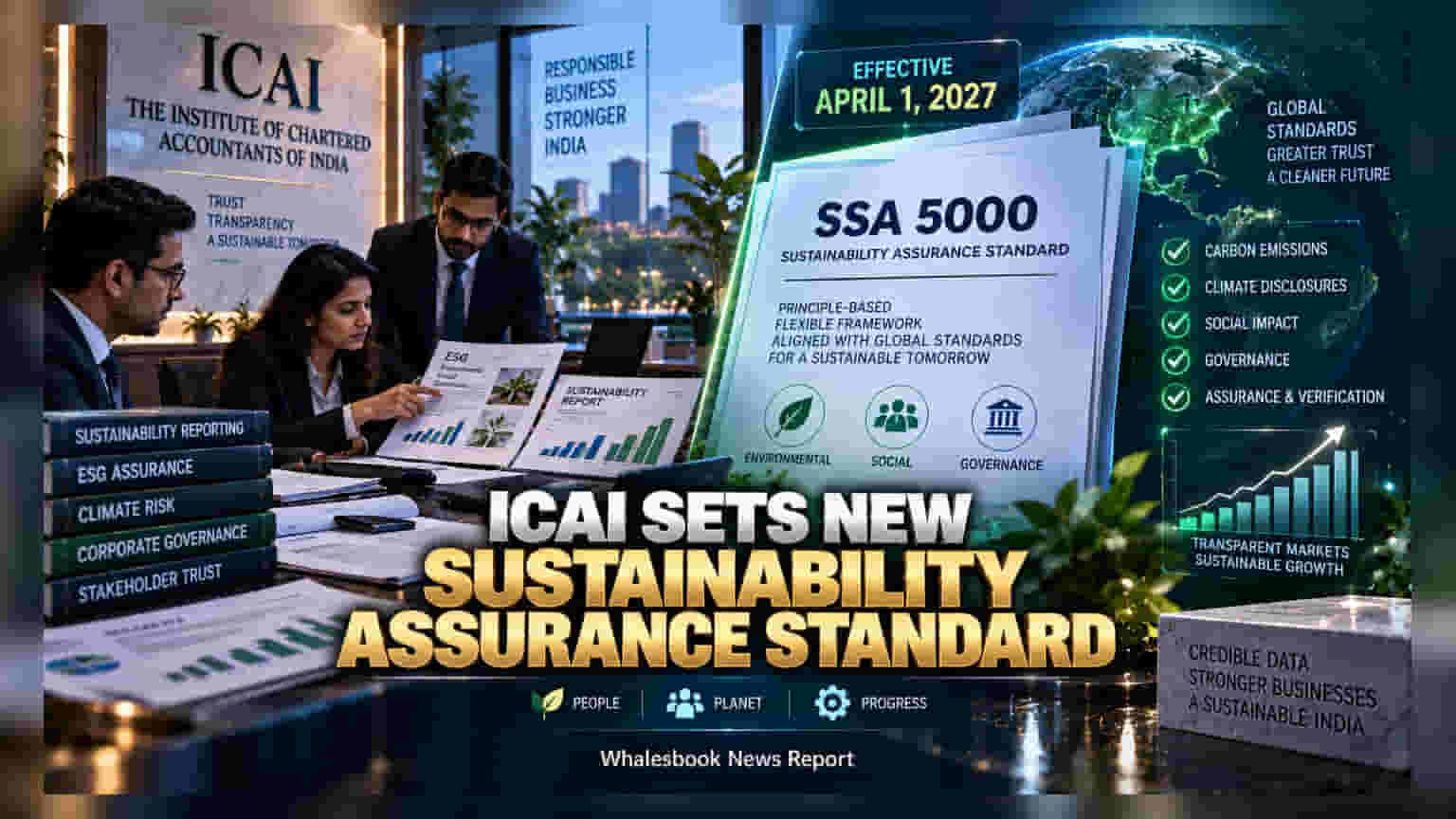
The Institute of Chartered Accountants of India (ICAI) has introduced SSA 5000, a new standard for auditing sustainability disclosures effective from April 1, 2027. This framework replaces existing rules to align Indian reporting with global benchmarks, aiming to improve the consistency and reliability of ESG data for investors and lenders.
The Institute of Chartered Accountants of India (ICAI) has formalised a new framework called SSA 5000 to standardize how companies report their sustainability data. This update will take effect for financial years starting on or after April 1, 2027. The move is part of an effort to align Indian reporting practices with international norms, specifically the global standards set by the International Auditing and Assurance Standards Board.
New Rules Replace Existing Standards
Once SSA 5000 is implemented, the current frameworks known as SSAE 3000 and SAE 3410 will be retired. The new system is principle-based, meaning it does not restrict auditors to a single rigid format for reporting. This flexibility allows professionals to apply a consistent level of rigor across various types of sustainability disclosures, ranging from carbon emissions tracking to social governance metrics.
For companies, this shift means that the process of obtaining an audit or verification on sustainability reports will become more structured. By adopting a standard that matches international expectations, the ICAI aims to make environmental and social disclosures more comparable and easier for shareholders and lenders to evaluate.
Why Investors Should Track Sustainability Data
While this policy change does not directly alter a company’s immediate earnings or capital structure, it has long-term implications for how investors assess corporate risk. As regulators and institutional lenders place higher importance on environmental, social, and governance (ESG) factors, the reliability of the data provided by companies has become a significant focus area.
Listed companies with complex supply chains or significant climate-related commitments will likely need to upgrade their internal documentation and control systems to meet the requirements of the new standard. The shift towards a more rigorous assurance process may lead to higher compliance work and scrutiny of non-financial disclosures. Investors may track how companies prepare their internal systems over the next two years. An improvement in data quality can reduce the uncertainty often associated with corporate sustainability claims, potentially leading to more transparent and trustworthy reporting. The delayed effective date provides businesses with sufficient time to adjust their processes before the standard becomes mandatory in FY28.