

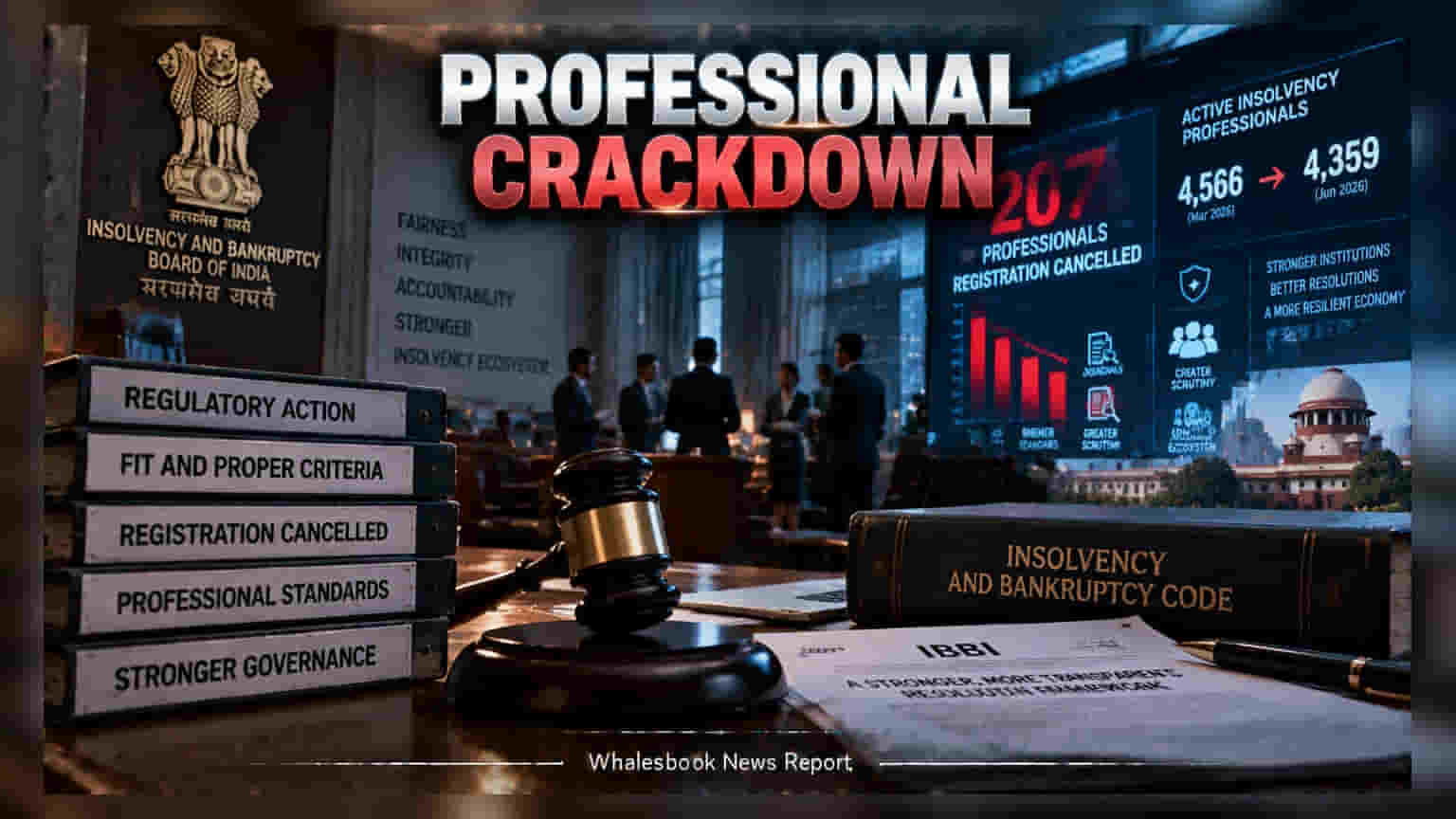
The Insolvency and Bankruptcy Board of India (IBBI) has cancelled 207 insolvency professional registrations in the June 2026 quarter for failing to meet compliance standards. This mass exit marks a significant tightening of regulatory oversight. For investors, this shift is important as it may influence the efficiency and speed of debt resolution processes for banks and NBFCs with large stressed asset portfolios.
The insolvency landscape in India is undergoing a major structural change. The Insolvency and Bankruptcy Board of India (IBBI) has cancelled the registrations of 207 insolvency professionals during the quarter ending June 2026. This move, which reduced the total count of active professionals to 4,359, is the largest single regulatory clean-up since the insolvency framework was established in 2016. Unlike standard industry exits, these cancellations were driven by failures to meet strict 'fit and proper' criteria, signaling a new era of enforcement.
Historically, the removal of insolvency professionals for integrity or eligibility concerns was rare, with only 28 such cases recorded between 2016 and early 2026. The sudden surge in cancellations highlights that the regulator is no longer just processing applications but is actively enforcing ongoing conduct requirements. The IBBI has made it clear that maintaining professional standards is a continuous obligation, not a one-time achievement.
For stock market investors, this regulatory tightening is a critical development to track. The insolvency process is the primary mechanism through which banks and financial institutions recover money from bad loans. When a company defaults, the appointed insolvency professional takes charge of the resolution process. If the regulatory environment becomes stricter, or if the number of qualified professionals decreases, it could potentially impact the speed and execution of these resolution cases. Any delay in resolving distressed assets often leads to higher provisioning and slower capital recovery for lenders.
There is also a broader operational risk to consider. With a smaller pool of active professionals, the sector may face capacity constraints. This could lead to a bottleneck in processing new insolvency cases as courts and the IBBI prioritize high-integrity standards over volume. Furthermore, professionals now face heightened scrutiny, where even minor oversights regarding the misuse of the Insolvency and Bankruptcy Code—such as failing to detect tax avoidance or potential malpractices in a company's accounts—could lead to immediate disciplinary action or license cancellation.
The regulatory pressure also extends to the quality of oversight in ongoing cases. The IBBI has issued multiple circulars warning professionals to be vigilant against the abuse of bankruptcy laws for malicious purposes. This environment of increased compliance means that while the recovery process may become cleaner and more ethical in the long run, it may also become more demanding and litigious in the short term.
Investors in the banking and NBFC sectors should monitor the resolution speed of non-performing assets (NPAs) in the coming quarters. The key monitorable will be whether the tighter regulatory grip improves the quality of asset resolution or if it creates a slowdown in the disposal of stressed assets. Management commentary from major banks regarding the pace of recoveries and the backlog of pending cases under the National Company Law Tribunal will provide the clearest signal on how this regulatory shift is impacting the ground-level recovery process.