

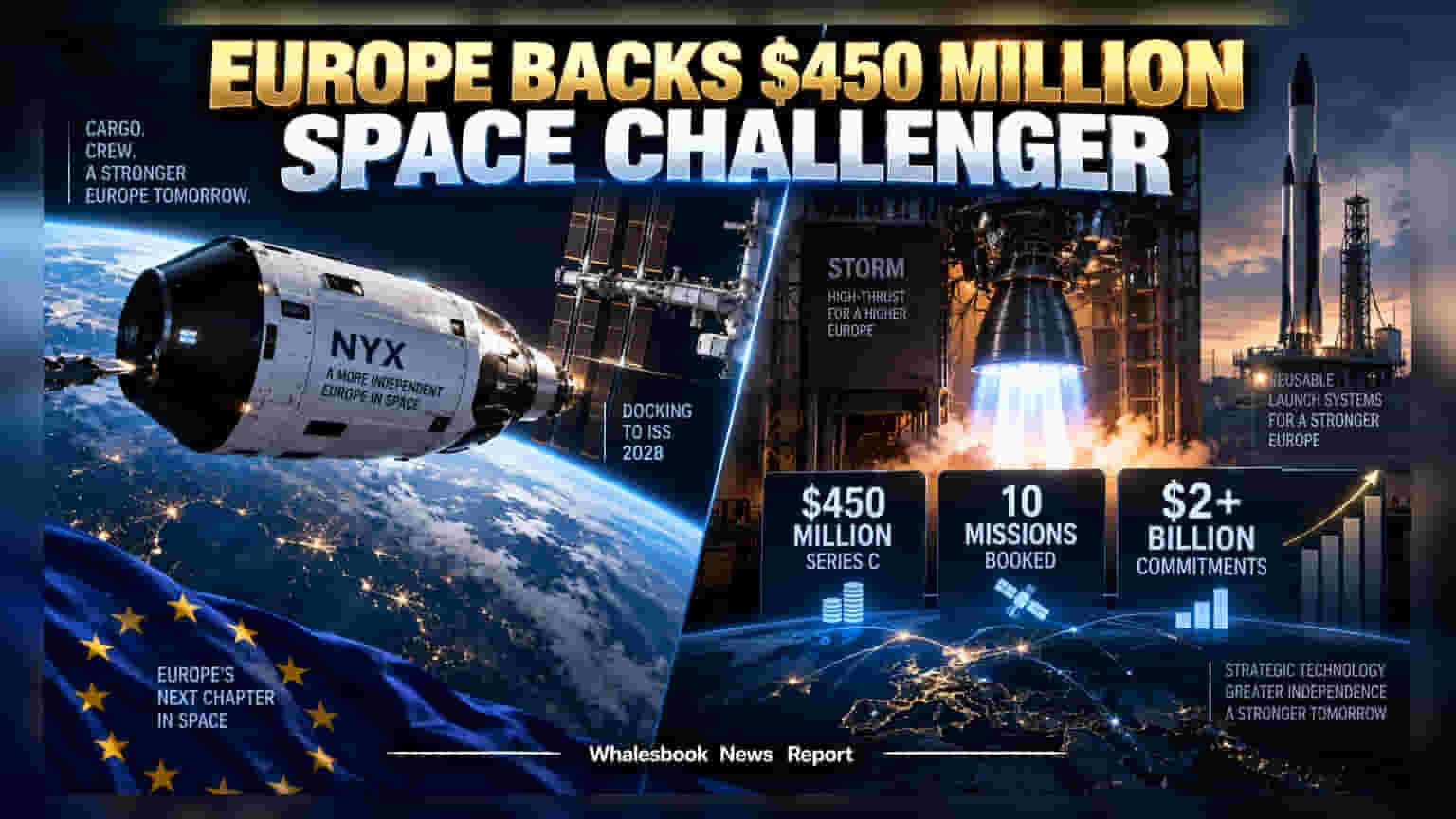
The Exploration Company has raised $450 million in a Series C funding round to develop its reusable Nyx spacecraft and Storm rocket engines. The investment, led by Bessemer Venture Partners, Atomico, and EQT’s Scaleup Europe Fund, targets building independent space infrastructure. As a private company, this development reflects the high capital requirements and execution challenges typical of the evolving global space sector.
The Exploration Company has announced a $450 million Series C funding round, marking one of the largest private capital raises for a European space technology firm. The funding round was co-led by Bessemer Venture Partners, Atomico, and the EQT-managed Scaleup Europe Fund. This fresh capital brings the company’s total funding to approximately $680 million since its inception in 2021.
The company’s primary objective is to accelerate the development of its Nyx reusable spacecraft, designed for both cargo and future crewed missions, and its Storm high-thrust rocket engine program. By developing this technology, the company aims to provide Europe with independent access to low-Earth orbit and lunar destinations, a strategic goal that has gained traction among European governments and institutional investors looking to diversify launch capabilities beyond existing US-based providers.
Commercial Focus and Execution Risks
The company has reported securing contracts and commitments valued at over $2 billion, with 10 missions already booked for the Nyx capsule. While these figures indicate strong commercial interest, investors typically monitor the difference between contract commitments and realized revenue. In the space industry, a signed contract is not equivalent to a completed mission or recognized revenue, and operational success depends on meeting strict technical and safety milestones.
The immediate technical target for the company is a docking mission with the International Space Station, currently scheduled for 2028. Achieving this timeline requires flawless execution in a highly capital-intensive industry. The development of reusable launch systems involves complex engineering, and the company has acknowledged that while this funding is significant, it will not cover the full cost of infrastructure, such as launch pads, which will likely require further investment.
Competitive Landscape and Strategic Hurdles
The global space sector is currently experiencing a wave of innovation, dominated by established players like SpaceX and other emerging private entities. For a company like The Exploration Company, competing in the heavy-lift launcher segment requires sustained funding and the ability to maintain a reliable, competitive launch cadence. The sector faces inherent challenges, including regulatory hurdles, supply chain management, and the high risk of project delays or cost overruns.
It is important for readers to note that The Exploration Company is a private entity and is not listed on the Indian stock exchanges, such as the NSE or BSE. Therefore, there is no direct impact on Indian stock markets. For those tracking the space tech sector, the key monitorables moving forward will be the successful testing of the Storm engine, the timeline for the 2028 mission, and the company’s ability to manage its high burn rate while building the necessary heavy-lift infrastructure.