

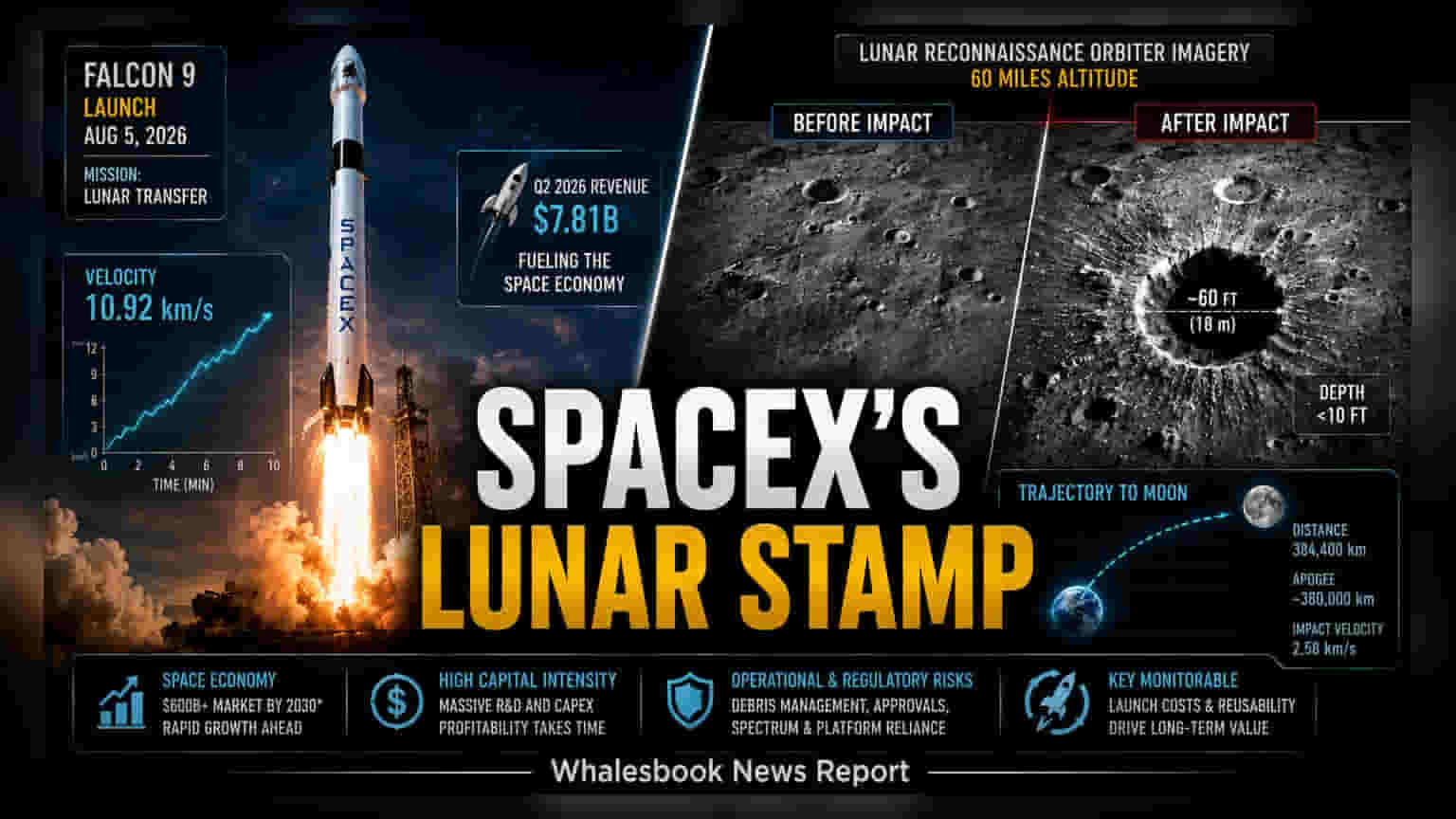
NASA’s Lunar Reconnaissance Orbiter has shared high-resolution photos of a 60-foot-wide crater formed by a SpaceX Falcon 9 rocket impact on August 5. While SpaceX is a private entity and not traded on Indian stock exchanges, the event highlights the accelerating pace of lunar missions. Investors monitoring the space sector track these global milestones as indicators of growing launch demand and the logistical risks involved in modern space exploration.
NASA’s Lunar Reconnaissance Orbiter has released detailed before-and-after imagery of a lunar impact site, providing new data on the collision of a SpaceX Falcon 9 upper stage rocket. The impact, which occurred on August 5, 2026, created a crater approximately 60 feet (18 meters) in diameter and less than 10 feet deep. The event, captured from an altitude of 60 miles, illustrates the physical impact of space debris on the moon’s surface.
While SpaceX remains a private company and its shares are not listed on Indian exchanges like the NSE or BSE, the event carries relevance for observers of the global space economy. For investors in India’s growing space-tech sector, such missions serve as a real-world benchmark for the operational demands and regulatory challenges facing the industry. As India continues to scale its own space programs through ISRO and emerging private players, milestones in global space logistics often provide insight into the sector's broader trends, including launch frequency, payload costs, and waste management in orbit.
The Capital-Intensive Space Sector
The aerospace industry is notoriously capital-intensive, characterized by massive research and development spending. SpaceX, for instance, recently reported Q2 2026 revenue of $7.81 billion, a figure that underscores the scale of the private space market. However, this growth is accompanied by significant financial demands. The company continues to manage high capital expenditure aimed at developing next-generation launch vehicles like Starship and expanding AI-integrated infrastructure. For the wider industry, this high spending requirement represents a structural risk where profitability is often secondary to long-term technological dominance.
Operational and regulatory risks also remain primary monitorables for the sector. As more private entities launch payloads to the moon and beyond, the potential for debris accumulation and the need for strict orbital management will likely increase. Challenges such as launch approvals, spectrum allocation, and the reliance on specific rocket platforms for mission success are common across the industry. Investors tracking Indian companies that supply components or engineering services to the space sector often watch these global developments to gauge potential demand for ancillary services, from satellite manufacturing to ground tracking and support systems.
The most important monitorable for investors interested in this space is not a single mission result, but the long-term trend in launch costs and the reliability of re-usable rocket technology. Continued investment in such heavy-lift infrastructure, while risky, is intended to drive down the cost-per-kilogram of payload, which remains the primary economic driver for the future of both commercial and scientific space exploration. As the sector evolves, the ability to balance aggressive innovation with financial stability will be the key test for major players.