

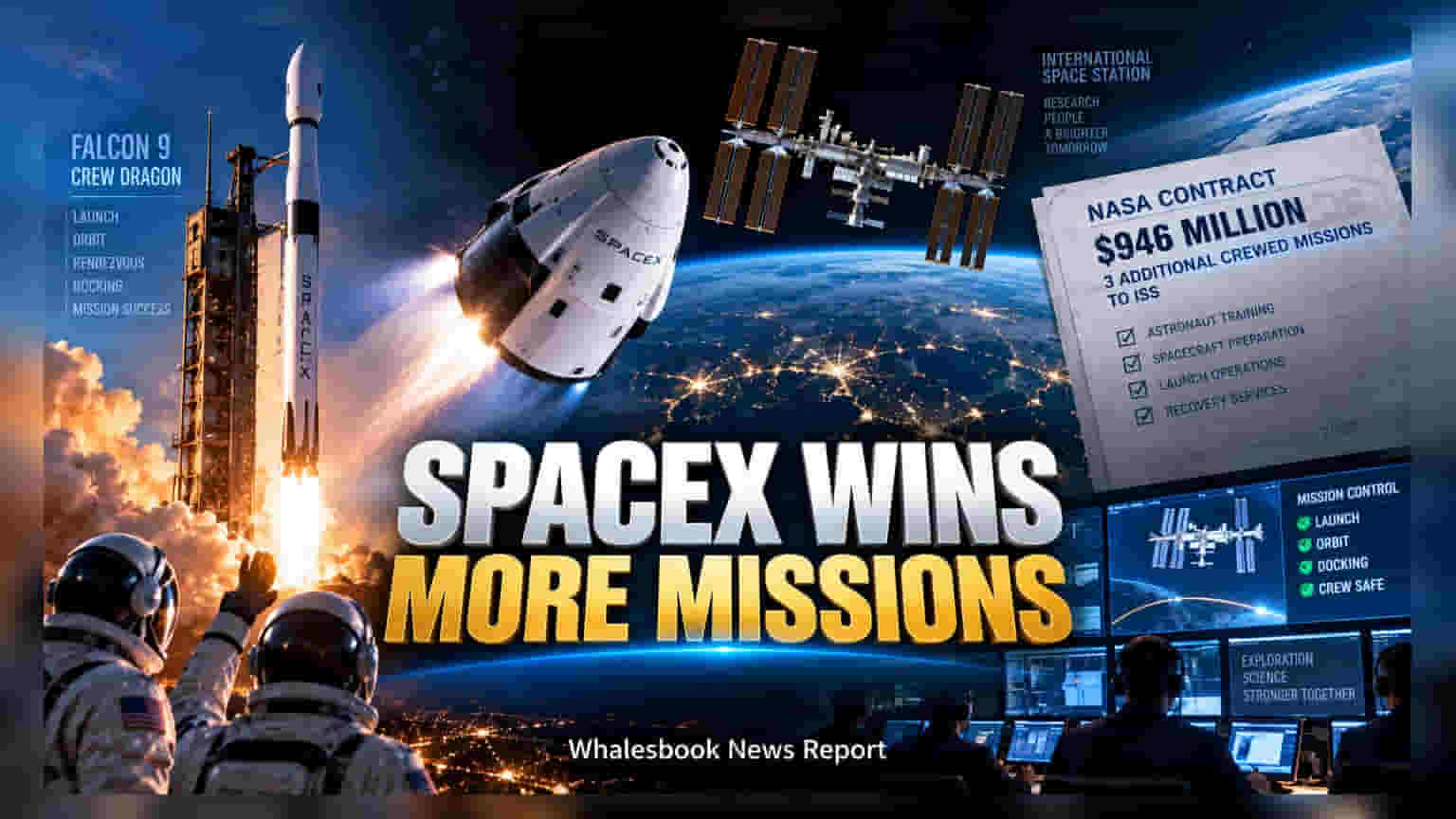
NASA has awarded SpaceX a $946 million contract for three additional astronaut missions to the International Space Station, bringing the total contract value to $5.92 billion. This agreement secures SpaceX’s role as a primary crew transport provider until 2030, highlighting the company's operational reliability in a market where competition remains challenging.
NASA has finalized a $946 million contract with SpaceX to conduct three additional crewed missions to the International Space Station (ISS). This latest agreement pushes the total value of SpaceX’s NASA crew transportation contracts to $5.92 billion and extends the partnership through 2030. Under the terms of the deal, SpaceX will manage the full scope of operations, including astronaut training, spacecraft preparation, launch activities, and recovery services.
Operational Reliability and Market Impact
This expansion increases the total number of SpaceX missions under NASA's Commercial Crew Program to 17. Since the company began operational flights in 2020, its Crew Dragon spacecraft, launched via the Falcon 9 rocket, has become the primary method for NASA to send astronauts to the orbital laboratory. For the aerospace sector, this contract serves as a measure of SpaceX's execution track record. While SpaceX is a private company and not available for direct investment, its performance and dominance in the space transportation market provide important context for investors tracking global aerospace developments and companies like Boeing.
The Dual-Provider Strategy
NASA officially maintains a dual-provider strategy, aiming to rely on two independent companies to transport astronauts. This approach is designed to prevent a total shutdown of missions if one provider faces technical failures. However, this strategy has been tested by the recent performance of Boeing, the other key partner in the program. Boeing's Starliner spacecraft encountered significant technical difficulties during its 2024 test mission, which resulted in the spacecraft returning to Earth without its crew, who were later brought back by a SpaceX capsule.
Future Monitorables
For market observers and space industry analysts, the key takeaway is the widening reliability gap between SpaceX and its competitors. While NASA continues to fund Boeing to maintain the dual-provider model, the continued dependence on SpaceX for critical missions suggests that the company has secured a significant business advantage in current space operations. Investors tracking the aerospace sector will continue to monitor the technical progress of Boeing’s Starliner program and whether it can return to regular service, as well as the long-term sustainability of the ISS operations toward 2030.