

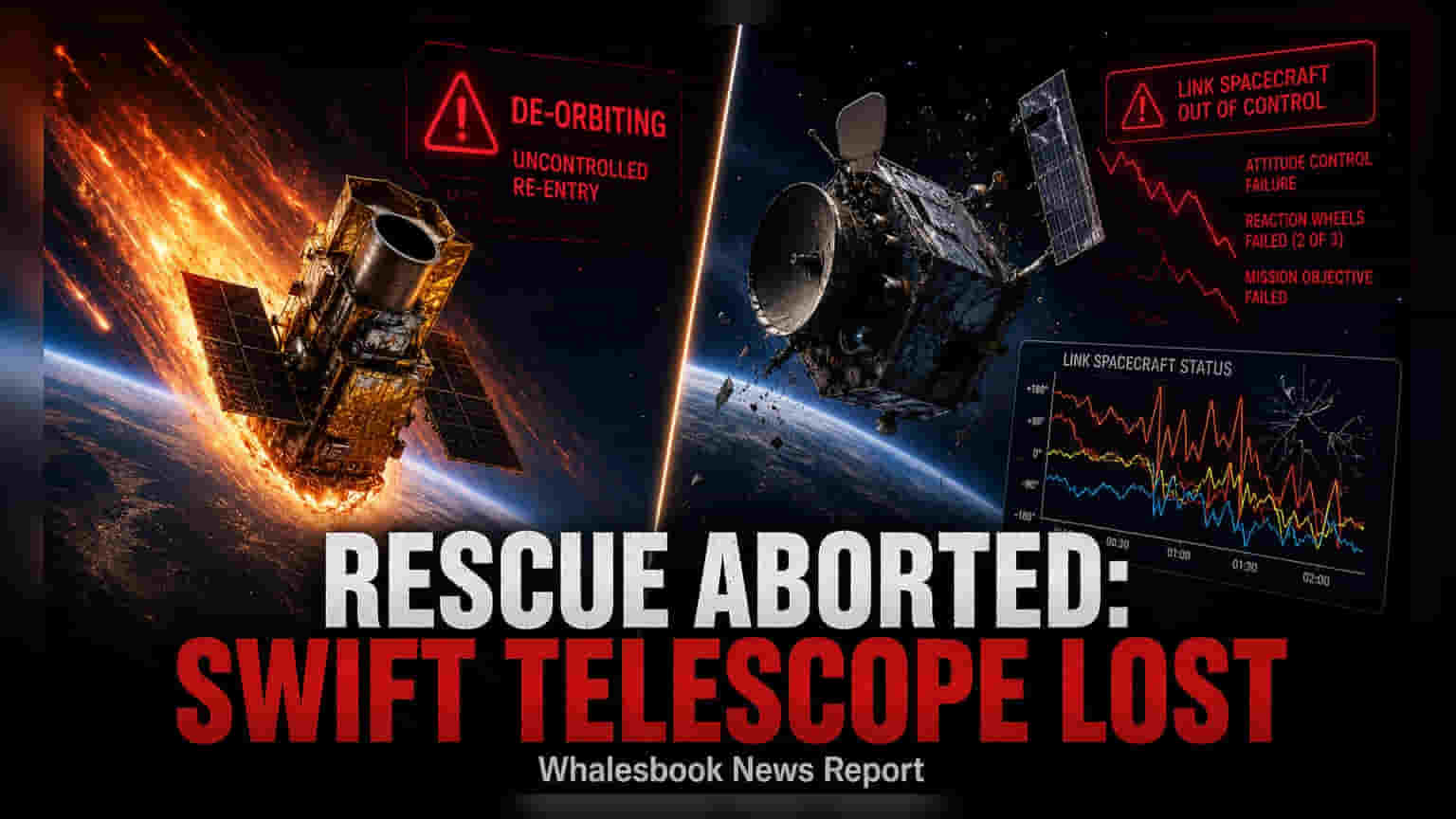
NASA has terminated its $30 million contract with Katalyst Space Technologies to rescue the aging Swift Observatory. The Link spacecraft, designed to boost the telescope's orbit, suffered critical mechanical failures shortly after its July launch. This setback highlights the high risks involved in emerging commercial space servicing technologies.
NASA has officially ended its mission to rescue the Neil Gehrels Swift Observatory, a scientific satellite that has been in space for over two decades. The agency announced the termination of the project on August 19, 2026, confirming that the telescope will now proceed toward an uncontrolled re-entry into Earth's atmosphere later this year. The decision follows the failure of the Link spacecraft, a vehicle developed by the private firm Katalyst Space Technologies, which was intended to dock with the telescope and boost it into a more stable, higher orbit.
The mission relied on the Link spacecraft to perform complex maneuvers in space. However, shortly after its launch in July, the craft experienced persistent mechanical issues, including the failure of two of its three reaction wheels. These wheels are essential for controlling the orientation and stability of a spacecraft. Despite attempts by flight controllers to stabilize the tumbling vehicle, the damage rendered the craft unable to complete the planned rendezvous with Swift.
For investors and market watchers, it is important to clarify the business context of this event. Katalyst Space Technologies is a private company and is not listed on any public stock exchange. The $30 million agreement was a firm-fixed-price contract, which means the financial impact is largely contained within the project's specific budget. This failed mission demonstrates the high-risk nature of the commercial space servicing industry—a sector that aims to create businesses around refueling, repairing, or moving satellites that are otherwise reaching the end of their operational lives.
The loss of the Swift Observatory is significant, as it represents a scientific asset valued at approximately $500 million. By failing to extend its operational life, the scientific community will lose a tool that has been tracking high-energy events in the universe since 2004. Furthermore, the failure of this rescue attempt creates uncertainty for future orbital servicing projects, including potential efforts to save the 36-year-old Hubble Space Telescope, which is also experiencing orbital decay.
Moving forward, Katalyst Space Technologies has stated that it will continue to operate the damaged Link spacecraft in proximity to Swift. The company intends to use the remaining hardware to test navigation and proximity operations, aiming to collect data for future missions. The broader space industry will likely focus on how this mission failure impacts the regulatory and funding environment for commercial companies attempting similar high-risk orbital repairs in the future.