 Whalesbook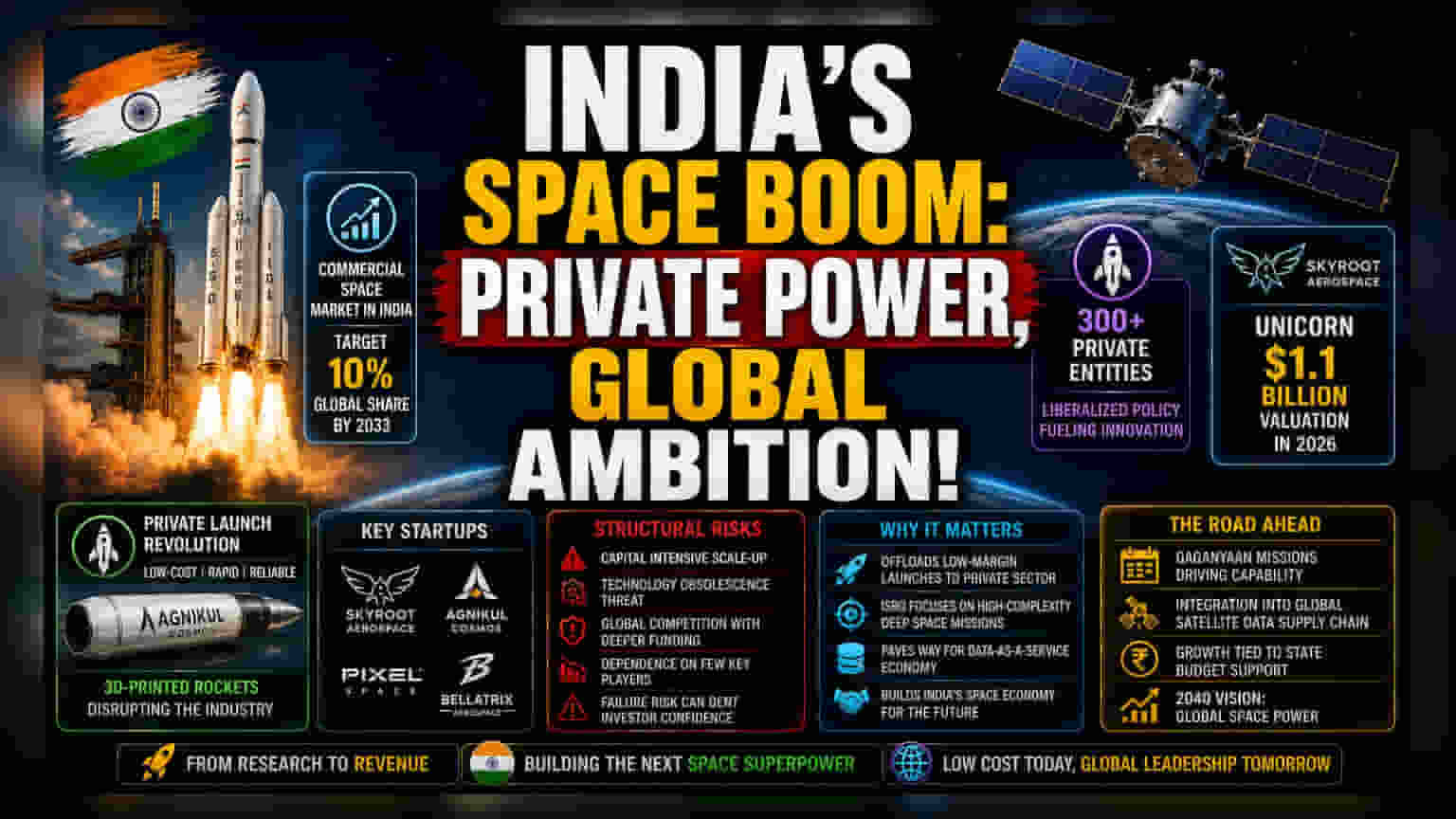


The Shift to Commercial Viability
Beyond the prestige of lunar landings and solar observation, the current trajectory of India’s space industry reflects a pragmatic transition from state-run research to a commercial marketplace. The liberalization of policy has moved the Department of Space from a closed-door entity to a facilitator of private-sector innovation. By decoupling launch capacity from state reliance, the government is effectively offloading the high-risk, low-margin activities of small-satellite deployment to emerging firms, allowing ISRO to focus on high-complexity, long-term deep space missions.
Scaling the Private Ecosystem
The economic implications of the 2020 regulatory reforms are only now crystallizing. With the emergence of over 300 private entities, the industry is witnessing a decoupling of space-tech valuations from broader equity market volatility. Unlike traditional manufacturing sectors, space startups are attracting significant venture capital, with Skyroot Aerospace reaching unicorn status at a $1.1 billion valuation early this year. This valuation reflects a market expectation that these firms can sustain the cost-efficiency model that made ISRO famous, while simultaneously offering the rapid iteration cycles that state agencies historically struggle to maintain.
Structural Risks and Market Hurdles
Despite the optimism, the industry faces severe structural friction. Scaling from a boutique provider of low-cost launch services to a top-tier global player requires massive capital expenditure that current domestic venture funding may struggle to sustain long-term. There is also the risk of technological obsolescence. While 3D-printed rockets and integrated platforms provide an initial competitive edge, global peers—supported by deeper institutional funding and mature defense budgets—continue to iterate at a pace that could erode India’s current price advantage. Furthermore, reliance on a handful of successful startups like Agnikul Cosmos masks the underlying fragility of the sector; the failure of a major private launch vehicle would likely trigger a contraction in risk appetite across the entire ecosystem, stalling the momentum required to meet the 2033 target of a 10% global market share.
The Long-Term Outlook
Future growth depends on the successful execution of the Gaganyaan missions and the integration of these private startups into the global supply chain for satellite data. If India can convert its low-cost launch capability into a broader data-as-a-service market, the current valuation of these startups may prove conservative. However, the path to 2040 remains heavily tethered to state budgetary allocations, leaving the private sector exposed to shifting political priorities.