 Whalesbook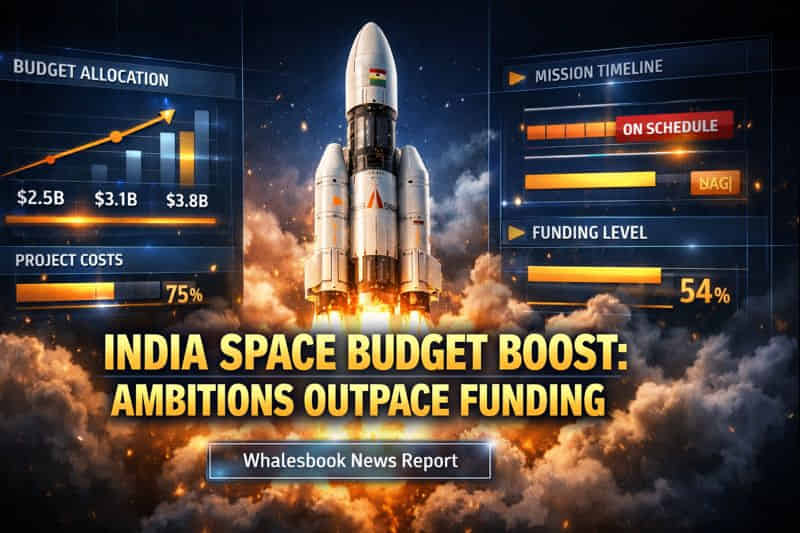


### Strategic Capital Push Amid Funding Scrutiny
The Department of Space received an allocation of ₹13,705.63 crore for the 2026–27 fiscal year, representing a marginal increase of just over 2% from the previous year's estimate. This allocation signals continued government commitment to India's space ambitions, with a discernible shift towards capital expenditure. The budget includes ₹6,375.92 crore for capital outlay, up by over ₹270 crore, focused on infrastructure development and long-term capability building. Revenue expenditure, which covers operational costs and salaries, has remained largely static at ₹7,329.71 crore. This budgetary structure underpins significant investments in launch vehicle development, satellite programs, ISRO center infrastructure, and the Gaganyaan human spaceflight mission, alongside sustained funding for space applications and sciences.
### Mission Roadmaps Demand More Than Incremental Growth
Despite the overall budgetary continuity, questions are emerging about the adequacy of this modest increase to support ISRO's increasingly ambitious roadmap. The organization is gearing up for complex initiatives, including advancing the Gaganyaan program, pursuing international lunar exploration under frameworks like Artemis, exploring the feasibility of an Indian space station, and undertaking further interplanetary missions. Analysts note that as these projects transition from development to execution, they will require substantially higher capital injections than the current budget offers. The comparison with the Revised Estimate for 2025–26, which stood at ₹12,448.60 crore, reveals that much of the apparent jump to the current year's budget reflects deferred spending rather than a step change in funding levels.
### NSIL: The Commercial Engine for Space Ambitions
The government is increasingly leaning on the commercial arm, NewSpace India Limited (NSIL), to supplement funding. NSIL's budget for 2026–27 is projected at ₹1,403.00 crore, an increase from the previous year, underscoring the push to monetize ISRO's technologies and foster private sector participation. NSIL's revenues have seen substantial growth, reaching ₹2,940 crore by FY23 and projected to hit ₹3,246.1 crore by FY25, demonstrating its growing commercial viability [5, 13, 24]. However, industry stakeholders emphasize that stronger public investment in shared infrastructure is crucial to lower entry barriers and accelerate the growth of India's private space ecosystem. The broader Indian space sector, valued at $8.4 billion, is projected to reach $44 billion by 2033, supported by over 300 startups [5]. Industry associations are advocating for a threefold increase in public funding, aiming for 0.12% of GDP, and urging the government to classify space assets as critical infrastructure to unlock financing and boost domestic procurement [10, 12, 20].
### Sector Outlook: Global Growth vs. Domestic Constraints
The global space economy is set for considerable expansion, projected to reach $1.01 trillion by 2034, driven significantly by defense and sovereignty programs [17, 21]. This growth is supported by innovation, new business models, and assertive government policies worldwide. While India aims to capture a larger share of this market, current budgetary constraints and underutilization of funds raise concerns about its ability to match global ambitions with financial capacity. The Department of Space's consistent failure to fully utilize its allocations has weakened the case for substantial increases, prompting a reliance on commercial entities like NSIL to fill the financial void for ambitious future ventures.