

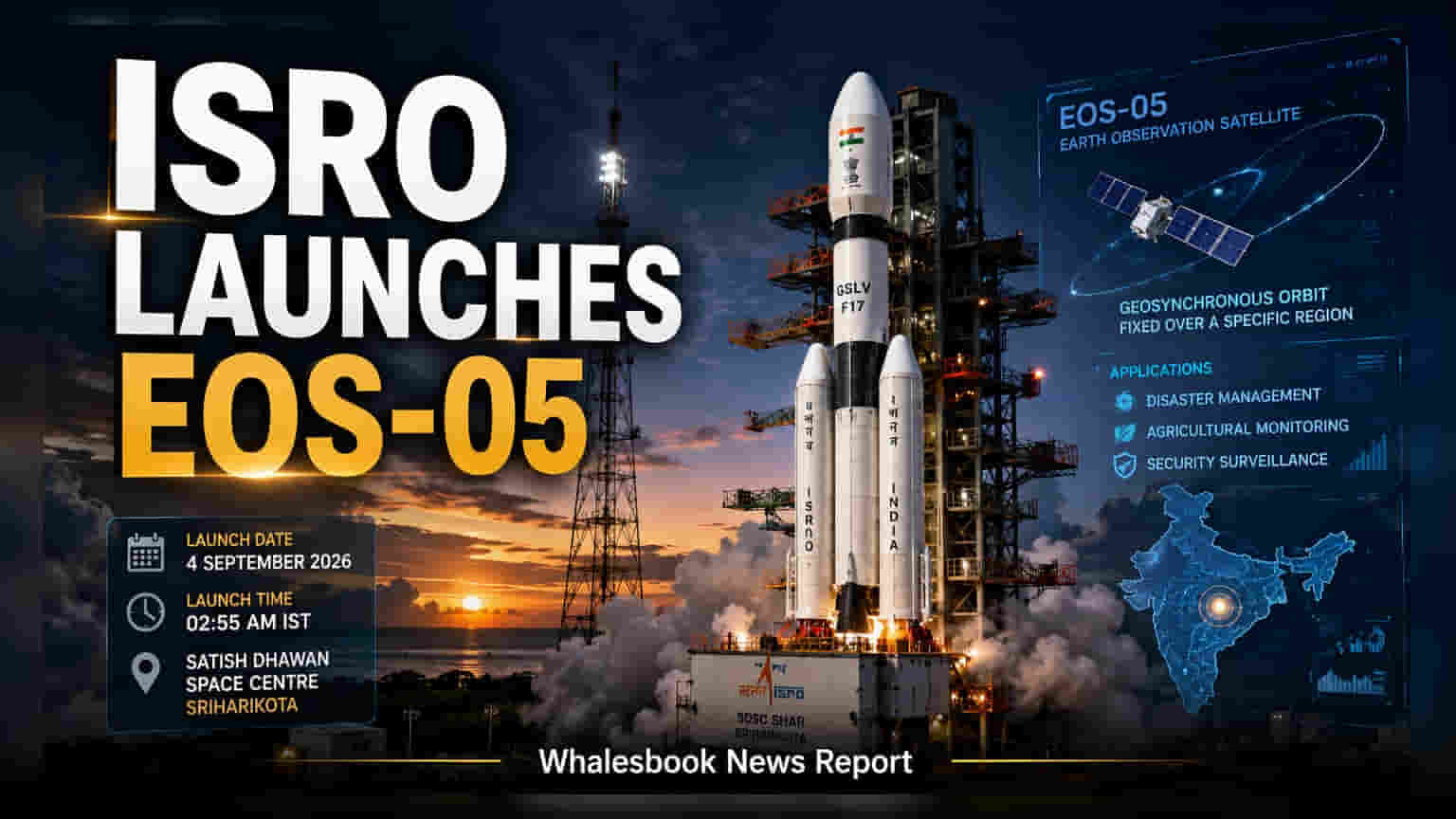
The Indian Space Research Organisation is set to launch the EOS-05 Earth observation satellite on September 4, 2026, from Sriharikota. This mission aims to place a satellite in a fixed geosynchronous orbit for continuous, real-time monitoring. The launch is a significant test for the space agency following recent operational challenges.
The Indian Space Research Organisation (ISRO) is scheduled to launch the EOS-05 Earth observation satellite on September 4, 2026, at 02:55 AM IST. The mission, designated as GSLV-F17, will take off from the Second Launch Pad at the Satish Dhawan Space Centre in Sriharikota.
This mission is designed to deploy the satellite into a geosynchronous orbit. Unlike typical Earth observation satellites that circle the globe in a lower orbit and provide intermittent snapshots, this craft will remain fixed over a specific region. This capability is expected to enable continuous, real-time monitoring of specific areas, which is valuable for disaster management, agricultural tracking, and security surveillance.
Operational Context and Mission Reliability
The upcoming launch is a high-stakes event for the national space program. It follows a period of inactivity for the space agency, particularly after the loss of the PSLV-C62 mission in January 2026, which involved a failure during the third-stage burn. Because of these recent setbacks, the current mission is being monitored as a critical test of recovery.
The GSLV, a three-stage launch vehicle, is under significant scrutiny regarding its long-term reliability. The vehicle has had a mixed operational history in past missions, making the success of the GSLV-F17 launch vital to restoring confidence in the agency's launch capabilities.
Impact on the Indian Space Sector
ISRO operates as a government agency under the Department of Space and is not a publicly traded company. Investors should note that there is no direct way to invest in the agency itself. However, the success of ISRO’s missions has a direct impact on the broader Indian space ecosystem.
A wide network of private Indian companies, including those in engineering, electronics, and manufacturing, provides components, materials, and technical services for these missions. When the space agency maintains a consistent and reliable launch schedule, it creates a stable environment for these private partners. Conversely, any launch failure or delay can impact the project timelines and demand for these private vendors.
The next important update for those tracking the sector will be the confirmation of the successful injection of the satellite into its intended orbit following the launch window.