

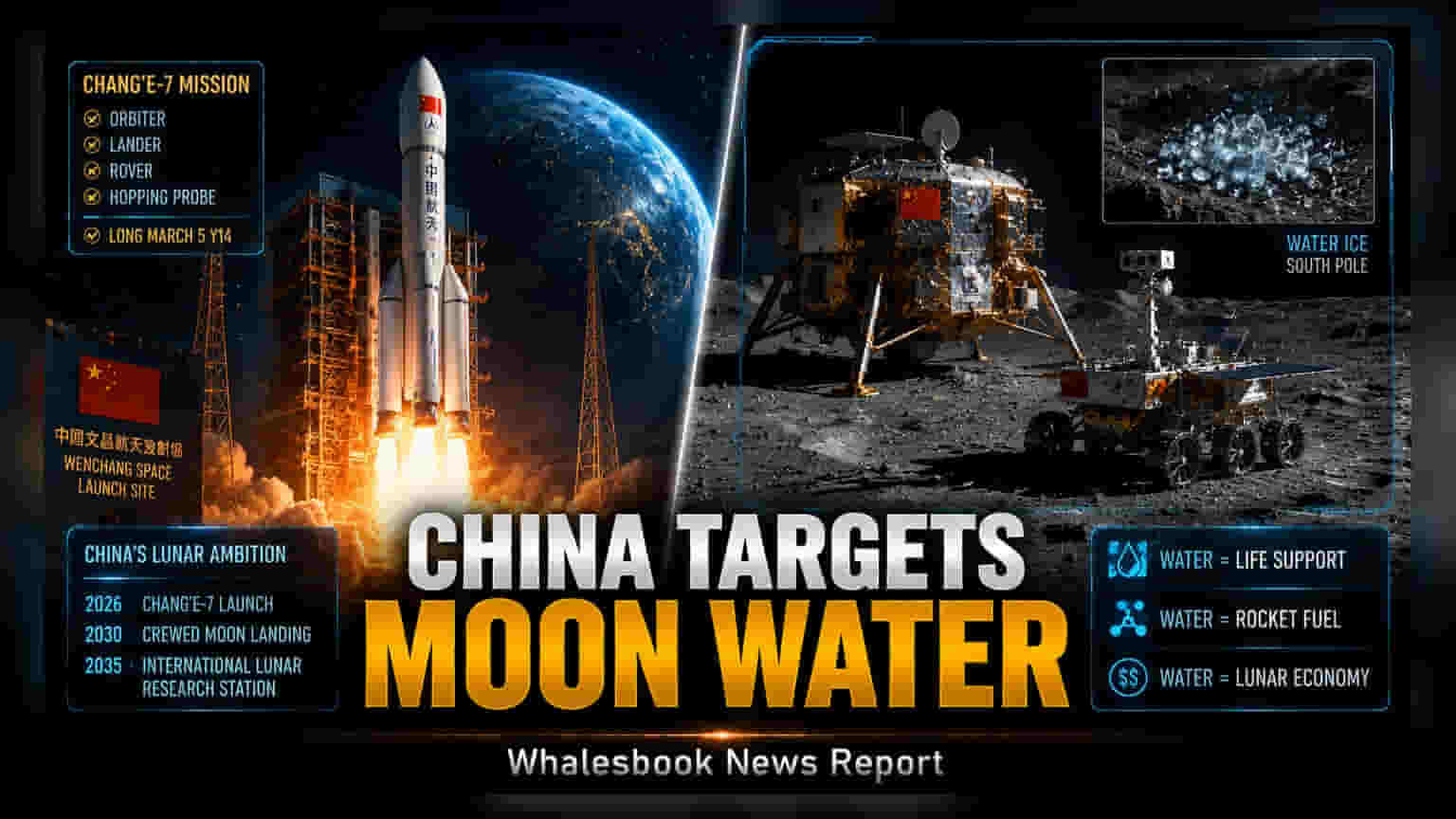
China is preparing to launch its Chang'e-7 lunar mission on August 24, 2026, using a Long March 5 rocket to search for water ice at the Moon's south pole. This mission is a vital step toward China’s goals for a 2030 crewed landing and a permanent research station by 2035. For investors, this underscores the heating global competition for space resources and the growing long-term importance of the aerospace and defense technology sectors.
China is set to execute its most ambitious lunar exploration mission yet, with the Chang'e-7 spacecraft scheduled to launch from the Wenchang Space Launch Site in Hainan on August 24, 2026. The mission will utilize a Long March 5 Y14 rocket to carry an extensive payload including an orbiter, lander, rover, and an innovative hopping probe. The primary objective is to survey the Moon’s south pole, specifically the Shackleton crater, to identify and analyze water ice reserves.
Finding accessible water on the Moon is not merely a scientific endeavor but a strategic economic necessity. In the context of space exploration, water ice can be converted into drinking water, breathable oxygen, and hydrogen-based rocket fuel. This reduces the need for expensive Earth-based supply chains, making permanent lunar habitation technically and financially feasible. China's objective is to leverage these resources to support a crewed lunar landing by 2030 and establish an International Lunar Research Station by 2035.
Technological innovation is at the forefront of this mission. The inclusion of a hopping probe allows the mission to overcome terrain challenges that standard wheeled rovers cannot handle. This probe is designed to navigate into permanently shadowed, freezing craters where water ice is most likely to be preserved, land on six legs, and then lift off again to return to sunlit areas for solar recharging. This technology could define future standards for lunar surface mobility.
This mission occurs in a period of intense global competition for lunar territory and resources. Major space agencies, including those from the United States, Russia, and India, are actively targeting the lunar south pole. India’s successful Chandrayaan-3 landing in 2023 established a baseline for exploration in this region, and upcoming collaborative projects like the Japan-India LUPEX rover reflect the collaborative yet competitive nature of the modern space race. The outcome of Chang'e-7 will likely influence future policies regarding lunar base placement and resource rights.
For market observers and investors, while this mission is a government-funded initiative, it serves as a bellwether for the expanding space economy. The mission highlights the increasing demand for high-end aerospace manufacturing, advanced sensors, robotics, and propulsion systems. As nations race to establish infrastructure on the Moon, companies involved in the aerospace supply chain—from specialized material providers to satellite and launch-vehicle component manufacturers—stand to see evolving demand for their technologies.
Investors should note that space missions carry significant inherent risks, including technical failure during launch or operation, and the high cost of development. Additionally, geopolitical scrutiny often follows such missions, as control over lunar resources can lead to diplomatic friction. The primary monitorable for the coming week is the successful lift-off of the Long March 5 rocket and the subsequent status reports on the deployment of the orbiter and hopping probe in lunar orbit.