

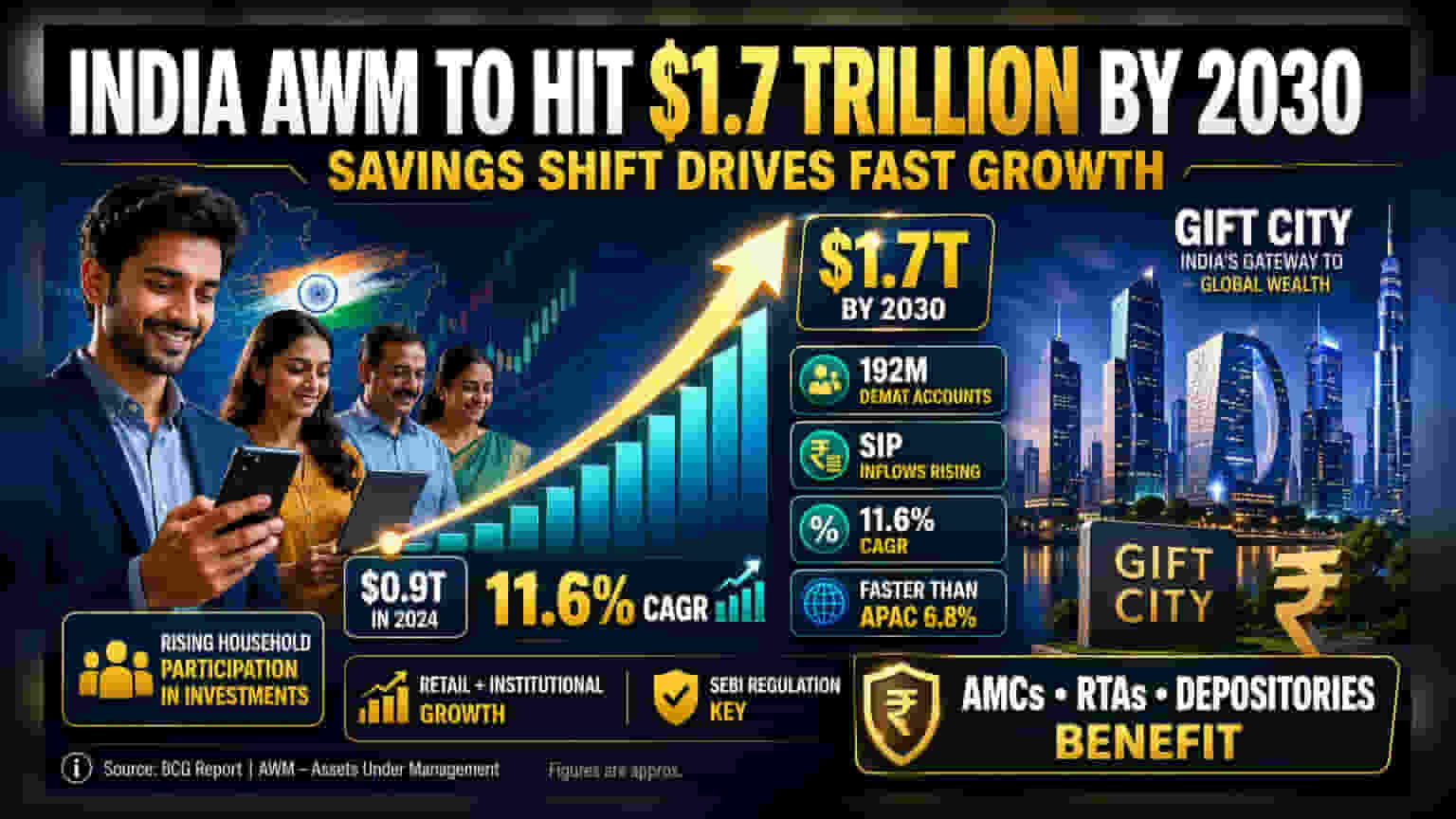
India’s asset and wealth management industry is set to nearly double its assets to $1.7 trillion by 2030, according to a recent PwC report. This growth is driven by rising retail SIP inflows, increasing institutional participation, and the development of GIFT City. Investors should note how this shift toward formal financial assets impacts listed financial intermediaries and market oversight.
What Happened
India’s asset and wealth management (AWM) sector is projected to grow to $1.7 trillion in assets under management (AuM) by 2030, up from $0.9 trillion in 2024. This represents an annual growth rate of 11.6%, which is faster than the predicted 6.8% for the broader Asia-Pacific region. According to a report by PwC, this expansion is being powered by more Indians moving their savings from bank accounts into formal investment products like mutual funds and equities, a trend often called the financialization of savings.
Impact On The Listed Financial Ecosystem
This growth trajectory has direct implications for companies that form the backbone of India's financial infrastructure. As more households participate in the markets—evidenced by 192 million demat accounts and strong monthly SIP inflows—the companies facilitating these trades stand to gain.
Listed asset management companies (AMCs), which earn fees based on the total money they manage, are direct beneficiaries of this trend. Similarly, registrar and transfer agents, who handle the back-end technology and record-keeping for mutual funds, see their business volume grow as the industry expands. Additionally, central depositories, which hold securities in electronic form, benefit from the rising number of demat accounts and active investors.
Two Parallel Growth Paths
The industry is seeing the rise of two distinct customer segments. On one side, there is a large, digitally savvy retail investor base, largely driven by mobile-first apps and discount brokers. This group is responsible for the consistent inflows into monthly Systematic Investment Plans (SIPs), with over 40% of new registrations coming from smaller Tier 2, 3, and 4 cities.
On the other side, institutional investors—such as pension funds like the EPFO and the National Pension System (NPS)—are allocating more capital toward equities and alternative assets. The report notes that the NPS aims to hit $1 trillion in assets by 2030. Furthermore, Alternative Investment Funds (AIFs) and private credit funds are expanding as investors look for returns beyond traditional stocks and bonds.
The Role of GIFT City
Gujarat International Finance Tec-City (GIFT City) is becoming a central pillar for this growth. By acting as a global financial hub, it is attracting fund management entities and international capital. This is intended to bridge the gap between global investors and Indian market opportunities, potentially increasing the flow of foreign institutional capital into the country.
Risks And Investor Monitorables
While the growth outlook is positive, the industry faces real-world challenges. The PwC report emphasizes that for this sector to reach its potential, it needs stronger governance, better investor protection, and high-quality advice.
Investors should watch for how regulatory bodies like SEBI (Securities and Exchange Board of India) manage this rapid growth. Regulatory focus on curbing mis-selling, improving transparency in AIFs, and regulating financial influencers are key factors that could shape the sector. Additionally, the sustainability of retail SIP inflows depends heavily on overall market sentiment; extended periods of market volatility can sometimes test investor patience and lead to higher redemption rates.
Key monitorables for investors include monthly AMFI data on SIP inflows, the pace of institutional capital allocation in equities, and any major regulatory updates regarding AIFs and distribution fees.