

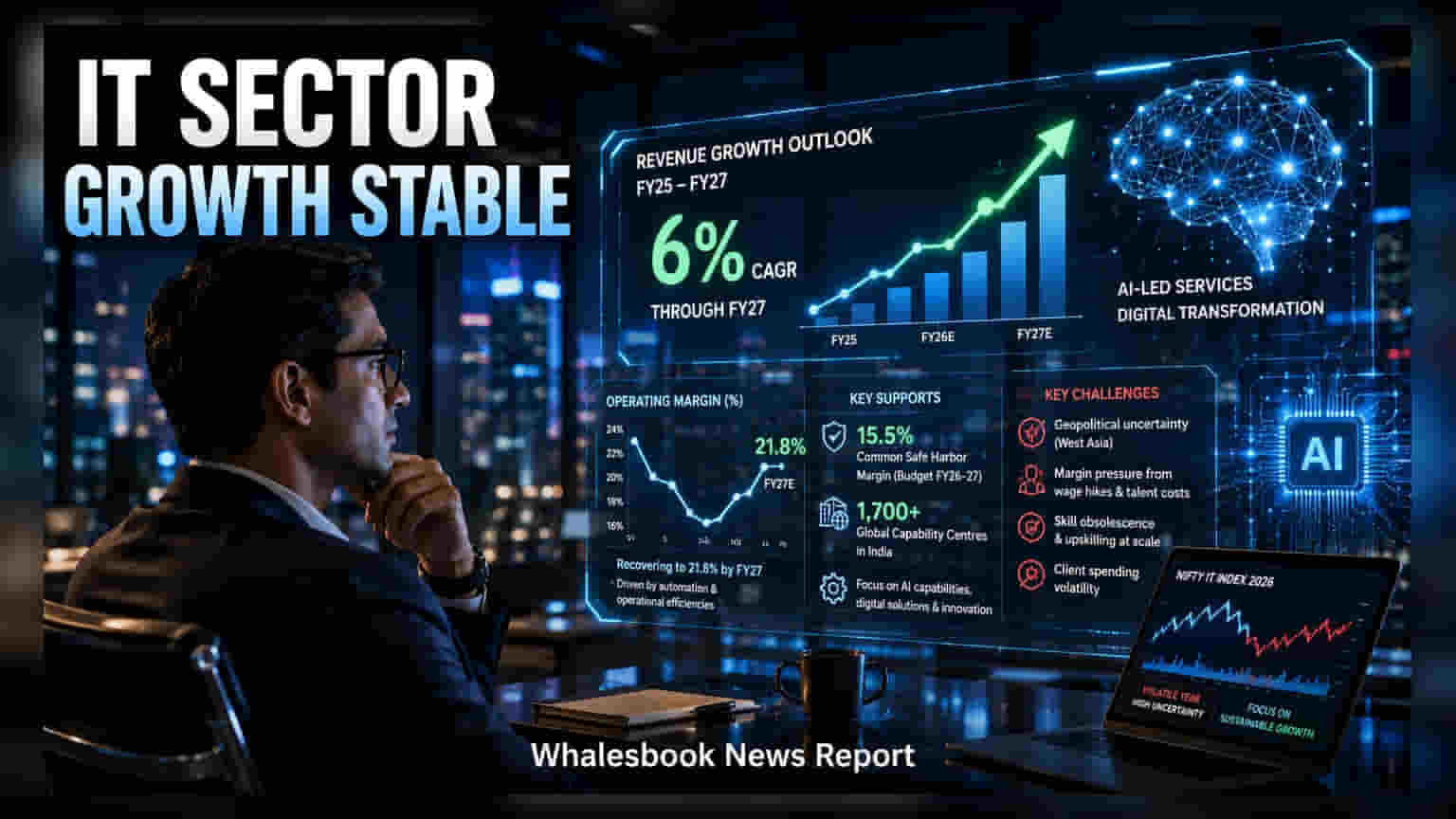
Brickwork Ratings projects 6% revenue growth for the Indian IT sector through FY27 as firms shift toward high-value AI services. While margins face short-term pressure from wage costs and talent acquisition, efficiency gains from automation are expected to aid recovery. Investors may track how companies manage this structural transition amid ongoing sector volatility.
The Indian IT sector is expected to maintain a steady revenue growth of 6% annually through fiscal year 2027, according to a recent assessment by Brickwork Ratings. This projection comes as the industry undergoes a significant transformation, shifting focus from traditional volume-based contracts to high-value AI services and digital solutions. For investors, this marks a fundamental change in the business model of top IT firms, which have historically relied on large-scale talent hiring to drive revenue.
The transition to an AI-led service model is currently impacting short-term profitability. Operating margins are facing pressure due to two main factors: annual wage hikes and the high costs associated with acquiring specialized talent to build AI capabilities. After dipping from previous levels, margins are expected to consolidate before moving toward a recovery of 21.8% by FY27, driven by operational efficiencies that companies expect to achieve through automation and better resource management.
Financial relief is coming from government initiatives aimed at supporting this transition. The Union Budget 2026-27 introduced a 15.5% common safe harbor margin for consolidated IT categories, which acts as a fiscal buffer for companies navigating this structural pivot. Additionally, the industry is supported by the rapid expansion of Global Capability Centres (GCCs) in India, which have grown to over 1,700 locations, providing a deep infrastructure base for innovation.
Despite these growth drivers, the sector faces distinct challenges that market participants are monitoring closely. Geopolitical uncertainty, particularly in West Asia, has the potential to impact client spending and decision-making cycles. The Nifty IT index has experienced significant volatility in 2026, reflecting investor concern over whether IT firms can successfully monetize AI investments without incurring excessive costs. Furthermore, there is the risk of skill obsolescence, where a large portion of the workforce must be upskilled quickly to stay relevant in an AI-driven market.
For investors, the key monitorable over the coming quarters will be the ability of companies to protect their margins while scaling their AI service offerings. The path to recovery by FY27 depends not only on the growth of digital revenue but also on how effectively these firms can manage wage inflation and project execution.