

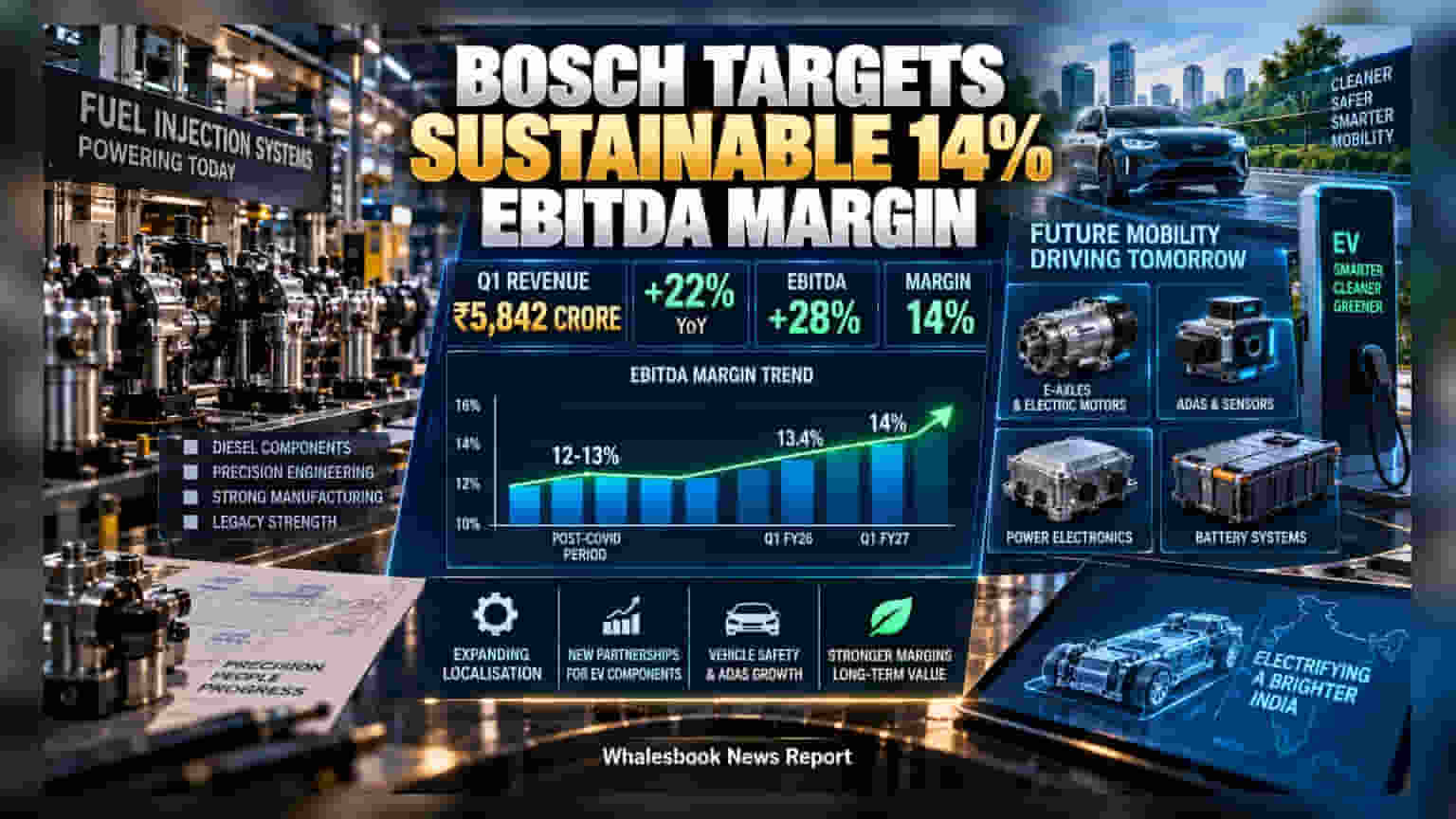
Bosch Ltd. reported revenue of ₹5,842 crore for Q1 FY27, a 22% increase compared to the previous year. Operating margins improved to 14% as the company balances its legacy diesel business with new growth in electronics and electric vehicle components. Investors will be tracking the company's ability to maintain these margins while navigating shifting automotive regulations.
Bosch Ltd. has posted a 22% year-on-year revenue increase in its Q1 FY27 results, with revenue from operations reaching ₹5,842 crore. Along with top-line growth, the company’s operating profit (EBITDA) margin improved to 14%, up from 13.4% in the same quarter last year. This marks the second consecutive quarter that the company has achieved a 14% margin, a shift from the 12-13% range seen in recent years.
The improvement in profitability comes as the company attempts to manage a structural change in its business model. For years, Bosch's profitability in India was closely tied to its diesel fuel-injection systems. However, as market demand for diesel vehicles has softened, the company has had to pivot its strategy toward new mobility solutions to sustain performance.
To drive growth, Bosch is increasingly focusing on electronics, vehicle safety systems, and electrification. The company is actively building its portfolio in electric motors, sensors, and power electronics, and is exploring partnerships for e-axle supplies. It has also expanded its aftermarket product line with items like LED lighting and batteries, which typically provide more stable, recurring revenue compared to the cyclical nature of original-equipment demand.
Localisation efforts are playing a key role in the company's current margin strategy. By increasing domestic sourcing and manufacturing, Bosch aims to reduce logistics costs and improve its control over the supply chain. A notable development in this space is its partnership with Tata AutoComp Systems, which is focused on creating a local manufacturing hub for electric vehicle components. Additionally, ventures with Brakes India and Wheels India, along with the integration of Bosch Chassis Systems, have been used to solidify its presence in vehicle safety technology.
Regulatory changes are also acting as a significant factor for the company. Upcoming mandates, such as the ADAS requirement for commercial vehicles starting in October 2026 and CAFE Phase 3 norms beginning in April 2027, are expected to drive demand for the advanced emission and safety systems that Bosch produces. While these regulations create opportunities, they also require the company to continuously invest in technology to meet stricter compliance standards.
Despite the positive performance, the company faces the challenge of execution. The core risk for investors is whether the newer growth engines like EV components and safety systems can fully replace the profitability that the legacy diesel franchise once provided. The ability to maintain 14% margins will depend heavily on the company's success in managing these transitions, as well as its ability to navigate potential input cost pressures. Moving forward, market participants will likely monitor the scaling of its EV business, the execution of these new partnerships, and how effectively the company can align its cost structure with the evolving demand in the Indian automotive market.