

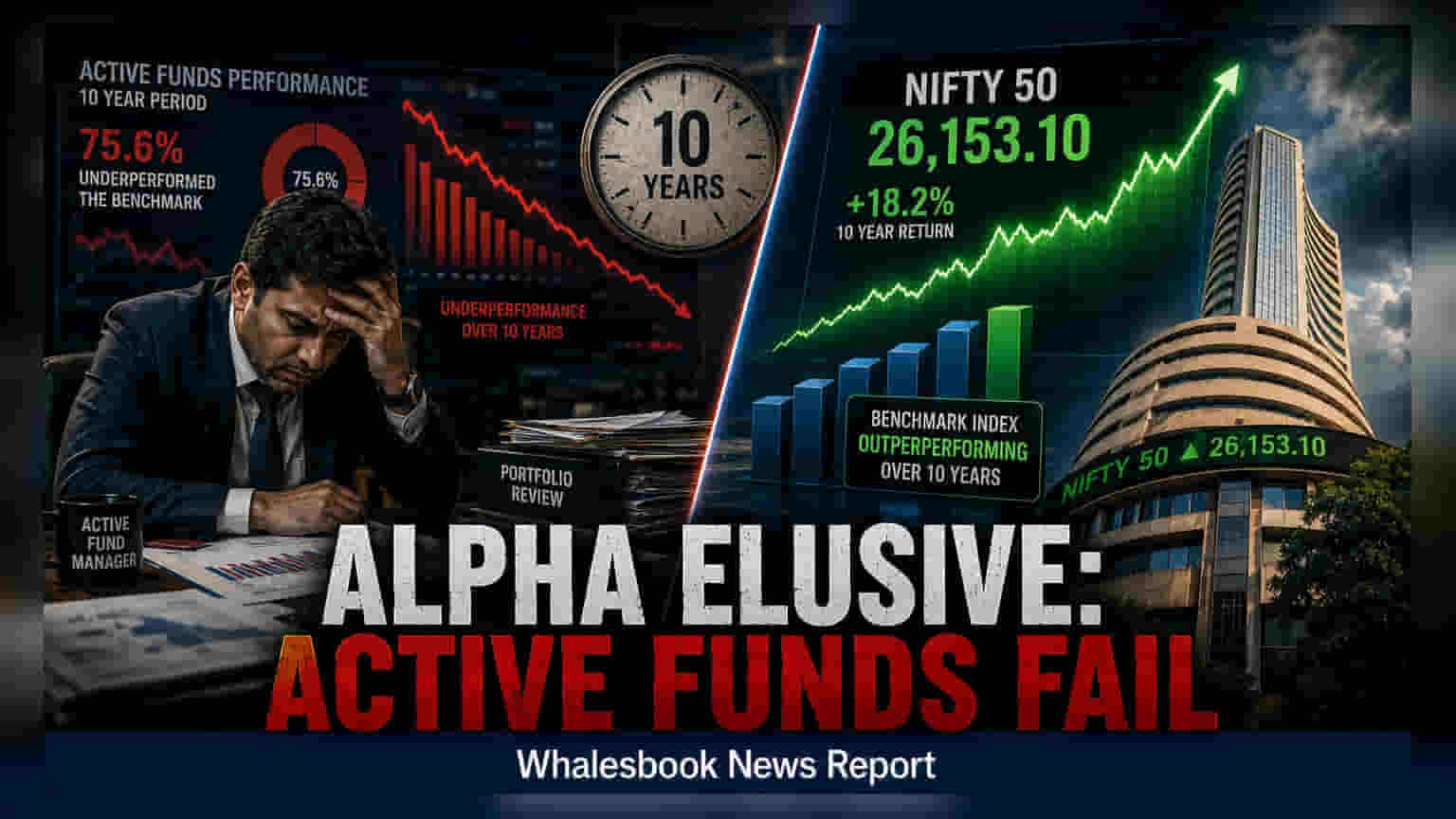
A new report from S&P Dow Jones Indices shows that over 75% of large-cap active mutual funds in India have underperformed their benchmarks over the last ten years. This data reinforces the growing challenge fund managers face in consistently generating excess returns, leading many investors to reconsider the role of low-cost passive index funds in their portfolios.
The latest S&P Indices Versus Active (SPIVA) India Year-End 2025 report has brought the performance of active fund management back into the spotlight. The data reveals that approximately 75.6% of large-cap active mutual funds failed to outperform their designated benchmarks over a ten-year period. For investors, this creates a critical question: is the higher fee paid for active management worth the results, or is a passive approach more reliable?
Why Active Managers Struggle to Outperform
Generating returns higher than the market—often called "alpha"—has become increasingly difficult. Several factors contribute to this struggle. First, modern markets have become more efficient. In the past, fund managers could find mispriced stocks more easily because information was not available to everyone. Today, thanks to the internet and widespread access to financial data, news travels instantly, and asset prices often adjust quickly. This leaves a smaller window for managers to profit from mistakes in the market.
Second, the cost of management plays a role. Active funds charge higher fees compared to passive index funds to cover the costs of research teams and trading. These fees are deducted from the fund’s returns. Over a long period, like ten years, these costs compound, making it harder for an active fund to net a return that is higher than the benchmark index, which itself is a low-cost representation of the market.
The Methodology Debate
While the SPIVA data presents a clear trend, it is important for investors to understand how these findings are reached. The report counts funds that have been merged or closed down—a process known as liquidation—as failures. Critics of this methodology argue that this approach can make the active management industry look worse than it is, as it ignores the nuances of fund consolidation. Some analysts also point out that these reports use equal-weighting for fund performance, which may not always align with how an actual investor’s portfolio is weighted. Despite these debates, the report remains a widely cited benchmark for comparing the two styles of investing.
The Rise of Passive Alternatives
This ongoing struggle of active funds to beat benchmarks has fueled a significant shift toward passive investing in India. Passive funds, such as index funds and Exchange Traded Funds (ETFs), simply aim to mirror the performance of a specific index like the Nifty 50 or Nifty Next 50. Because they do not require active stock picking, they generally come with much lower fees. For many investors, the data suggests that capturing the market return at a low cost may be a more consistent strategy than hoping to pick the one manager who can consistently outperform.
Investors monitoring this trend should focus on long-term performance consistency and expense ratios. While some active managers do succeed in beating the market, the statistics suggest that finding and sticking with them for a decade is a difficult task. Moving forward, the key monitorable for investors will be how the performance gap between active and passive strategies evolves, particularly as the Indian market continues to mature and data accessibility increases.