

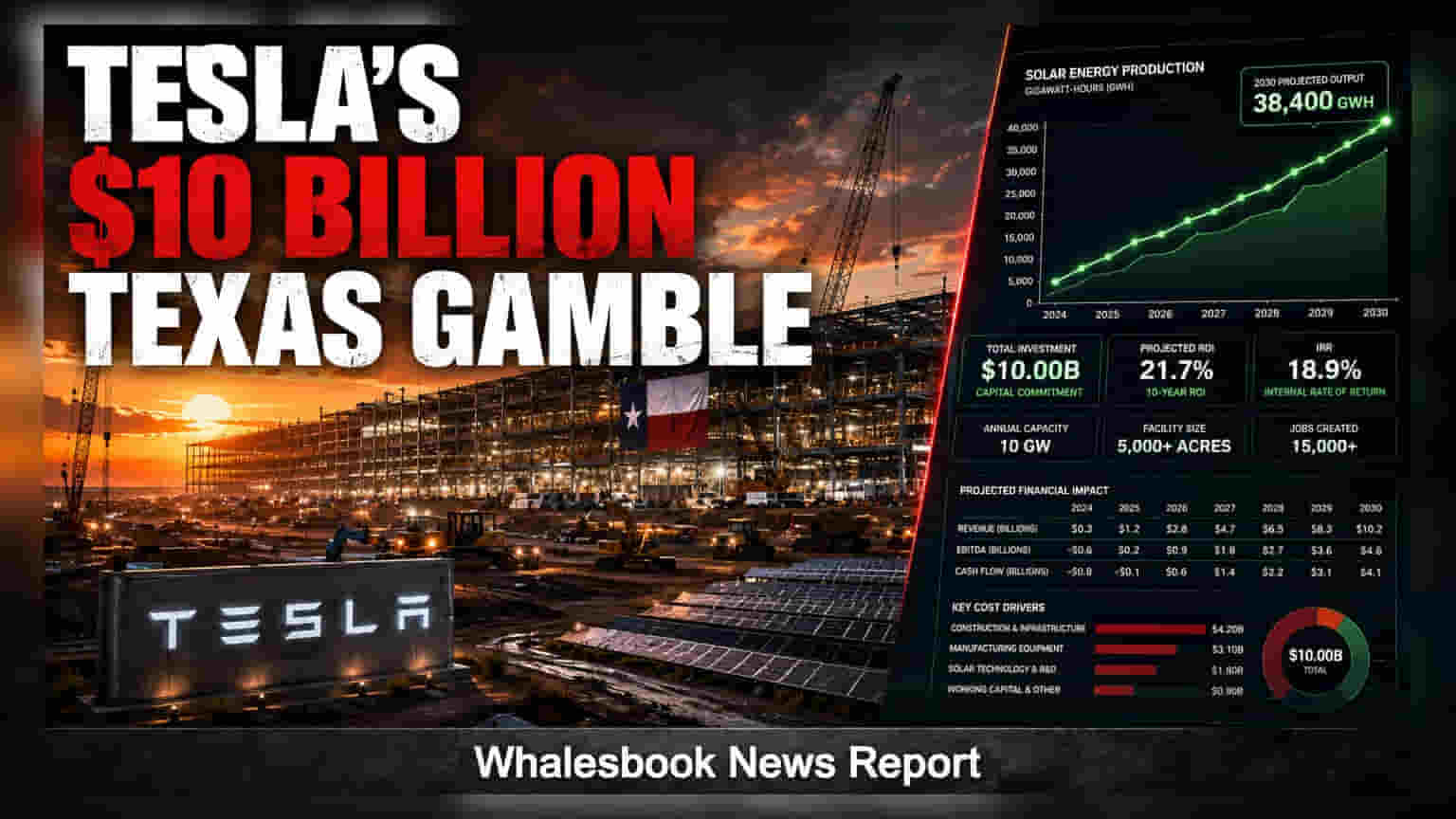
Tesla has filed for tax incentives to build a $10.1 billion, fully integrated solar manufacturing plant in Texas. While the project promises nearly 10,000 jobs, investors are watching the company’s ability to fund this massive expansion amid recent profit margin compression and negative free cash flow.
Tesla has unveiled plans for 'Project Crystal Sun,' a proposed $10.1 billion solar manufacturing facility to be located in Fort Bend County, Texas. The company has officially applied for state tax incentives, arguing that these are necessary to offset a projected $1.1 billion property tax liability over the next 37 years. The facility is designed to be a fully integrated production site, capable of manufacturing ingots, wafers, and solar cells.
Project Crystal Sun: A Massive Bet on Solar
The scale of this investment is significant, with approximately $1.5 billion earmarked for real property and $8.6 billion allocated for equipment. Tesla estimates that once fully operational, the plant will create 9,712 permanent jobs, with an additional 1,147 positions expected during the peak construction phase. The company aims to break ground in 2026, with the goal of beginning production in early 2029. This project aligns with Tesla’s broader strategy to expand its renewable energy footprint, though it faces a challenging financial environment.
Financials and Expansion Hurdles
For investors, the timing of such a large capital expenditure (CapEx) project is a critical factor. Tesla’s most recent financial performance has shown clear signs of pressure, with the operating margin for the second quarter of 2026 compressing to 1.4%. The company is also reporting negative free cash flow, largely driven by the high costs associated with its aggressive growth plans and ongoing investment in other experimental projects, such as the Robotaxi and Optimus robot initiatives.
While the solar plant represents a long-term growth opportunity, the market has been cautious. Tesla’s stock has experienced notable volatility recently, hitting a 52-week low of $297.38 in late July 2026 before recovering to trade in the $330–$335 range. Investors remain focused on how the company plans to balance these high spending requirements with the need to improve its underlying profitability.
The Road Ahead for Investors
There are several risks that shareholders may monitor closely. Beyond the typical execution challenges of a project of this magnitude, the company faces potential headwinds from competitive pricing in the solar sector, global trade policy, and the reliance on government incentives to maintain the project's financial viability. Furthermore, because Tesla is simultaneously funding multiple unproven, capital-intensive projects, the company’s ability to maintain a healthy balance sheet remains a key point of discussion. The success of Project Crystal Sun will depend not only on construction timelines but also on Tesla's ability to navigate current margin pressures and capital constraints in the coming years.