 Whalesbook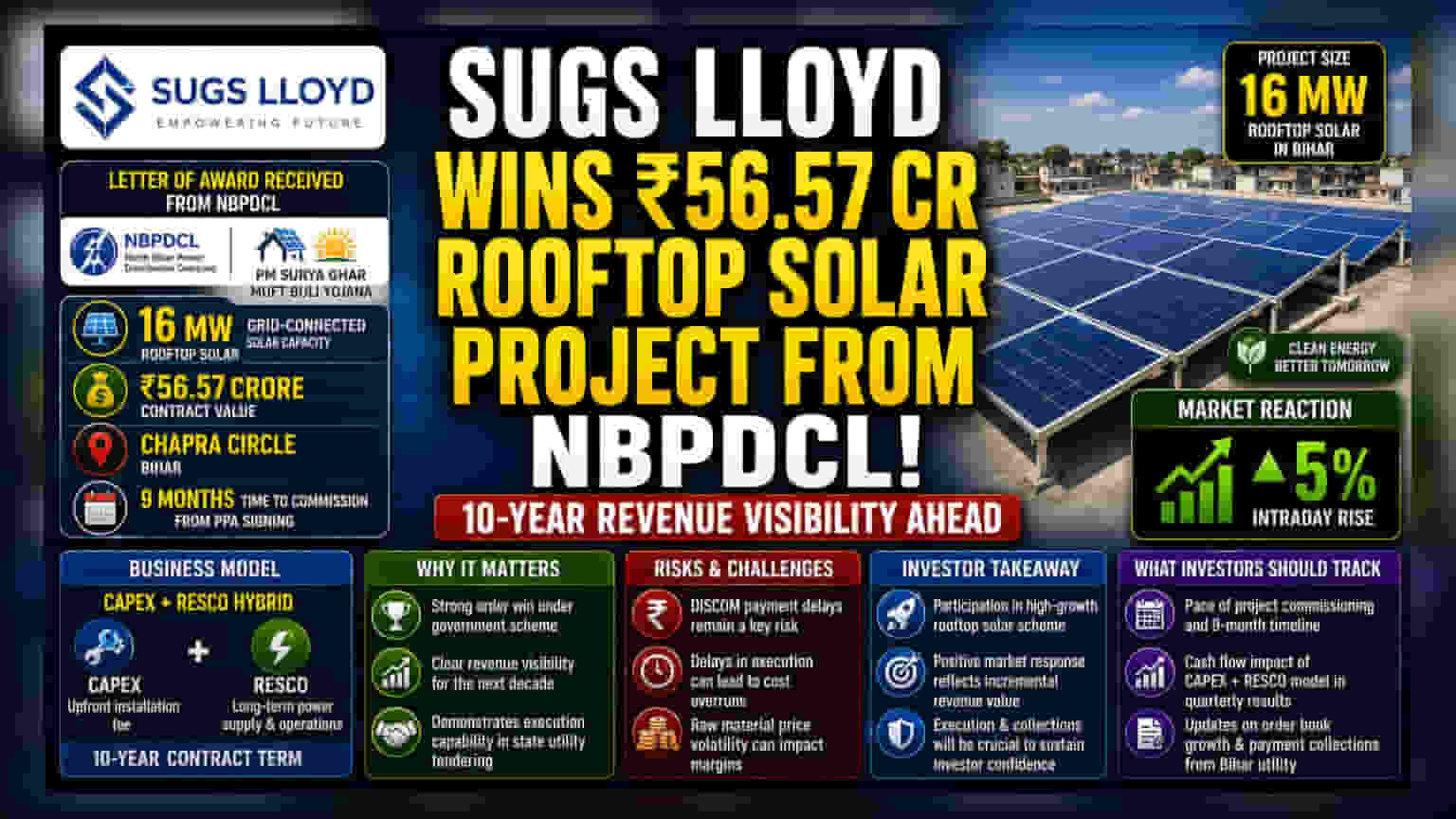


Sugs Lloyd has secured a 16 MW rooftop solar project from the North Bihar Power Distribution Company. The contract, valued at Rs 56.57 crore, will be executed under the PM Surya Ghar scheme using a hybrid model. Shares gained 5% following the announcement.
What Happened
Sugs Lloyd has received a Letter of Award from the North Bihar Power Distribution Company (NBPDCL) for a rooftop solar energy project. The contract, valued at approximately Rs 56.57 crore, involves the installation of 16 MW of grid-connected rooftop solar capacity in the Chapra Circle of Bihar. This project is part of the central government’s 'PM Surya Ghar-Muft Bijli Yojana,' which encourages the adoption of solar energy in residential sectors.
Understanding the Business Model
The project will be executed using a 'CAPEX plus RESCO' (Renewable Energy Service Company) hybrid model. In a standard CAPEX model, the company installs the solar system and receives an upfront fee from the customer. In a RESCO model, the company acts as a power provider, owning the system and selling power to the consumer or utility over a long-term contract. By combining these, Sugs Lloyd is likely balancing immediate cash flow from the installation phase with long-term operational involvement. The contract is set for a duration of ten years from the date of commercial operation.
Why This Matters for the Business
This order provides the company with clear revenue visibility for the next decade. For companies in the solar installation space, such projects are important as they demonstrate an ability to navigate state utility tendering processes and government-backed schemes. The project must be completed within nine months from the signing of the Power Purchase Agreement. Successfully executing this timeline is critical to maintaining margins, as solar projects can be sensitive to raw material price fluctuations and site-specific delays.
Risks and Execution Factors
Investors looking at solar EPC (Engineering, Procurement, and Construction) and RESCO companies should remain mindful of certain industry-specific risks. State utility companies, often referred to as DISCOMs, have historically faced challenges regarding timely payments. While the project is backed by a government scheme, the speed of payments and the company's ability to manage its working capital will be essential factors to watch. Furthermore, solar projects require strict adherence to timelines; any delay in commissioning can lead to cost overruns, which can pressure profit margins. Investors should also consider that while this order is significant, the company's overall financial health depends on the execution quality of its entire portfolio.
How Investors May Read This
The market reacted positively to the news, with the stock price rising 5% during intraday trading. This reaction suggests that the market values the incremental revenue and the company's participation in a high-growth government solar scheme. However, this immediate reaction is only one part of the picture. Because the stock has seen a marginal decline over the past year, the company will likely need to show consistent order book growth and efficient project execution to sustain investor confidence.
What Investors Should Track
Moving forward, the primary monitorables for shareholders include the actual pace of project commissioning and whether the company can meet the nine-month timeline. Additionally, investors should monitor the company’s cash flow statements in upcoming quarterly reports to see how the 'CAPEX plus RESCO' model impacts its working capital requirements. Keeping an eye on any updates regarding further order wins or clarity on payment collection from the Bihar utility will also provide a better understanding of the project's long-term value to the balance sheet.