 Whalesbook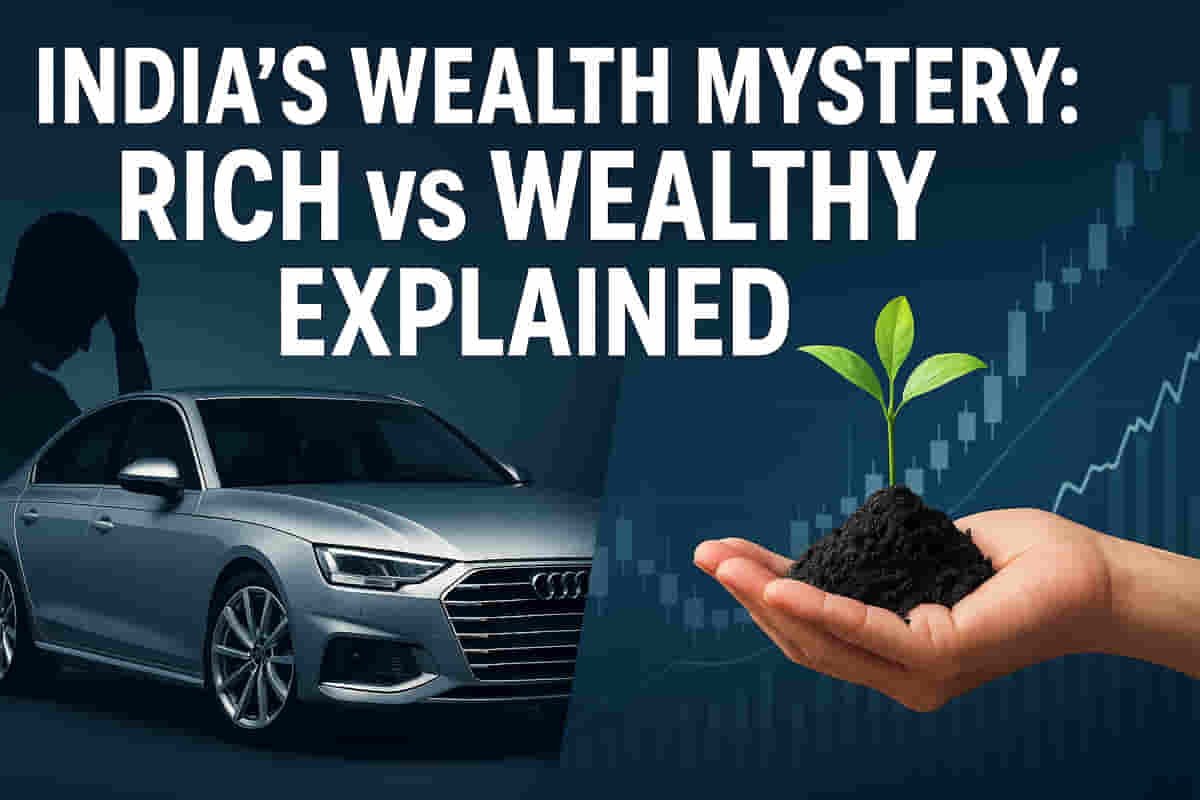
India's Rich vs. Wealthy Paradox
Modern India is witnessing a peculiar phenomenon where the outward appearance of wealth often masks financial reality. A strong societal emphasis, amplified by social media, encourages visible spending, leading many to conflate high income with genuine wealth. This article delves into the "Rich vs. Wealthy Paradox," a critical distinction for financial well-being.
Observing daily life reveals stark contrasts. A person in an expensive luxury car might be burdened by debt, while someone in a modest vehicle could possess substantial hidden assets. This paradox highlights how chasing the image of being "rich" can be a significant impediment to building true, lasting "wealth."
Understanding Richness vs. Wealth
The core of the issue lies in defining "rich" versus "wealthy." "Rich" typically refers to current income and visible assets – the salary credit alerts, the new car, the latest gadgets. It is primarily about what one spends. Wealth, however, is often hidden. It is income that is not spent but saved and invested, representing unspent potential and financial freedom.
The 'Validation Tax' and Social Media Influence
Social media platforms, particularly those focused on visual content, have intensified this trend. The "premiumization" wave sees increased demand for luxury goods, fueled by the desire to display success. This drive for external validation leads to what is termed the "Validation Tax." This is the extra cost incurred on luxury items, not for their functional utility, but for societal approval and status.
A car costing ₹75 lakhs might perform the same basic function as a ₹15 lakh car. The additional ₹60 lakhs is essentially a tax paid to society for perceived success, a cost that directly erodes potential wealth.
The 'Man in the Car Paradox'
Psychologically, the "Man in the Car Paradox" explains this behavior. When people see someone driving an expensive car, they often don't admire the driver but rather fantasize about owning the car themselves and receiving admiration. The driver mistakenly believes they are buying respect, when in reality, they are merely providing a symbol for others' aspirations.
The Mathematics of Lost Future Wealth
The financial consequences are substantial, illustrated through the concept of opportunity cost. If an individual opts for a practical car and invests the savings from a luxury purchase, that money can grow exponentially over time. For instance, ₹35 lakhs invested could grow to over ₹10 crores by retirement, demonstrating that the "cost" of a luxury car is not just its price but also significant future wealth.
True Wealth: The Power of Autonomy
The most valuable financial asset is autonomy – the freedom to make life choices independent of financial constraints. Wealth provides the power to leave a difficult job, pursue personal passions, or navigate emergencies without distress. Trading this freedom for status items means prioritizing visible inventory over future security.
Conclusion: The Choice to Save
In a spending-rewarding society, saving is an act of rebellion. True wealth is invisible – it's the unspent money compounding silently in investment accounts. The article urges readers to differentiate between those who merely "look rich" and those who are genuinely wealthy, emphasizing that the goal of money is to have it, not just to appear to have it. The status game, it concludes, is best won by not playing at all.
Impact
This news has a significant impact on personal financial planning and consumer behavior in India. It educates individuals about making informed decisions regarding spending, saving, and investing, potentially leading to improved long-term financial outcomes and greater financial literacy across the population.
Impact Rating: 8/10
Difficult Terms Explained
- EMI: Equated Monthly Installment, a fixed monthly payment for a loan.
- Emergency fund: Savings kept aside for unexpected financial needs.
- Premiumization: A trend where consumers increasingly opt for higher-end or more expensive versions of products and services.
- Mutual fund: An investment vehicle that pools money from many investors to buy stocks, bonds, or other securities.
- Demat account: An account that holds financial securities like shares and bonds in electronic form.
- Opportunity Cost: The value of the next-best alternative that is forgone when a choice is made.
- Validation Tax: The extra cost paid for luxury goods primarily for social approval rather than intrinsic value.
- Man in the Car Paradox: The phenomenon where people admire a car, not its driver, using it as a reflection of their own desires for status.