 Whalesbook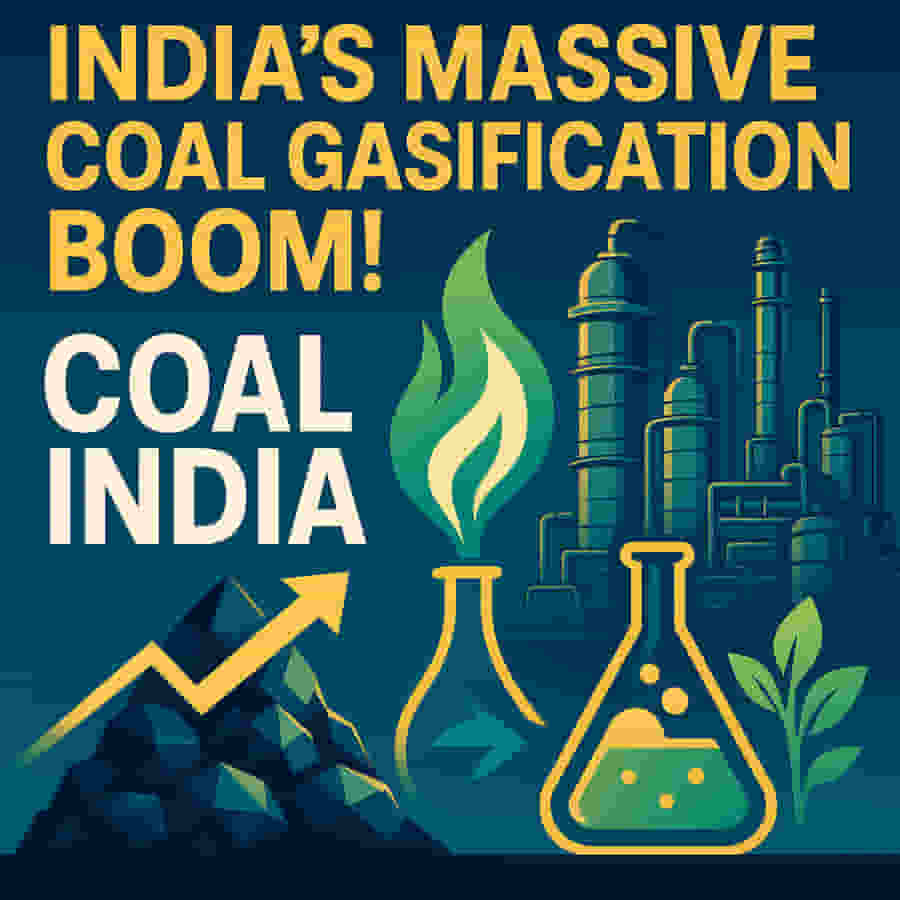
India's Ambitious Coal Gasification Drive Takes Flight
India is making a significant push to transform its energy and industrial landscape through an ambitious coal gasification program. The nation aims to achieve a capacity of 100 million tonnes of coal gasification by the year 2030, backed by a massive investment exceeding ₹85,000 crore. This initiative is poised to foster a robust low-carbon chemicals and fertiliser economy, potentially worth ₹60,000–90,000 crore annually, primarily through import substitution.
The Core Issue: Transforming Coal into Value
Coal gasification is a process that converts solid coal into a synthetic gas known as syngas. This transformation occurs by reacting coal at high temperatures with controlled amounts of oxygen and steam, rather than through complete combustion. The resulting syngas is a versatile intermediate, capable of being used to produce electricity, liquid fuels like gasoline and diesel, and vital chemicals including fertilisers, methanol, and ammonia. This capability is central to India's strategy for energy independence.
Financial Implications and Government Support
The financial scale of this undertaking is substantial, with over ₹85,000 crore earmarked for investment. The projected economic returns, estimated between ₹60,000 and ₹90,000 crore each year, highlight the potential for significant growth and cost savings through reduced reliance on imported commodities. To catalyze this development, the government launched a financial incentive scheme in January 2024 with an outlay of ₹8,500 crore, offering viability gap funding (VGF) to promote both public sector and private sector coal and lignite gasification projects.
Projects Moving Forward
Momentum is building as numerous projects transition from planning stages to active construction. Minister of State for Coal Satish Chandra Dubey recently indicated in the Lok Sabha that two major gasification projects are set to commence operations soon. Among the key developments, Bharat Coal Gasification & Chemicals Limited (BCGCL), a joint venture between Coal India and Bharat Heavy Electricals Limited, is constructing India's first indigenous coal-to-chemical plant in Odisha. Another joint venture involving Coal India and GAIL Ltd is establishing a project in West Bengal to produce synthetic natural gas, with an investment over ₹13,000 crore. Furthermore, a Coal India–Steel Authority of India joint venture is targeting syngas production for steelmaking, while NLC India Ltd plans lignite-to-methanol projects and NTPC Ltd is reportedly exploring entry into the coal gasification business.
Global Context and Technological Nuances
Coal gasification is a technology with historical precedents, used in Germany during World War II and in the United States during the 1980s energy crises. However, its economic viability in the US diminished with the shale gas revolution. China currently leads globally, gasifying vast quantities of coal annually. Experts, such as Atanu Mukherjee, CEO of Dastur Energy, stress that successful implementation requires technology tailored to specific coal types. Indian coal, with its higher ash content, necessitates gasification technologies distinct from those used in countries with different coal compositions, like the US or South Africa. Simple transplantation of foreign technology ecosystems is unlikely to yield optimal results.
Future Outlook and Impact
This strategic initiative underscores India's drive to enhance energy security, maximize the utility of its domestic coal reserves, and significantly reduce its import bill for oil, methanol, and ammonia. By investing heavily in coal gasification, India aims to build a more self-reliant and sustainable industrial future.
Impact
This initiative has the potential to significantly reshape India's industrial landscape, reduce its foreign exchange expenditure on energy imports, and create substantial economic value in the chemical and fertilizer sectors. It could also spur technological innovation and generate new employment opportunities. Impact Rating: 8/10.
Difficult Terms Explained
- Coal gasification: A process that converts solid coal into a synthetic gas called syngas.
- Syngas: A mixture of carbon monoxide and hydrogen, produced from coal, used as fuel or a chemical feedstock.
- Viability Gap Funding (VGF): Financial assistance provided by the government to make projects economically viable that would otherwise not be financially attractive.
- Direct Reduced Iron (DRI): Iron produced from iron ore using a chemical reducing agent, without melting.
- Fischer–Tropsch process: A set of chemical reactions that convert carbon monoxide and hydrogen into liquid hydrocarbons.
- Petcoke: Petroleum coke, a solid carbon byproduct of oil refining.
- Olefins: Hydrocarbons containing at least one double bond, often used as building blocks for plastics and other chemicals.