

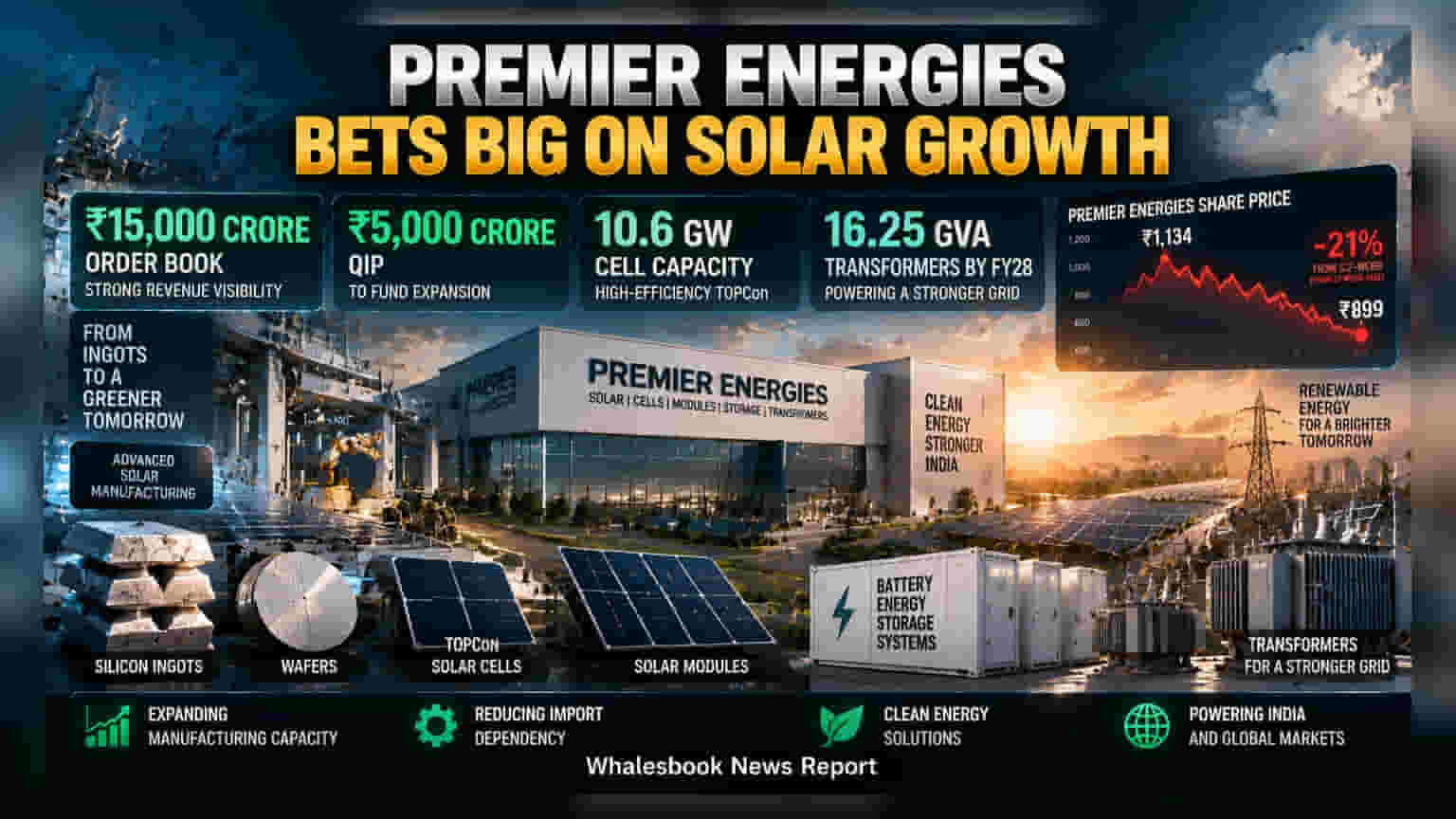
Premier Energies will ask shareholders on September 21 to approve a ₹5,000 crore fundraising plan to accelerate its solar, battery storage, and transformer manufacturing. While the company recently posted strong Q1 earnings and holds a robust order book, investors are balancing this expansion against the risks of equity dilution and large capital spending.
Premier Energies is moving into a significant phase of its expansion, with shareholders set to vote on a ₹5,000 crore capital raise during the annual general meeting scheduled for September 21, 2026. This fundraising, proposed through a Qualified Institutions Placement or similar route, is central to the company’s plans to deepen its manufacturing capabilities and enter new technology sectors.
Expanding Beyond Solar Modules
The company is aggressively shifting its business model beyond standard solar module assembly. A core part of the strategy involves moving upstream into ingot and wafer manufacturing. By controlling these early stages of production, the company aims to reduce its reliance on imported raw materials, which have historically introduced supply chain volatility and cost pressures for many domestic players.
Alongside this, Premier Energies is diversifying into new growth areas. The company is investing in battery energy storage systems, or BESS, having recently established a binding term sheet with RCT India for a planned 12 GWh plant in Telangana. Additionally, the company is scaling its transformer manufacturing, targeting a capacity of 16.25 GVA by FY28. This move is designed to capture demand from power grid upgrades, both in India and in international markets like North America and Europe.
Financial Momentum and Order Visibility
The expansion comes on the back of strong financial performance. In the first quarter of fiscal year 2027, the company reported revenue growth of approximately 35% and a profit jump of 53% compared to the previous year. This growth is supported by an order backlog of roughly ₹15,000 crore, providing clear revenue visibility for the coming quarters. This solid operational foundation recently earned the company a credit rating upgrade to 'A+/Positive' from CRISIL in August 2026.
Capital Spending and Investor Risks
While the growth plans are ambitious, they bring specific risks that market participants are monitoring. The most immediate concern for existing shareholders is equity dilution. A large capital raise of ₹5,000 crore will increase the number of shares outstanding, which can affect earnings per share if the new capital does not generate returns immediately.
Furthermore, the solar manufacturing sector remains capital-intensive. Heavy spending on new facilities like the 7 GW solar cell unit at Naidupeta and the large-scale BESS plant can pressure cash flows and return ratios in the short term. The company also remains exposed to global commodity price swings for critical inputs like wafers and ingots. If global supply exceeds demand, it could lead to margin pressure.
Investors are also watching the execution timeline. The company’s shares have experienced volatility, recently trading about 21% below their 52-week high. Whether the company can successfully ramp up its new capacities, maintain its targeted EBITDA margins, and convert its large order book into profitable revenue will be the primary factors determining its long-term performance.