 Whalesbook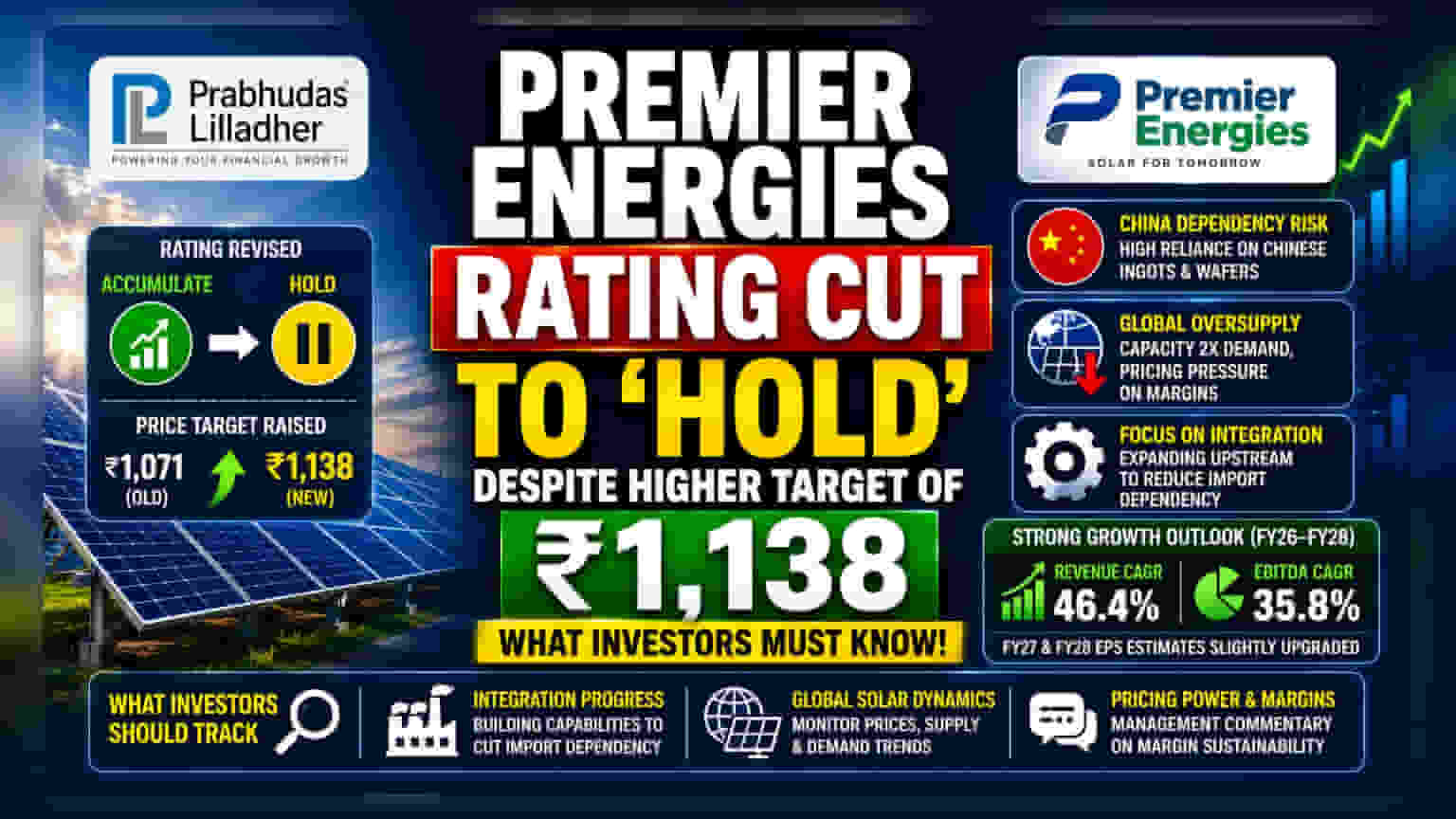


Brokerage firm Prabhudas Lilladher has downgraded Premier Energies to 'Hold' despite raising its price target to INR 1,138. The update highlights concerns over intense global solar competition and a persistent reliance on imported components from China. While the company is pushing for expansion, investors are weighing these growth plans against the reality of margin pressures caused by global oversupply.
What Happened
Brokerage house Prabhudas Lilladher has revised its rating for Premier Energies to 'Hold' from the previous 'Accumulate' stance. Interestingly, the firm also increased its price target for the stock to INR 1,138 from INR 1,071. This rating change followed a recent meeting with the company's management, where analysts reviewed the business outlook and competitive landscape.
Why the Rating Changed
When a brokerage raises a price target but lowers a rating, it often signals that the stock’s current market price may already be reflecting most of the positive growth expectations. Essentially, the analysts are acknowledging the company's potential to grow but are balancing this against the risks currently present in the solar energy sector. This suggests that the stock may no longer offer the same upside potential relative to its current valuation, or that the risks to the business model have become more pronounced in the eyes of the analyst.
The China Dependency Risk
A key point raised by the brokerage relates to the company's dependency on the Chinese market. The global solar supply chain is heavily reliant on China, especially for crucial raw materials like ingots and wafers. While India is working to build its own manufacturing ecosystem, the current dependence on imports creates a vulnerability for Indian manufacturers. This means fluctuations in global supply, changes in trade policies, or unexpected cost increases in China can directly impact the profitability and operational stability of domestic companies like Premier Energies.
Solar Sector Competition
The broader solar energy sector is currently facing a challenging global environment. Data shared by the brokerage highlights that global solar manufacturing capacity is currently double the global demand. This massive oversupply allows global producers to lower prices, which creates intense pressure on profit margins for manufacturers everywhere. Investors are closely monitoring how the company handles this pricing pressure. For Premier Energies, the goal is to shift toward more integrated manufacturing, which involves taking control of more steps in the production process to reduce reliance on external suppliers.
Growth Forecasts
Despite the immediate challenges, the financial outlook remains active. The brokerage has projected a revenue growth rate of 46.4% annually between the 2026 and 2028 financial years. Earnings before interest, taxes, depreciation, and amortization (EBITDA)—a key measure of operating profitability—are also expected to grow at an annual rate of 35.8% over the same period. The firm also slightly improved its earnings estimates for the 2027 and 2028 financial years, indicating that the company’s internal growth strategy is still seen as robust by analysts.
How Investors May Read This
The market reaction to such news depends on the balance between growth expectations and the reality of the sector. The shift to a 'Hold' rating indicates a more cautious approach, suggesting that investors may focus less on aggressive buying and more on stability. The company's future performance will likely depend on its ability to execute its expansion plans without succumbing to the margin pressure typical of the current solar landscape.
What Investors Should Track
Investors may want to watch several factors moving forward. The primary monitorable is the company's progress in building its integrated manufacturing capabilities, as this will determine how successfully it can reduce dependency on imported components. Additionally, tracking the demand-supply dynamics in the global solar market will be essential, as any change in global solar prices will directly impact the company's profit margins. Finally, management commentary regarding their ability to maintain pricing power amid high competition will be crucial to understanding if they can meet their growth targets.