

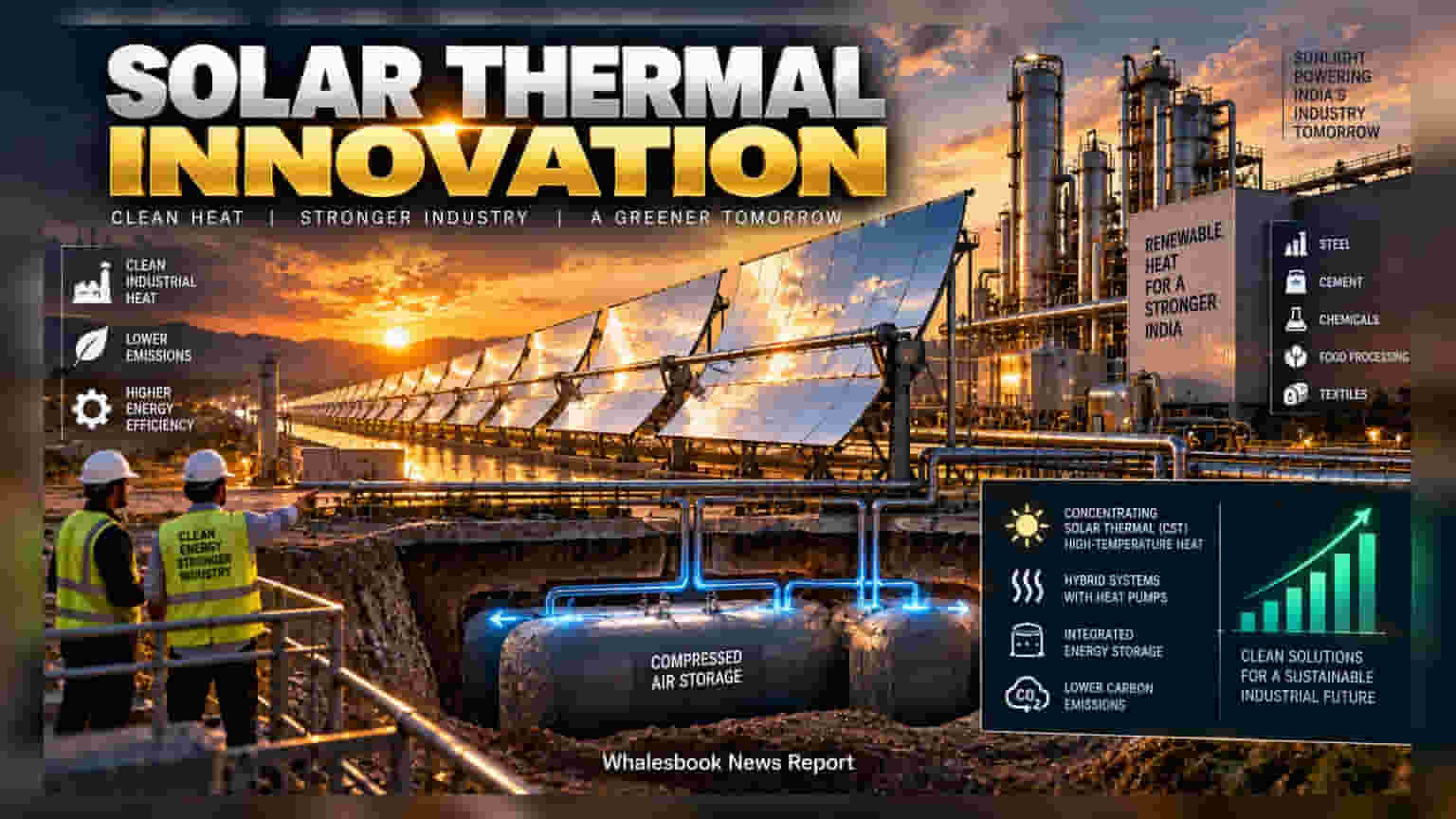
The Ministry of New and Renewable Energy has launched a call for proposals for Concentrating Solar Thermal technology to boost industrial energy efficiency. This initiative aims to help manufacturers replace fossil-fuel heating with cleaner alternatives. While the technology is in the early research phase, it highlights the government's focus on industrial decarbonization, which could eventually open new opportunities for capital goods and renewable energy companies.
The Ministry of New and Renewable Energy (MNRE) has issued a fresh call for proposals aimed at advancing Concentrating Solar Thermal (CST) technology. This move is part of a broader push to improve energy efficiency within the industrial sector, which is a major consumer of energy in India. By focusing on CST, the government intends to help manufacturers transition away from traditional fossil fuels like coal and gas for their high-temperature heating needs.
The Challenge of Industrial Heating
Most industrial manufacturing processes require significant heat. Currently, this heat is largely generated by burning fossil fuels, which contributes to high operational costs and carbon emissions. While India has made massive strides in Solar Photovoltaic (PV) technology, which generates electricity, Solar Thermal technology works differently. It uses mirrors to focus sunlight to generate direct heat. The challenge has always been that generating high-temperature heat for industries like steel, cement, or food processing is more complex and expensive than generating electricity.
To bridge this gap, the new MNRE proposals are looking into advanced hybrid systems. These include integrating solar thermal energy with heat pumps or using thermal energy to support compressed air storage systems. These methods are designed to solve a technical hurdle known as the 'temperature gap,' where basic solar heat is not hot enough for specific heavy-duty manufacturing tasks.
Investor Context and Market Outlook
For investors, this development is a signal of the government's long-term intent to decarbonize the industrial sector. However, the technologies mentioned in the current research are in their early stages. These systems are currently at a low technology readiness level, meaning they are far from commercial, large-scale deployment. Developing these into viable, cost-effective industrial solutions will likely take several years of pilot testing and R&D.
Companies in the capital goods, industrial boiler, and renewable energy sectors that are investing in sustainable process heating will be the ones to watch. If these research projects prove successful, it could create a new niche market for industrial equipment suppliers that can offer integrated solar-thermal heating solutions. However, investors should be aware that significant risks remain, including high capital expenditure for setting up large mirror arrays, the need for land, and the competitive cost of traditional fuels.
The most important monitorable for investors will be the response to these proposals, the types of companies or institutions that participate, and the timeline for these pilot projects. As the government releases more details on funding and project timelines, it will become clearer whether these innovative thermal solutions can scale efficiently enough to offer a sustainable alternative to conventional heating fuels.