

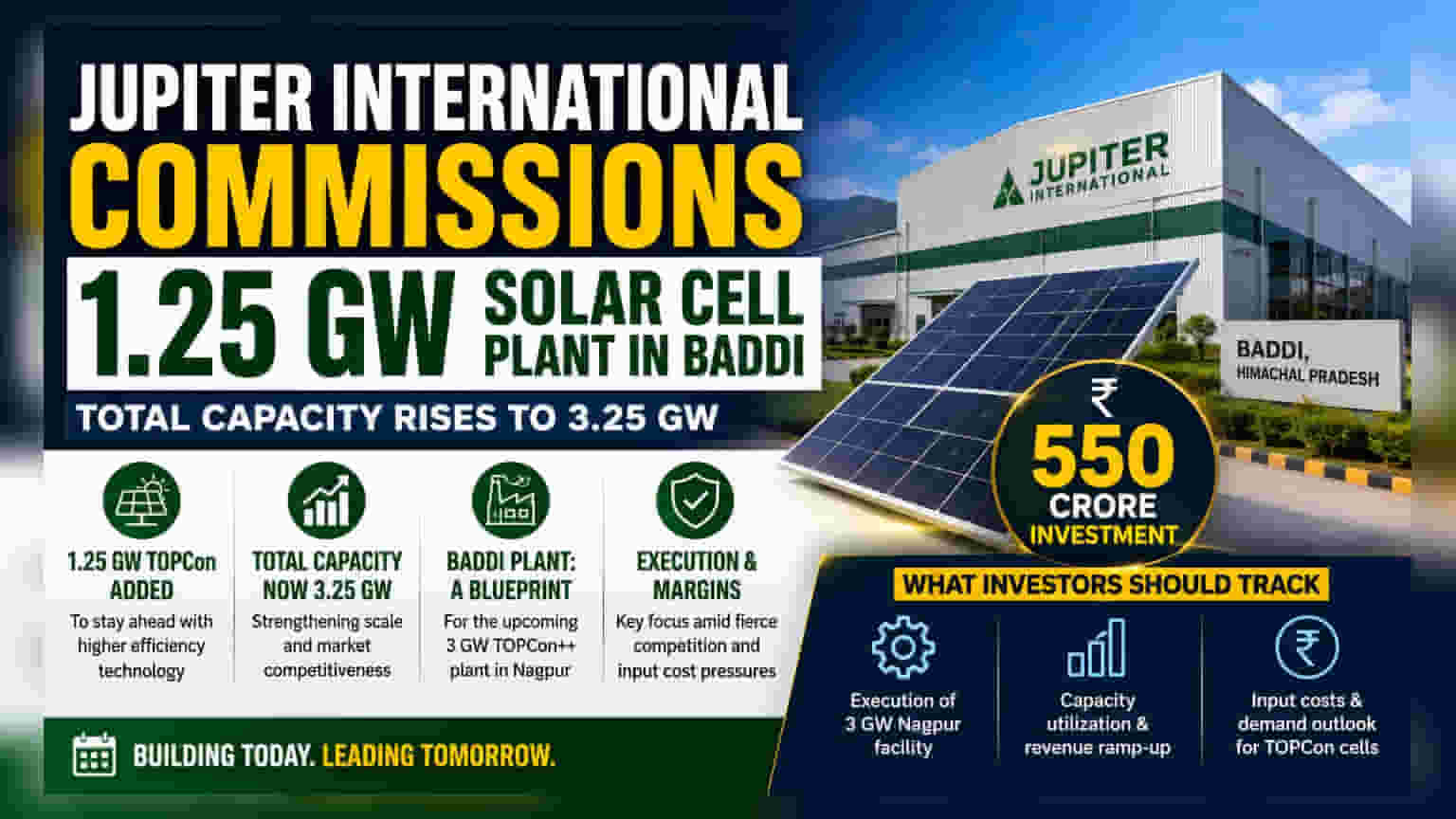
Jupiter International has launched a new 1.25 GW solar cell unit in Himachal Pradesh with a Rs 550 crore investment. This expansion increases the company's total capacity to 3.25 GW and marks a shift toward higher-efficiency TOPCon technology. Investors may watch how this shift impacts production costs and the upcoming 3 GW Nagpur project schedule.
What Happened
Jupiter International has commissioned a new 1.25 GW solar cell manufacturing plant in Baddi, Himachal Pradesh. The company invested Rs 550 crore to set up this facility, which increases its total solar cell manufacturing capacity to 3.25 GW. This move is part of the company's broader strategy to move beyond standard solar cells and adopt newer, more efficient manufacturing technologies.
Why It Matters For The Business
The solar power industry is currently moving toward a technology called TOPCon (Tunnel Oxide Passivated Contact) because these cells offer higher efficiency compared to the older PERC cells. By adding 1.25 GW of TOPCon capacity, Jupiter International is trying to ensure it stays competitive. If a manufacturer relies only on older technology, its products may become harder to sell as solar projects demand higher power output per panel. This expansion is designed to provide the scale and technology needed to compete in the domestic market.
Scaling Up Capacity
This expansion comes after the company added 1 GW of mono PERC capacity earlier this year. The company is using the Baddi facility as a testing ground for its larger plans. According to management, this site serves as a blueprint for a much bigger 3 GW TOPCon++ facility planned in Nagpur, which is expected to be completed by the end of the year. Successfully running this plant is crucial for proving the company can execute its technology upgrade.
The Competitive Reality
The Indian solar manufacturing sector is seeing significant capacity additions as companies race to benefit from government support and high domestic demand. However, this also brings risks. The solar cell market is sensitive to the price of raw materials, particularly silicon wafers, which are mostly imported. If the company cannot manage the cost of these inputs effectively, profit margins may come under pressure, regardless of how much capacity is added.
Furthermore, solar technology changes rapidly. A core risk for any manufacturer is the possibility that the technology they are investing in today could be surpassed by newer innovations tomorrow. Investors may track how well the company manages to sell its current output at profitable margins, especially with many competitors also increasing their capacity.
What Investors Should Track
The most important monitorable is the execution of the planned 3 GW Nagpur facility. Investors will also look for updates on capacity utilization—essentially, how much of this new 1.25 GW plant is actually running and generating revenue. Additionally, market participants will watch for management commentary on input costs and whether the demand for TOPCon cells remains strong enough to maintain healthy profit margins in a competitive market.