

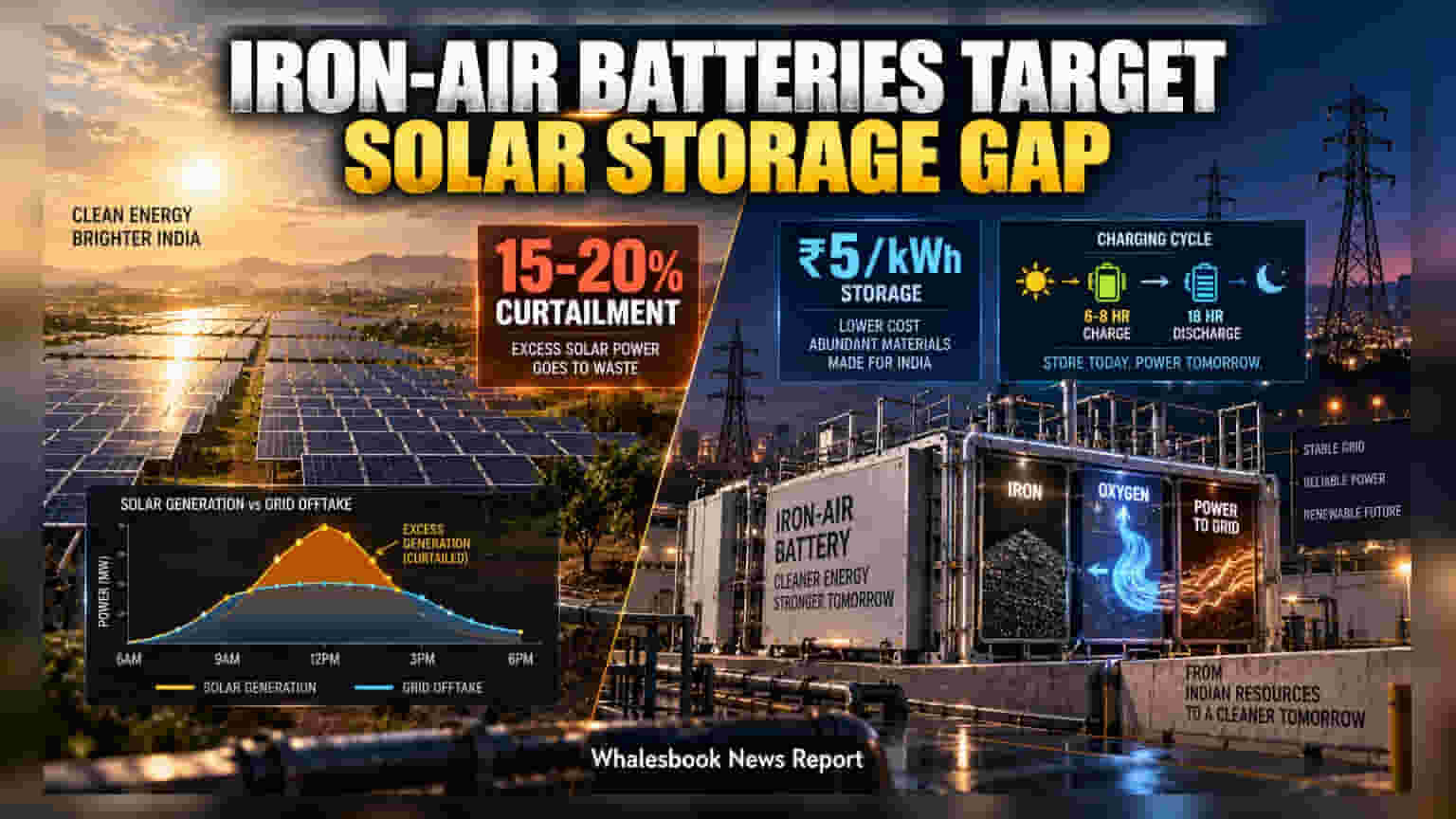
As India expands its renewable energy capacity, solar producers are losing 15-20% of power to storage shortages. Iron-air technology is being positioned as a cost-effective alternative to lithium-ion, but it remains in early, experimental stages. For investors, this technology is a long-term development to watch rather than an immediate commercial solution.
India is rapidly building its renewable energy sector, but a major problem has surfaced: a lack of storage capacity. As the country moves toward a goal where a significant portion of power comes from renewable sources, the inability to store excess energy is leading to what experts call curtailment. This essentially means solar producers are forced to waste 15-20% of the electricity they generate because the grid cannot absorb it or store it for later use. In some instances, this waste has reached as high as 65%.
To bridge this gap, new battery technologies are being explored, including iron-air systems. One developer, Meine Electric, is working on a system that utilizes a cycle of charging for six to eight hours and discharging for up to 18 hours. This design is specifically aimed at capturing solar energy produced during the day and releasing it to meet power demand during the evening and night. The technology relies on a simple reaction where iron reacts with oxygen and water to release electricity, and the process reverses during charging. Since India is a major iron ore producer, this chemistry could offer a significant supply chain advantage over lithium-ion batteries, which often rely on imported materials.
However, there is a clear trade-off investors should understand between cost and efficiency. While the projected lifetime storage cost for iron-air systems is estimated at about ₹5 per kWh, the technology suffers from lower energy efficiency compared to established lithium-ion batteries. Estimates suggest that iron-air systems operate at roughly 23-50% efficiency, significantly lower than what current lithium-ion technology offers. This means that while iron-air batteries may be cheaper to build and use abundant local materials, they are less effective at converting input power into usable output.
Furthermore, the technology is currently far from mainstream adoption. Industry analysis indicates that iron-air battery systems are still in the validation stage. They lack the extensive track record of real-world use that banks and large investors require to finance major projects. Experts suggest that these systems will likely require at least another five years of testing across thousands of charge-discharge cycles before they can be considered a reliable, large-scale solution for the national grid. While the engineering concept is promising for India's specific energy needs, the practical reality is that significant work remains to prove durability, performance consistency, and commercial viability. Investors should view this as a long-term research and development theme rather than an immediate driver of corporate earnings.