

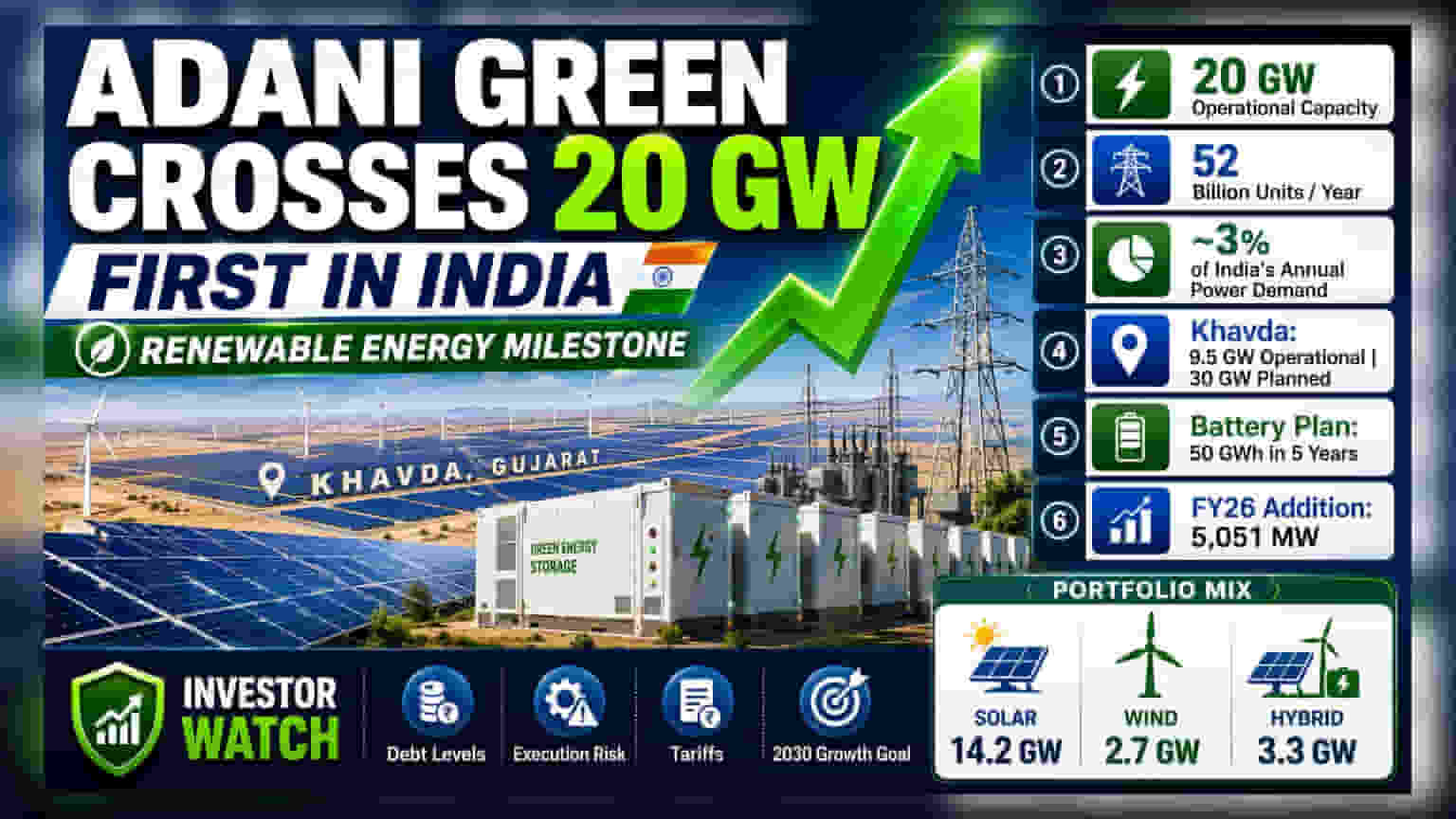
Adani Green Energy has become the first Indian company to operate 20 gigawatts (GW) of renewable capacity. This output accounts for nearly 3% of India's annual electricity consumption. While the company pursues an ambitious 50 GW target by 2030, investors are focused on how it manages the high debt and execution risks associated with such massive capital spending.
What Happened
Adani Green Energy Ltd. (AGEL) has officially crossed the 20-gigawatt (GW) threshold in operational renewable energy capacity. This milestone makes it the first Indian company to reach this scale of renewable power generation. The company, which commissioned its first project in Kamuthi, Tamil Nadu, in 2016, has grown rapidly over the last decade. In the most recent fiscal year alone, AGEL added 5,051 megawatts (MW) of capacity, which the company claims is the highest annual addition by any company globally outside of China.
The Scale Of Energy Production
The 20 GW portfolio is now generating over 52 billion units of electricity annually. According to company data, this provides enough power to meet nearly 3% of India's total yearly electricity demand. The company’s current operational portfolio is a mix of solar (14.2 GW), wind (2.7 GW), and wind-solar hybrid projects (3.3 GW). To support the reliability of this power, AGEL has also installed 3.55 gigawatt-hours (GWh) of battery energy storage, a technology that helps store power when generation is high and release it when demand peaks.
Focus On Khavda And Future Plans
A significant part of this growth is centered at the Khavda renewable energy park in Gujarat. The company plans to build a total of 30 GW of capacity at this single location, spanning 538 square kilometers. As of now, 9.5 GW of solar capacity is operational at Khavda. The company's management has stated that battery storage will be a core part of its future strategy, with plans to expand its storage portfolio to 50 GWh over the next five years to help deliver consistent electricity.
Financial And Execution Risks
While the scale of expansion is large, it brings specific risks that investors regularly monitor. Renewable energy projects are capital-intensive, meaning they require massive upfront spending. AGEL has historically relied on significant debt to fund this rapid growth. For investors, the ability of the company to manage this debt, maintain healthy profit margins, and generate enough cash flow to cover interest payments is critical.
Additionally, the company faces execution risks. Projects of this size, particularly in remote areas like Khavda, depend on complex logistics, timely approvals, and stable supply chains for equipment like solar modules and wind turbines. Any delay in these large-scale infrastructure projects can lead to cost increases and lower returns than originally expected.
What Investors Should Track
Investors may want to watch several key areas moving forward. First is the pace of commissioning for the remaining capacity at the Khavda site. Second is the trend in debt levels and the company's credit rating, as these impact the cost of borrowing. Third, the company’s ability to secure competitive tariffs in government tenders will determine its future profit margins. Finally, performance against the 50 GW goal by 2030 will be the primary yardstick for evaluating the company’s growth trajectory compared to domestic peers like Tata Power and JSW Energy, which are also scaling up their renewable energy businesses.