

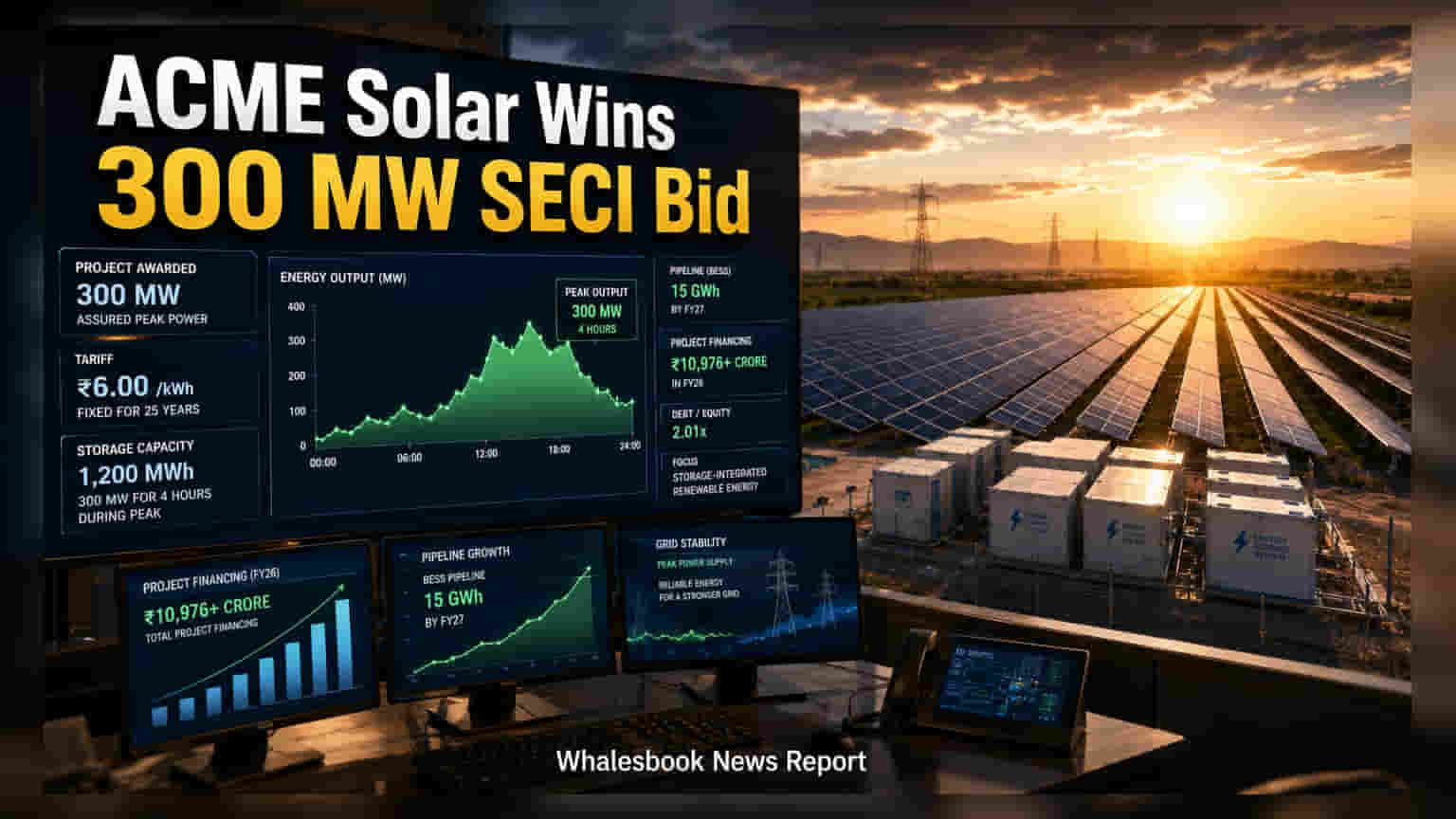
ACME Solar has secured a 300 MW assured peak power contract from SECI at a ₹6.00 per kWh tariff. The project will add to the company's growing energy storage portfolio, though investors are monitoring the rising debt load required to fund this expansion.
ACME Solar Holdings has been declared a successful bidder for a 300 MW assured peak power project under the Solar Energy Corporation of India’s (SECI) FDRE-IX tender. Under the terms of the agreement, the company will supply power at a fixed tariff of ₹6.00 per kWh over the next 25 years. This project includes 1,200 MWh of storage capacity, requiring the company to supply 300 MW of power for four hours during peak demand periods.
This project is part of a larger strategy by the company to expand its battery energy storage system (BESS) pipeline, which is expected to reach 15 GWh. By focusing on storage-integrated renewable energy, the company aims to provide more reliable power to the grid, which is becoming a priority for government agencies.
The project comes during an active year for the company’s capital raising. The firm has secured significant financing recently, including ₹1,571 crore from IIFCL for a separate 300 MW project in Rajasthan, bringing the total project financing for the current fiscal year to over ₹10,976 crore. This demonstrates the company's ability to secure large-scale capital, but it also highlights the heavy capital requirements of this business model.
While the expansion is significant, investors often look closely at the impact of such growth on the company’s financial health. The firm carries a debt-to-equity ratio of approximately 2.01, which is a metric that investors frequently track. Maintaining an interest coverage ratio that supports this debt level will be important, as rising interest expenses can impact profitability. If operating profits do not keep pace with the debt taken on for these projects, it could create financial pressure.
Operationally, the company faces the standard risks associated with large-scale utility projects in India. These include the risk of delays in securing land, getting necessary environmental clearances, and connecting to the transmission network managed by the Central Transmission Utility (CTU). Any delay in commissioning can lead to cost overruns, which can squeeze the profit margins of these projects. Additionally, the solar energy sector continues to face risks related to the availability and cost of imported components like modules, as well as the potential for tariff pressure in competitive bidding environments.
Investors will likely monitor the progress of these ongoing projects, specifically looking for updates on the actual commissioning timelines and whether the company can maintain its profit margins while managing its significant debt load.