

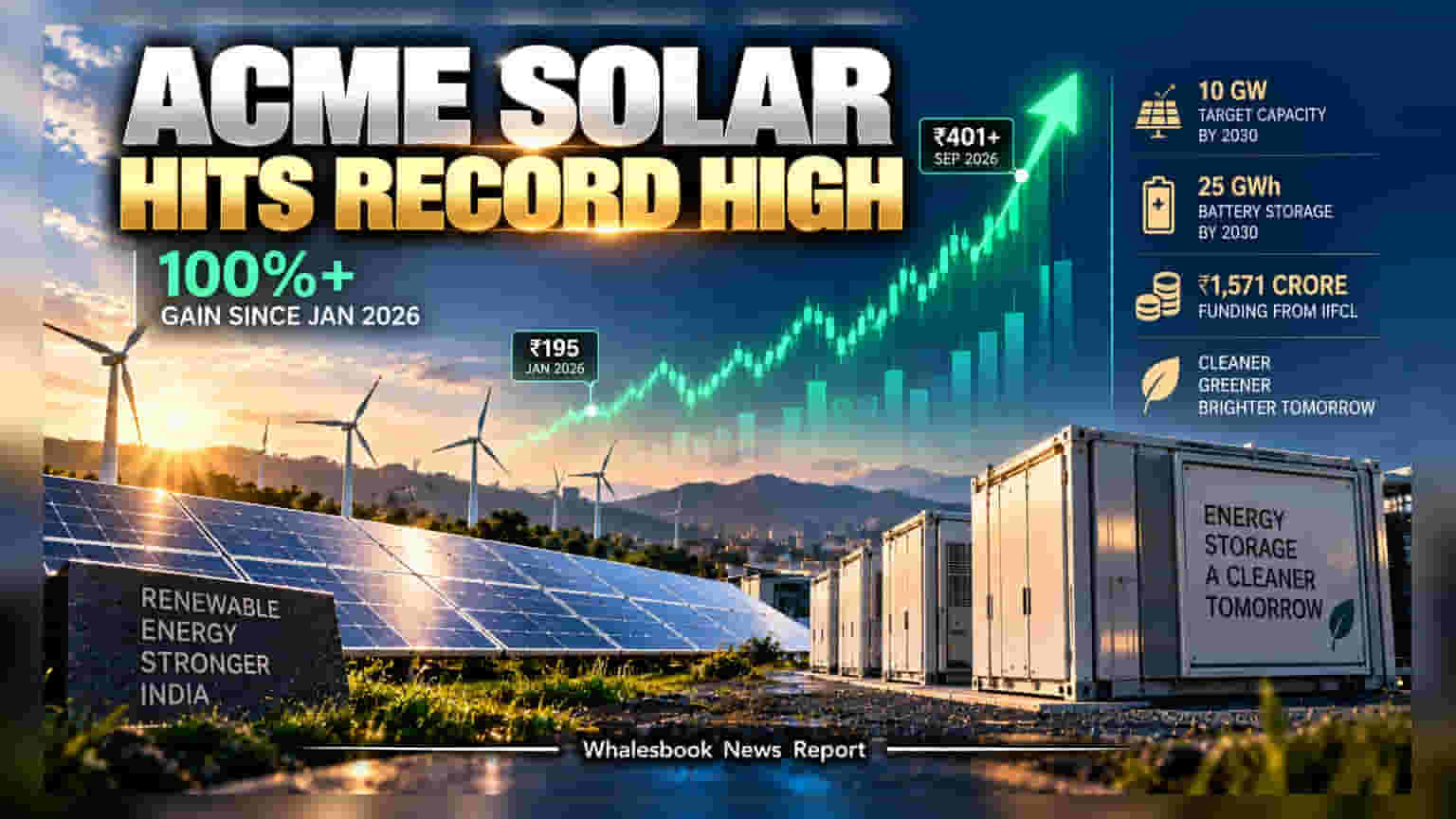
ACME Solar Holdings has seen its stock price more than double since January 2026, driven by a growing renewable portfolio and government support. While investor interest is strong, the company faces significant challenges, including high debt levels and the need for consistent project execution.
ACME Solar Holdings has experienced a major rally in 2026, with the share price rising more than 100% since January. The stock, which traded near ₹195 at the start of the year, has seen its value climb to the ₹401–407 range in recent trading sessions. This upward trend reflects strong market optimism toward renewable energy companies, supported by favorable government policies and increased sector funding.
Strategic Expansion and Funding
The company is currently pursuing an aggressive growth plan, targeting 10 GW of generation capacity and 25 GWh of battery energy storage by 2030. To fuel this expansion, the firm recently secured ₹1,571 crore in financing from the India Infrastructure Finance Company (IIFCL) in late August 2026. This funding is specifically tied to a 300 MW peak power project, highlighting the company’s ability to attract institutional capital for its capital-intensive projects. Additionally, the company recently filed its inaugural Business Responsibility and Sustainability Report (BRSR) for FY26, signaling a move toward more transparent reporting on environmental and social goals.
Financial Risks and Debt Concerns
While the stock's growth has been substantial, investors should balance this with the company’s financial structure. A key monitorable for the business is its leverage, or the amount of debt used to fund its projects. Like many companies in the power generation sector, ACME Solar carries significant debt, which results in a high debt-to-equity ratio. This puts pressure on the company to maintain strong interest coverage metrics, ensuring that profits are sufficient to cover interest payments.
Beyond debt, the company faces operational risks common to the renewable sector. These include potential delays in project commissioning, which can impact revenue, and challenges with grid evacuation—the process of connecting new power plants to the main electricity grid. Furthermore, as the company enters new power purchase agreements, it remains exposed to the risk of tariff compression, where state electricity distribution companies might attempt to negotiate lower power prices, potentially squeezing profit margins.
Future Outlook
The company’s ability to maintain its current growth trajectory will largely depend on its execution speed. Investors will likely look for updates on the 8,070 MW project portfolio, specifically regarding timelines for project completion and the actual utilization of new capacity. As the firm integrates green hydrogen and battery storage solutions, tracking management’s commentary on cost control and debt management will be essential for assessing long-term stability.