

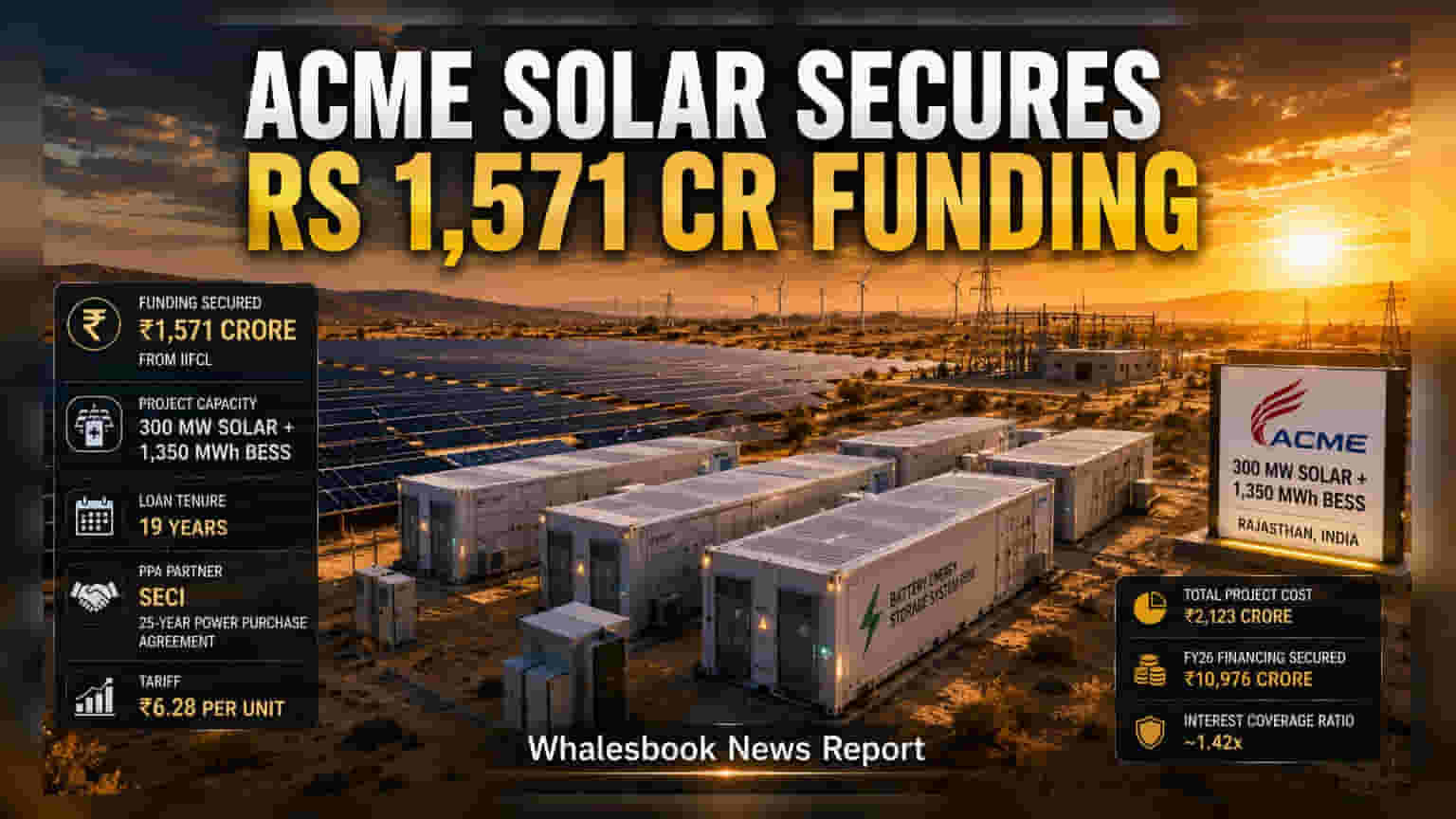
ACME Solar Holdings has finalized a ₹1,571 crore debt deal with India Infrastructure Finance Company Ltd (IIFCL) for its 300 MW Rajasthan solar-storage plant. This project, which integrates a large battery system, is supported by a 25-year power agreement with the Solar Energy Corporation of India (SECI). The company has now raised ₹10,976 crore in the current fiscal year, though investors should note risks such as debt-servicing capacity.
ACME Solar Holdings Ltd has secured ₹1,571 crore in long-term project financing from the India Infrastructure Finance Company Ltd (IIFCL). The funds are designated for the development of the 300 MW "ACME Renewtech Sixth" project located in Rajasthan. This deal comes with a 19-year repayment period and marks a significant step in the company's funding strategy for the current fiscal year.
The Rajasthan project is designed as a hybrid energy solution, combining solar power generation with a 1,350 MWh battery energy storage system. This setup allows the company to provide a more stable power supply, which is critical for meeting the requirements of its 25-year power purchase agreement with the Solar Energy Corporation of India (SECI). The power from this plant has been contracted at a tariff of ₹6.28 per unit, which locks in revenue for the long term.
With a total project cost estimated at ₹2,123 crore, this debt funding covers a substantial portion of the capital required for construction. This latest transaction brings ACME Solar's total financing secured during the current fiscal year to ₹10,976 crore, reflecting an aggressive approach to building its renewable energy pipeline.
While the company is scaling its infrastructure, investors often track the financial health of such capital-intensive projects. The company’s interest coverage ratio, which indicates how easily it can pay interest on its debt, stands at approximately 1.42x. A lower ratio can sometimes signal tight financial flexibility, meaning the company must generate consistent cash flow to manage its debt obligations effectively. Additionally, the renewable sector faces inherent operational risks, such as potential delays in grid connectivity or supply chain bottlenecks for essential components like solar modules.
Looking ahead, the long-term success of this project will depend on the company’s ability to execute construction on time and maintain efficiency at the site. Investors may continue to monitor the company’s debt levels and its ability to maintain profit margins amid potential industry-wide pressure on power tariffs for new projects.