

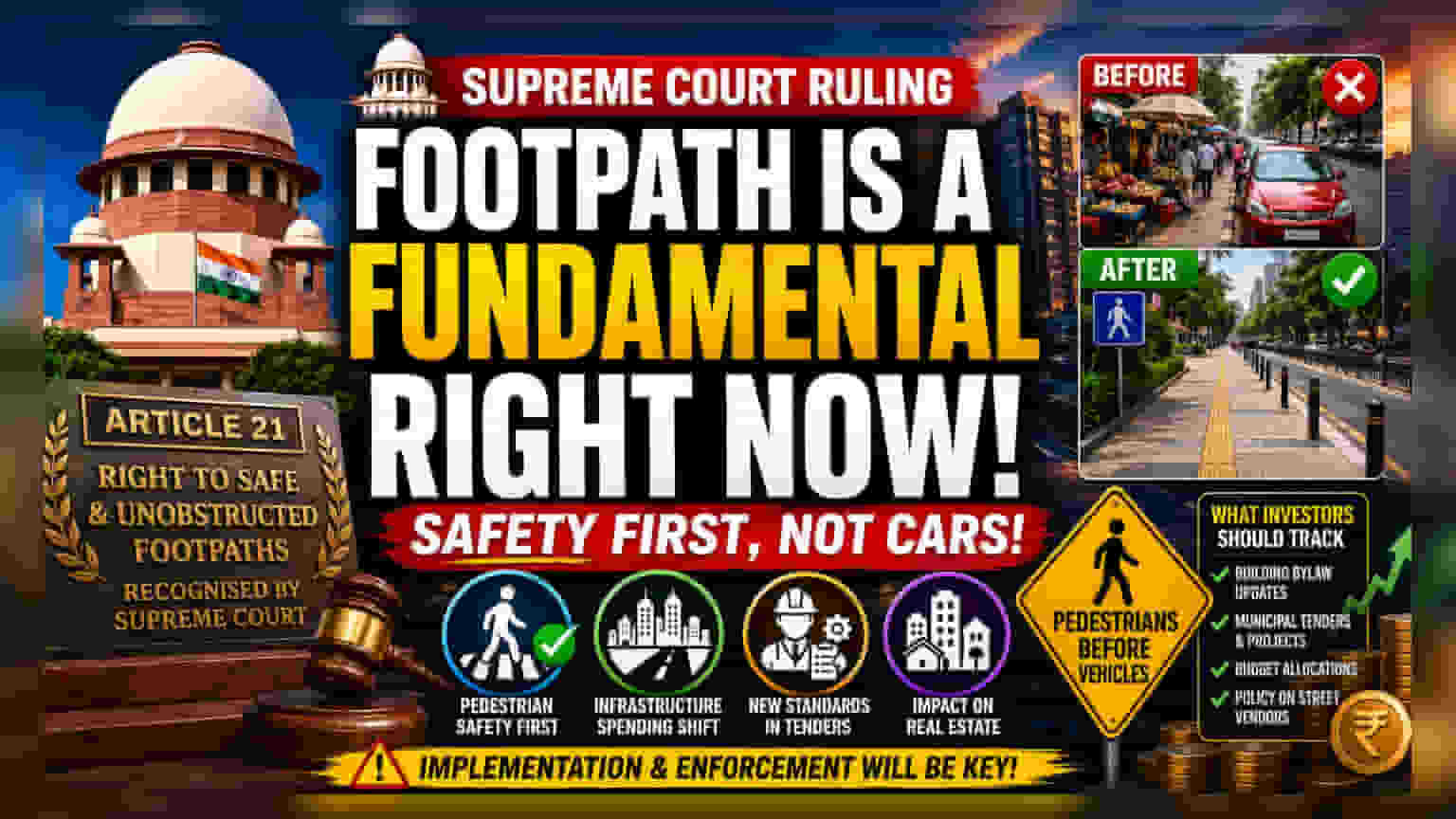
The Supreme Court has declared the right to safe footpaths a fundamental right under Article 21, shifting urban planning priorities. For investors, this signals potential changes in infrastructure spending, new construction compliance standards for real estate developers, and increased demand for pedestrian-friendly urban design. The ruling compels municipal bodies to upgrade infrastructure, which may influence future government tenders and project costs.
What Happened
The Supreme Court has issued a landmark ruling recognizing the right to safe and unobstructed footpaths as a fundamental right under Article 21 of the Indian Constitution. This decision effectively prioritizes pedestrian safety over the traditional urban planning model that has long favored vehicular traffic. The court has directed municipal and local government bodies to actively maintain and protect pedestrian infrastructure. This includes clearing encroachments—such as illegal parking and street vendors—and ensuring that walkways are accessible to all, including persons with disabilities.
Infrastructure Spending Shifts
This ruling is likely to influence how urban development projects are planned and funded. Historically, road infrastructure spending has been heavily skewed toward flyovers, highway expansions, and road widening to accommodate vehicle growth. With the court now mandating that footpaths be a central component of urban design, local municipal corporations may need to reallocate budgets toward pedestrian infrastructure projects.
For engineering, procurement, and construction (EPC) companies that bid for municipal road contracts, this could mean changing the scope of work in upcoming tenders. Projects may now require stricter adherence to safety standards, including dropped kerbs, tactile paving, and improved street lighting. While this could potentially increase the contract value for well-equipped contractors, it may also lead to more rigorous quality audits and compliance requirements during execution.
Impact on Real Estate Developers
For the real estate sector, this ruling could influence future township developments and commercial projects. Developers have traditionally optimized land use to maximize floor space index (FSI) and vehicle parking. Future building bylaws and development control regulations may be updated to reflect this mandate, requiring developers to ensure that pedestrian access within and around their properties meets new safety benchmarks.
Projects located in high-density urban areas may face stricter scrutiny regarding street-level accessibility. While this could raise initial construction costs, it may also improve the long-term value of properties that offer better 'walkability,' which is an increasingly sought-after feature in premium and integrated townships.
Potential Risks and Challenges
Investors should note the operational complexities involved. The ruling highlights a conflict between pedestrian safety and the livelihoods of street vendors. Moving forward, the implementation of this order will depend on how local bodies handle this delicate balance. If authorities pursue aggressive, unplanned eviction drives, it could lead to social unrest or legal challenges, potentially stalling public infrastructure projects.
Furthermore, the quality of implementation remains a monitorable. A mandate is only as effective as its enforcement. If municipal bodies struggle with funding or administrative capacity, the improvements may be delayed, leading to inconsistent infrastructure quality across different regions.
What Investors Should Track
Investors in the infrastructure and real estate sectors should track the following:
- Updates to Building Bylaws: Look for changes in state-level building codes or municipal development plans that incorporate these new accessibility standards.
- Municipal Tenders: Watch for shifts in the scope of government road and infrastructure tenders. Increased focus on pedestrian safety features may become a standard requirement.
- Government Budgeting: Monitor municipal and state government budget allocations toward urban pedestrian projects, as this will determine the actual pipeline of work for construction firms.
- Regulatory Clarity: Watch for how local bodies address the issue of street vendors, as this policy framework will determine the speed at which footpaths can actually be cleared and upgraded.