

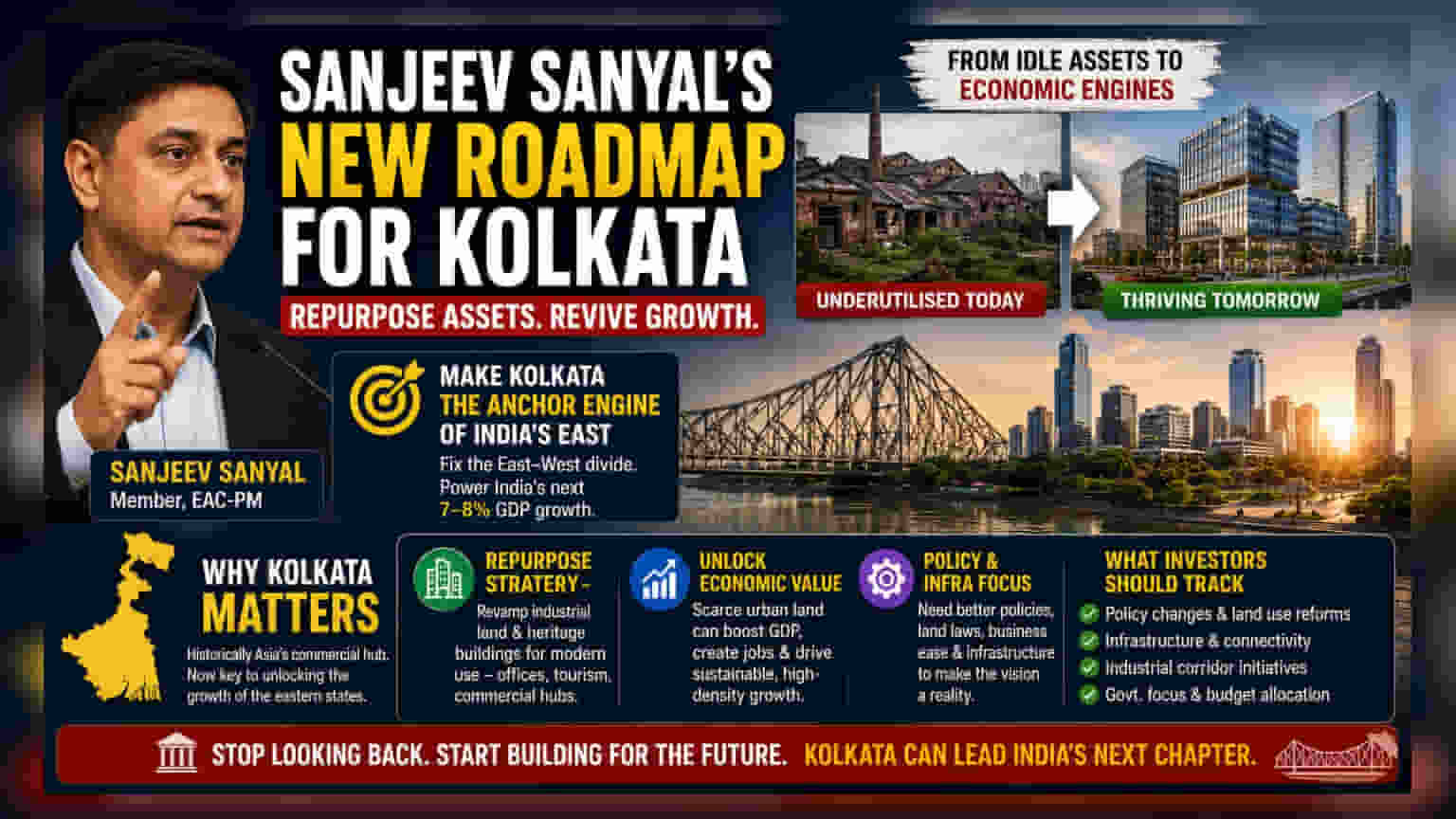
Sanjeev Sanyal, member of the PM’s Economic Advisory Council, has urged Kolkata to repurpose derelict industrial land and colonial heritage assets to spark economic growth. He identifies this as a critical strategy to bridge India’s east-west economic divide and position Kolkata as a primary growth engine for Eastern India.
What Happened
Sanjeev Sanyal, a member of the Prime Minister’s Economic Advisory Council (EAC-PM), has proposed a new economic roadmap for Kolkata, focusing on the strategic redevelopment of the city’s assets. During a recent event in Kolkata, Sanyal emphasized that reviving the city is essential for correcting the economic imbalance between India’s eastern and western regions. His proposal focuses on repurposing unused industrial land and colonial-era heritage buildings to create a more dynamic and productive urban environment.
Sanyal argued that Kolkata should stop viewing itself through the lens of nostalgia and instead embrace a pragmatic approach to urban density. By utilizing existing land assets more efficiently, he suggests the city can transform into a modern growth hub rather than allowing derelict spaces to remain underutilized.
The Economic Argument for Repurposing
Sanyal’s vision for "repurposing" is centered on the idea that urban land is a scarce and valuable resource. In many cities, old industrial plots or heritage structures sit idle, contributing little to local GDP or employment. By updating these sites—reimagining them for modern office, commercial, or tourism use—cities can unlock economic value without the environmental and financial cost of building entirely new developments on greenfield (undeveloped) land.
This approach mirrors successful global models where historical buildings were converted into museums, hotels, or office hubs, maintaining the city's character while fueling the local economy. Sanyal argues that Kolkata’s historical assets should be treated as functional economic levers rather than just cultural artifacts.
Why Kolkata Matters for the East-West Divide
Sanyal has frequently highlighted that the real economic gap in India is not between the North and the South, but rather the East and the West. While Western and Southern states have significantly contributed to India's GDP growth post-1991, the Eastern region has lagged behind. He asserts that Kolkata, historically one of Asia’s most important commercial cities, must reclaim its position as an "anchor engine" for the entire eastern seaboard.
His core argument is that national economic growth is driven by a handful of strong, high-density urban hubs. For the eastern states like West Bengal, Odisha, Bihar, and Jharkhand to prosper, they need a central metropolitan anchor. Reviving Kolkata’s industrial ecosystem and infrastructure is, therefore, framed as a national necessity to sustain India’s 7-8% GDP growth target in the coming decades.
Challenges and Policy Shifts
While the vision is ambitious, Sanyal acknowledged that hardware (infrastructure) is only one part of the solution; the "software" (policy environment, business ease, and institutional culture) needs an upgrade. He pointed out that industrial policies in the past may not have been sufficiently supportive of business expansion. The call for redevelopment also implies a need for changes in urban land laws, as the legal framework often dictates how easily land can be repurposed for modern industry or commercial use.
What Investors Should Track
Investors interested in the region may track several key developments following this call for urban renewal:
- Policy Changes: Watch for potential amendments to urban land use policies or new state government initiatives aimed at unlocking industrial land for private development.
- Infrastructure Projects: As Sanyal emphasized infrastructure as a key enabler for density, look for updates on connectivity, transport corridors, and urban renewal projects that could benefit real estate and construction companies operating in Bengal.
- Industrial Policy: Monitor government announcements regarding industrial corridors or special zones that align with this push to make Kolkata a more competitive business hub.
- Institutional Focus: Continued government rhetoric and potential budgetary allocations toward urban rejuvenation in the eastern states could signal a long-term shift in the regional business landscape.