 Whalesbook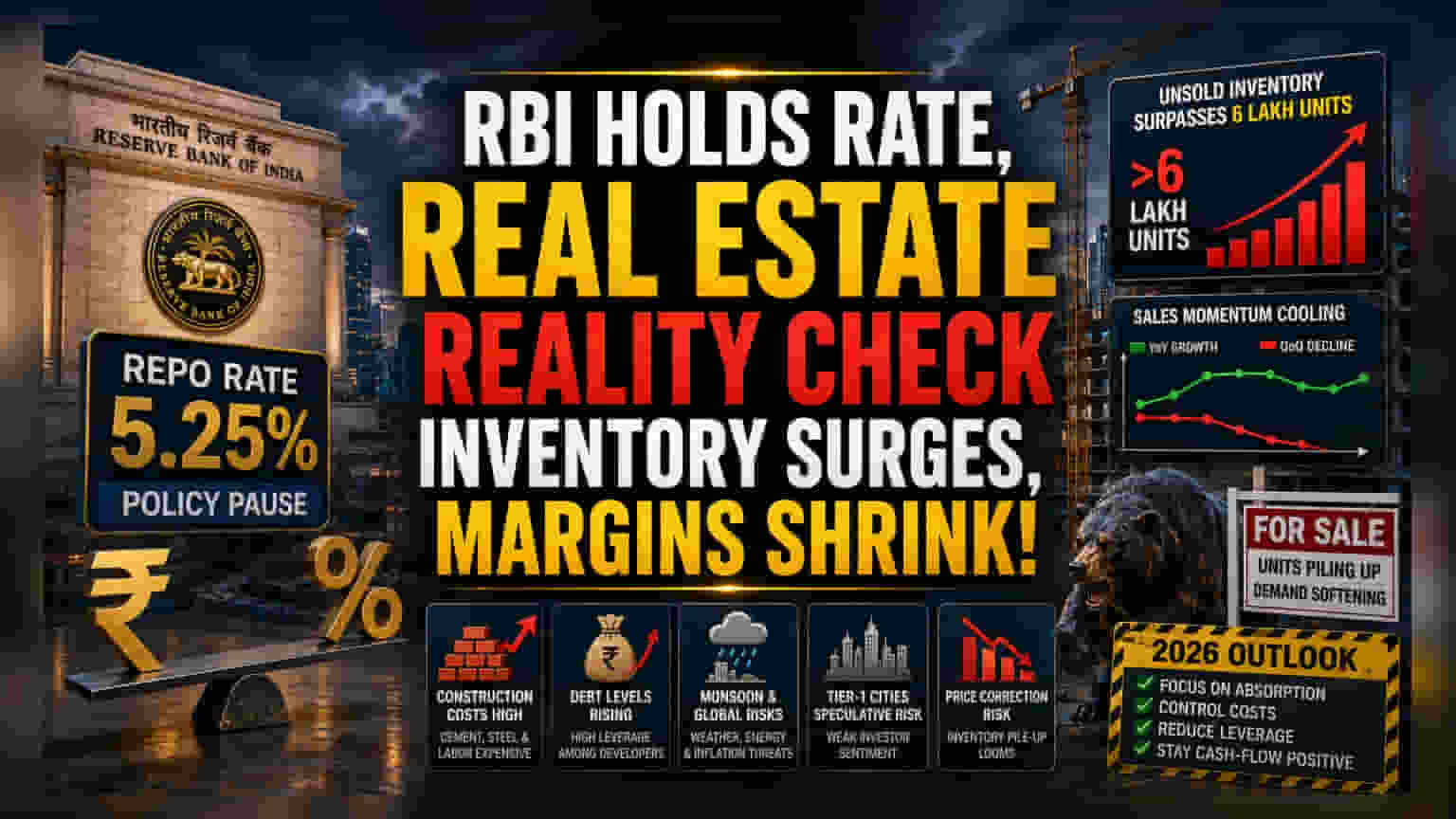


The Illusion of Market Equilibrium
The central bank's decision to maintain the repo rate at 5.25% serves primarily as a cooling mechanism for a sector that is increasingly defined by supply-side volatility rather than demand-side strength. By insulating the market from immediate borrowing cost shocks, the Reserve Bank of India has effectively hit the pause button on a potential liquidity crisis for developers. However, this policy stability does little to address the fundamental imbalance developing in the residential space, where the rate of new construction launches has decisively overtaken absorption rates for the first time since the post-pandemic recovery.
The Inventory Overhang and Margin Squeeze
Market data suggests that while year-on-year demand appears healthy, a sequential contraction in sales volume indicates that the froth is coming off the residential sector. With unsold inventory now surpassing 6 lakh units, developers are facing a compounding pressure: the necessity to move stock in a softening demand environment while simultaneously contending with a sustained elevation in construction expenses. Inputs such as cement and steel, sensitive to global commodity fluctuations and a volatile currency, have effectively compressed margins for mid-income and affordable housing projects. Unlike the luxury segment, which exhibits lower price sensitivity, the broader market relies on volume-driven profitability that is currently being eroded by these inflationary headwinds.
The Forensic Bear Case
The optimism surrounding the rate pause ignores the structural fragility of the Indian real estate sector. The current reliance on external debt to fund massive project pipelines, coupled with the rising cost of capital for firms with lower credit ratings, creates a precarious environment. Should the monsoon season underperform or if global energy prices trigger a renewed inflationary spike, the Reserve Bank may be forced into a hawkish pivot that would disproportionately impact highly leveraged mid-sized developers. Furthermore, the reliance on speculative buying in Tier-1 cities remains a hidden risk; should investor sentiment from the Middle East continue to wane due to geopolitical instability, the resulting drop in absorption could lead to a inventory pile-up that forces price corrections across major urban centers.
Strategic Outlook for 2026
Investors and stakeholders should look beyond the headline stability of interest rates and focus on the inventory absorption metrics of individual developers. The market is transitioning from a period of unbridled growth to a more selective, cost-conscious cycle. While home loans remain accessible, the ability of firms to maintain cash flow will depend less on central bank policy and more on operational efficiency in managing construction costs and reducing debt-to-equity ratios. Expect a cooling in new launches as developers pivot toward clearing existing stock, a move that will define the winners and losers in the second half of the fiscal year.