

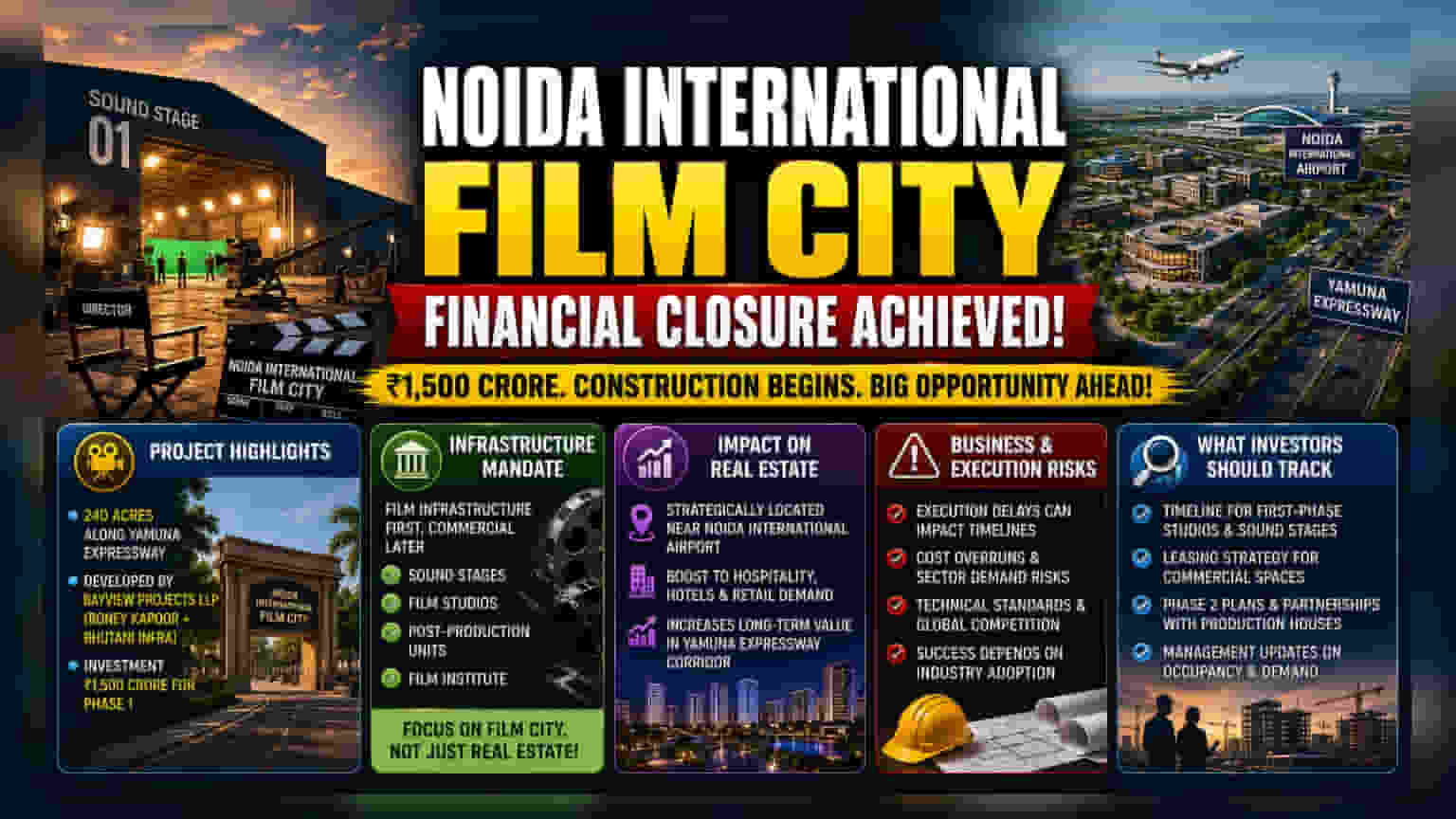
The Noida International Film City project has moved to the construction phase following financial closure, with developers Bayview Projects LLP committing ₹1,500 crore for the first stage. Located along the Yamuna Expressway, the development aims to integrate film infrastructure with commercial and hospitality spaces. Success will depend on the timely execution of studio facilities, which are a mandatory requirement before commercial development can proceed.
What Happened
Noida International Film City has reached a significant milestone with the achievement of financial closure, allowing construction for its first phase to begin. Developers Bayview Projects LLP, a consortium involving filmmaker Boney Kapoor and Bhutani Infra, have earmarked ₹1,500 crore for this initial rollout. Spanning 240 acres along the Yamuna Expressway, the project is designed to become a large-scale entertainment and commercial hub, complementing the rapid infrastructure growth in the National Capital Region (NCR).
The Infrastructure Mandate
A critical condition set by the authorities is the sequencing of development. The project mandate requires the completion of core film infrastructure—such as sound stages, film studios, post-production units, and a film institute—before the development of larger commercial or retail components is allowed. For investors and stakeholders, this is a vital protection mechanism. It ensures that the project remains focused on its primary objective as a film city rather than transforming into a standard real estate or residential development, a common risk in large-scale land projects.
Impact On Regional Real Estate
The development is strategically positioned near the upcoming Noida International Airport. This proximity is expected to increase the long-term value of land and commercial spaces in the Yamuna Expressway corridor. While the film city itself is a private venture, the development of a 'destination' project often acts as an economic multiplier. It can lead to increased demand for hospitality, hotels, and retail services in the surrounding areas. Property owners and real estate developers with projects in this belt will be tracking how quickly this ecosystem takes shape, as it could support higher commercial occupancy rates in the future.
Business And Execution Risks
While the project has secured funding, the primary risk for such a complex, integrated development remains execution. Building a globally competitive film city requires precise technical standards and continuous demand from the media and entertainment industry. Any delays in the first phase could postpone the development of the intended hospitality and retail hubs. Additionally, large-scale infrastructure projects often face risks related to cost overruns and changing demand patterns in the media sector, which can affect the overall return on investment for the developers.
What Investors Should Track Next
The most important monitorable for those tracking the region’s economic progress is the construction timeline. Investors should watch for updates on the commissioning of the first phase of sound stages and studios. Management commentary regarding the leasing or occupancy strategy for the commercial spaces will also provide insights into the project's viability. Furthermore, any updates on Phase 2 plans or partnerships with major production houses will be indicators of the project's long-term commercial interest.