

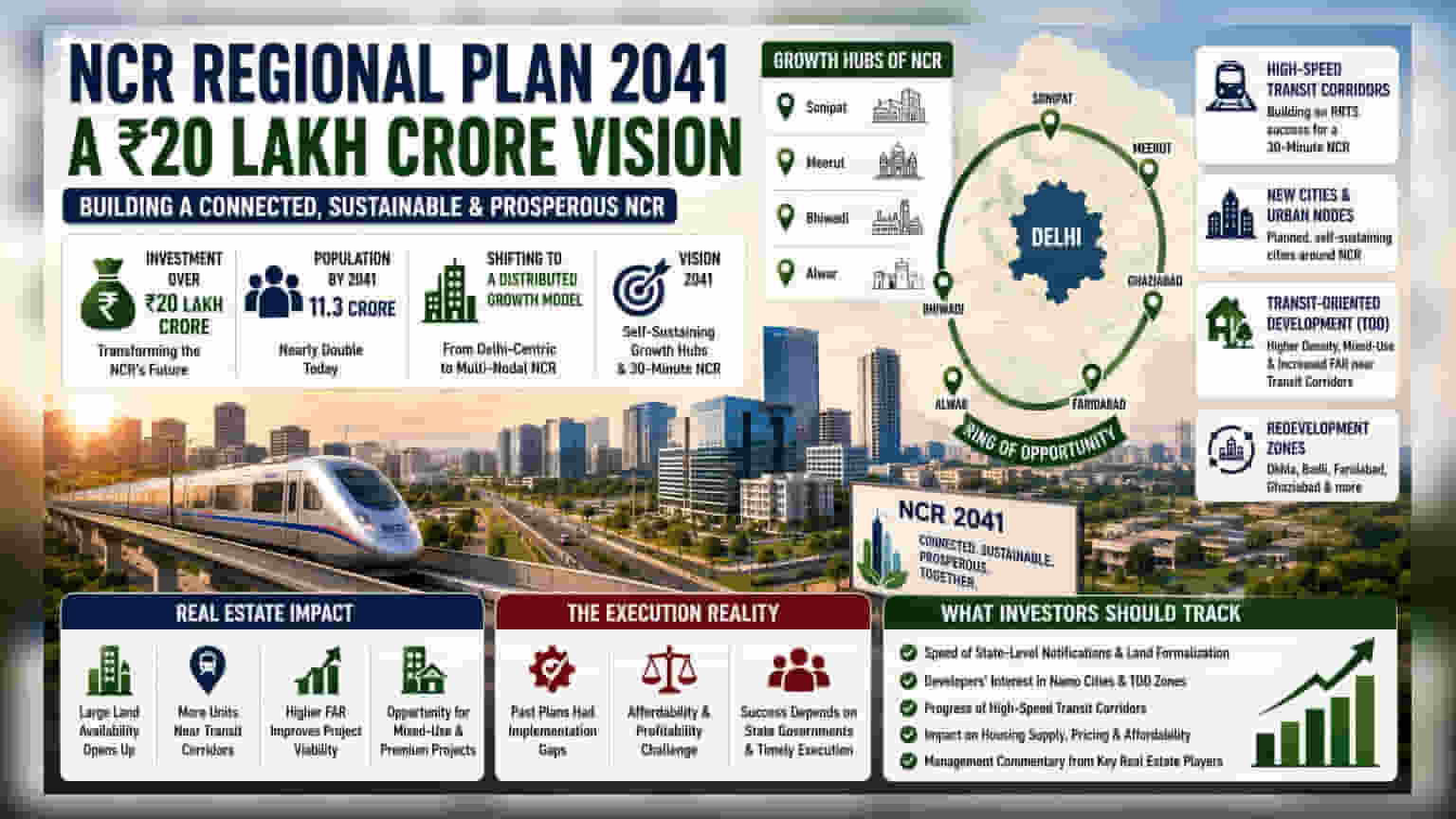
The government has proposed the NCR Regional Plan 2041, aiming to invest Rs 20 lakh crore into infrastructure, new growth hubs, and high-speed transit. This initiative seeks to reshape the Delhi-NCR urban landscape to accommodate a projected population of 11.3 crore. While the infrastructure boost is significant for real estate and construction, investors should monitor execution risks and whether the plan actually improves housing affordability.
What Happened
The government has unveiled the NCR Regional Plan 2041, a massive infrastructure and urban development roadmap for the Delhi-National Capital Region. The proposal envisions a total investment of over Rs 20 lakh crore to redraw the region’s urban map. The plan aims to shift from a Delhi-centric model to a more distributed network, creating self-sustaining growth hubs in locations like Sonipat, Bhiwadi, Meerut, and Alwar. With the NCR's population expected to nearly double to 11.3 crore by 2041, the initiative seeks to solve long-term urban density and connectivity challenges through high-speed transit corridors and new city developments.
Infrastructure And Connectivity Boost
A core part of this strategy is the "Ring of Opportunity," which focuses on formalizing land usage along the KMP-Eastern Peripheral Expressway. By bringing these peripheral areas into a formal planning framework, the government aims to reduce regulatory uncertainty and open up large tracts of land for development. The plan also prioritizes high-speed connectivity, building on the success of existing projects like the Delhi-Meerut RRTS. By linking these satellite cities with faster transit, the vision is to enable a "30-minute NCR," making it easier for people to work in major hubs while living in newly developed surrounding areas.
The Real Estate Development Angle
For the real estate sector, the plan introduces Transit-Oriented Development (TOD). This concept encourages higher density and mixed-use projects near transit corridors. By increasing the Floor Area Ratio (FAR) in these zones, the government hopes to create more housing supply efficiently. Additionally, the plan calls for redevelopment in older industrial or residential pockets like Okhla, Badli, Faridabad, and Ghaziabad. If these changes are implemented effectively, it could allow developers to build more units per acre, potentially improving the viability of projects in these designated zones.
The Profitability And Execution Reality
While the infrastructure vision is ambitious, investors should keep a balanced view regarding the actual impact on housing supply. The property market in Delhi-NCR has been trending toward premium and luxury projects, largely because developers have found it difficult to maintain healthy profit margins in the affordable housing segment. Even with increased land availability, developers will only build if they see commercial viability. Past regional plans for the NCR have faced significant gaps in implementation, and the success of this 2041 vision depends on how quickly state governments expedite notifications and land conversion processes. There is a risk that without structural changes to support affordability, the focus may remain heavily on the premium segment.
What Investors Should Track
Investors looking at the infrastructure and real estate sectors should track a few key monitorables. First, watch for the speed of state-level notifications, as these are required to formalize land and unlock development. Second, look for management commentary from developers active in the NCR regarding their interest in the new "Namo Cities" or TOD zones. Finally, monitor the progress of high-speed transit corridors, as infrastructure connectivity is the primary driver that will determine if these new growth hubs actually become attractive for end-users and commercial tenants.