 Whalesbook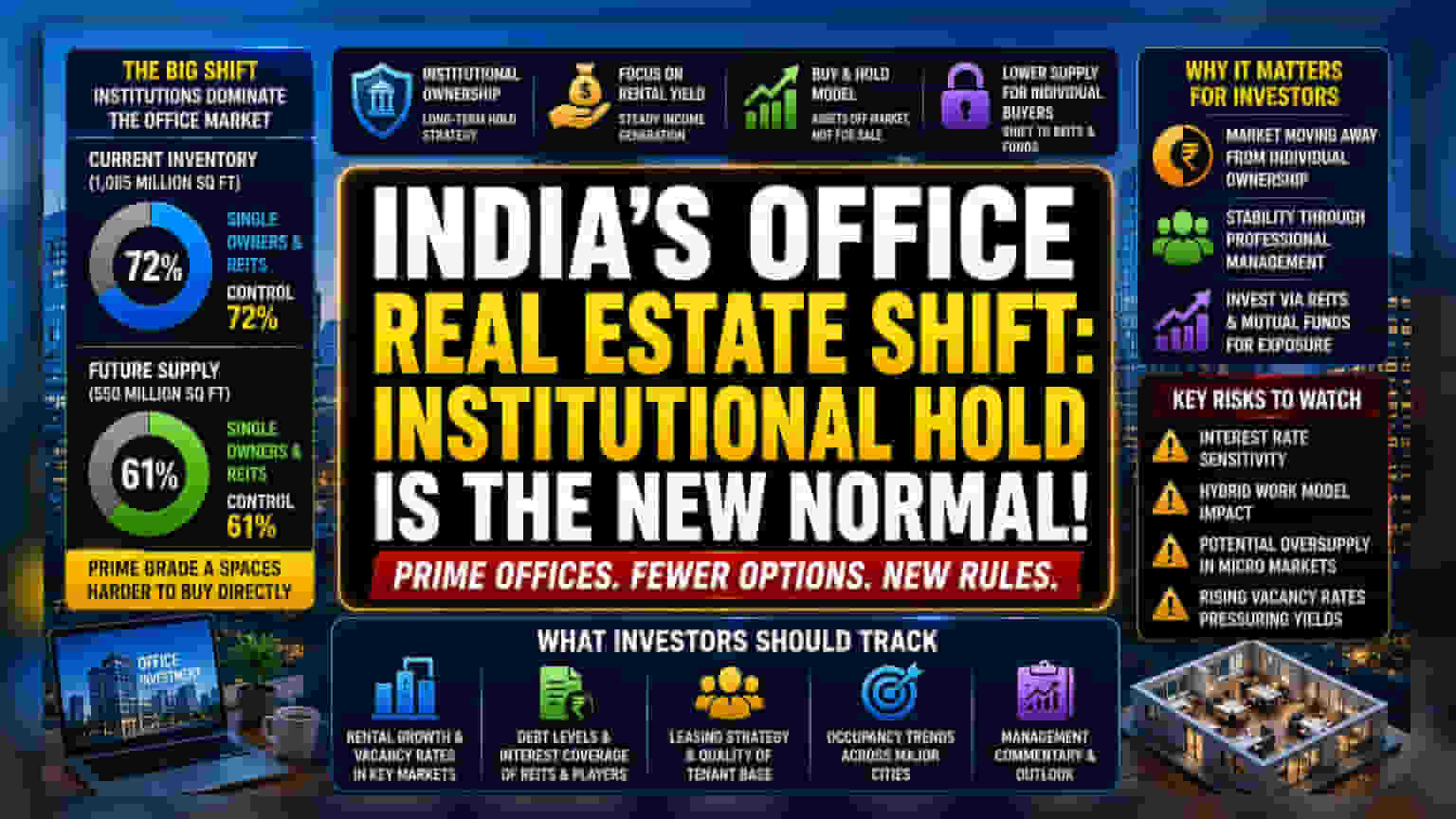
Large investors and REITs are holding on to more office properties, making it harder for private buyers to find premium assets. This trend changes how Indian commercial real estate works, focusing more on long-term rental income rather than quick sales.
What Happened
India's office real estate sector is undergoing a major shift. Large institutional players, including Real Estate Investment Trusts (REITs) and private equity funds, are increasingly choosing to hold onto their office properties rather than selling them to individual investors. Data indicates that single owners and REITs now control 72% of the country's 1,085 million sq ft of current office inventory. This trend is also visible in new projects, where these large entities hold 61% of the 550 million sq ft of office space that is either planned or under construction. This creates a situation where prime, Grade A office spaces are becoming harder for individual or smaller private buyers to purchase directly.
Why This Matters For Investors
For investors, this shift highlights that the commercial real estate market is moving away from the model of buying and selling individual office units. Instead, it is becoming a market dominated by large-scale, long-term rental income generators.
Institutional investors and REITs operate with a 'hold' strategy. Their goal is to maximize rental yield and achieve long-term capital appreciation by keeping properties under their management. When these entities buy buildings from developers, they often remove those assets from the open market permanently. For high-net-worth individuals who traditionally sought to buy office space for personal ownership, the supply of high-quality assets is shrinking. This forces them to either settle for lower-quality properties or pivot their investment approach toward buying units in REITs or real estate mutual funds to gain exposure to the sector.
The Role of REITs and Yield-Based Investing
In India, listed entities like Embassy Office Parks, Mindspace Business Parks, and Brookfield India Real Estate Trust have popularized the concept of yield-based investing. These REITs consolidate large, premium office assets under one umbrella to generate steady cash flow from leasing.
Because their core business model relies on collecting rent, these REITs have little incentive to sell their buildings. This 'buy-and-hold' strategy provides stability for the REITs but reduces the liquidity of office assets for smaller investors. The market is effectively shifting toward a professional management structure where the asset remains institutional, and individual investors participate through dividends and price appreciation on the stock exchange rather than through physical ownership of a building.
Risks and Market Challenges
While institutional holding provides stability, it also introduces specific risks that investors should understand. Office real estate is highly sensitive to macro-economic changes.
First, interest rate sensitivity is a key factor. REITs and large developers often carry significant debt. If interest rates rise, borrowing costs go up, which can pressure the profitability of these large portfolios. Second, the 'hybrid work' model remains a structural challenge. While many companies have returned to the office, the demand for space is more nuanced. If corporations reduce their office footprints to save costs, vacancy rates in some buildings could rise, which directly impacts the rental income that these institutional owners rely on.
Additionally, there is the risk of oversupply in specific micro-markets. If developers continue to build new capacity without corresponding demand, the occupancy levels could drop, hurting the valuations of these large office assets.
What Investors Should Track
Investors looking at the broader commercial real estate sector should pay attention to a few key areas.
Monitoring rental growth and vacancy rates across major cities like Bengaluru, Mumbai, and Hyderabad is essential, as these indicators show whether the demand for office space is truly outpacing supply. It is also important to watch the debt levels and interest coverage ratios of major real estate players and REITs, as high debt can be a major disadvantage in a volatile interest rate environment. Finally, management commentary regarding their leasing strategy and their ability to attract high-quality, long-term tenants will remain a critical monitorable for the health of the entire sector.

