

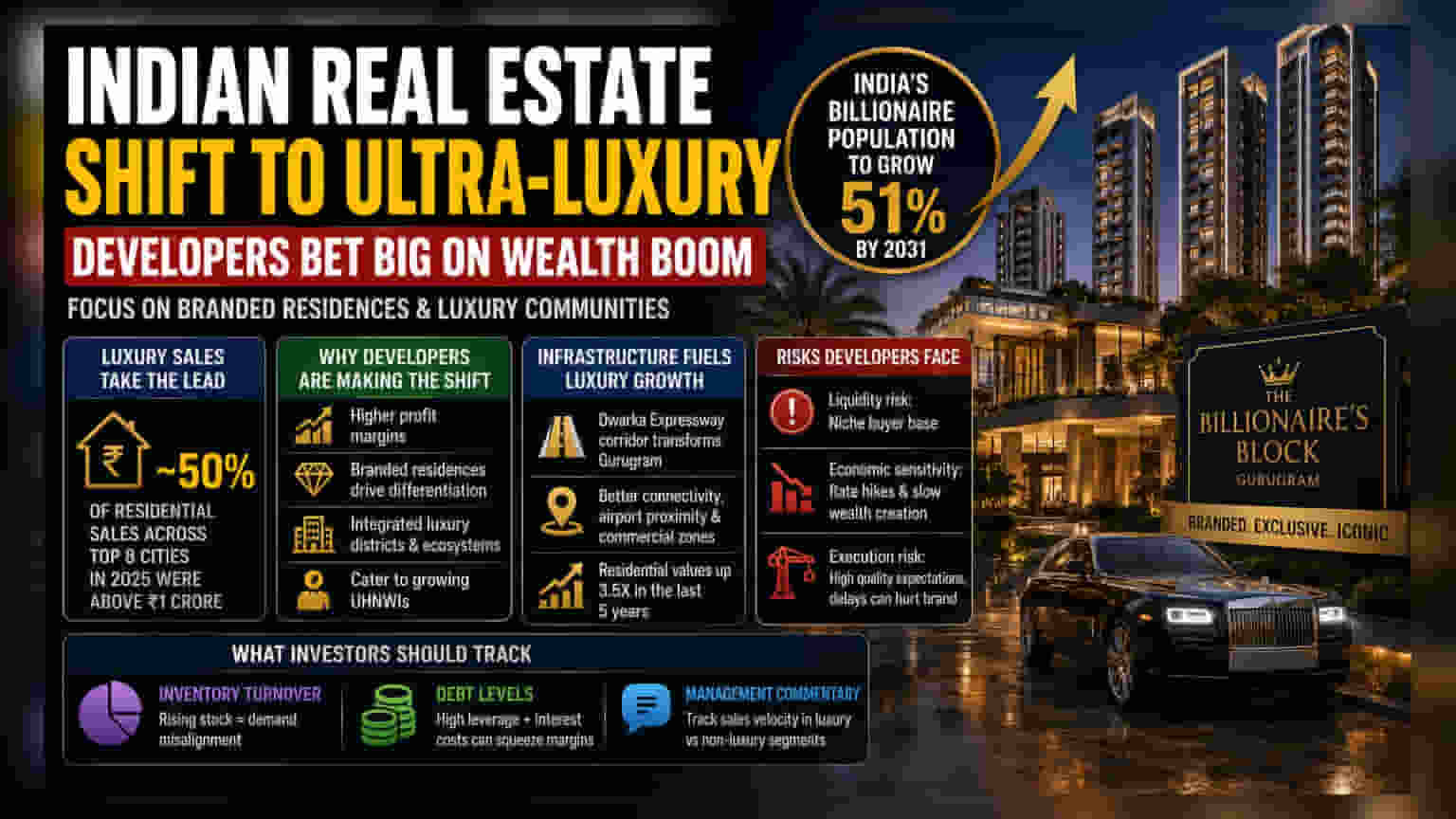
As India’s billionaire population is set to grow by 51% by 2031, developers are aggressively launching branded, ultra-luxury residential projects. These high-value properties already dominate market sales, with units priced above ₹1 crore accounting for nearly half of 2025 residential transactions. This pivot signals a strategic focus on premium segments, though it brings distinct liquidity and market risks.
What Happened
India's real estate sector is undergoing a clear transformation. Developers are increasingly moving away from mass-market housing to focus on ultra-luxury, branded residences. This shift is driven by the rapid growth of India's ultra-high-net-worth individuals (UHNWIs). According to projections, the nation's billionaire population is expected to expand by 51% between 2026 and 2031. This trend is already visible in sales data; in 2025, residential properties valued at over ₹1 crore represented nearly 50% of all sales across India's eight largest cities.
The Shift Toward Luxury Communities
Developers are redesigning their business models to cater to this specific demographic. Instead of standalone high-rises, the focus is now on creating integrated luxury districts. These projects often feature international branding—such as the recent tie-ups with fashion houses—to differentiate themselves. For example, developers like M3M have introduced projects like "The Billionaire's Block" in Gurugram, which aims to cluster multiple branded residences within one exclusive ecosystem.
For investors, this shift is significant because luxury projects generally offer higher profit margins compared to affordable or mid-segment housing. However, these projects also require higher initial spending on branding, premium design, and luxury amenities, which can tie up capital for longer periods.
Infrastructure As A Growth Driver
This luxury boom is not happening in isolation. It is heavily supported by infrastructure development. A prime example is the Dwarka Expressway corridor in Gurugram. The combination of improved connectivity, proximity to the international airport, and new commercial zones has made this micro-market a hotspot for high-end residential demand. Reports indicate that residential values along this specific corridor have risen more than 3.5 times in the last five years. This demonstrates how infrastructure projects often act as a multiplier for luxury property values.
The Business And Execution Risks
While the demand for luxury homes is rising, the model is not without risks. The primary challenge is liquidity. Unlike mass-market homes, which have a broader buyer base, ultra-luxury properties have a niche customer segment. If economic conditions slow down, the sales velocity—the speed at which a company sells its inventory—can drop sharply.
Additionally, these projects are highly sensitive to economic sentiment. If interest rates rise or global wealth creation slows, demand for luxury real estate is often the first to face pressure. Furthermore, developers face execution risk. Building ultra-luxury communities requires high-quality construction and maintenance to justify the premium price tag. Any delay in project delivery or failure to meet the promised "luxury experience" can damage a developer's brand and future sales.
What Investors Should Track
Investors looking at real estate companies should track three main things. First, monitor the inventory turnover ratio; if luxury inventory starts piling up, it indicates a mismatch between supply and demand. Second, look at the debt levels of developers; large luxury projects often require significant upfront capital, and rising interest costs can squeeze margins. Finally, pay attention to management commentary on sales velocity in luxury versus non-luxury segments to see if the company is becoming too dependent on a single, potentially cyclical, market segment.