 Whalesbook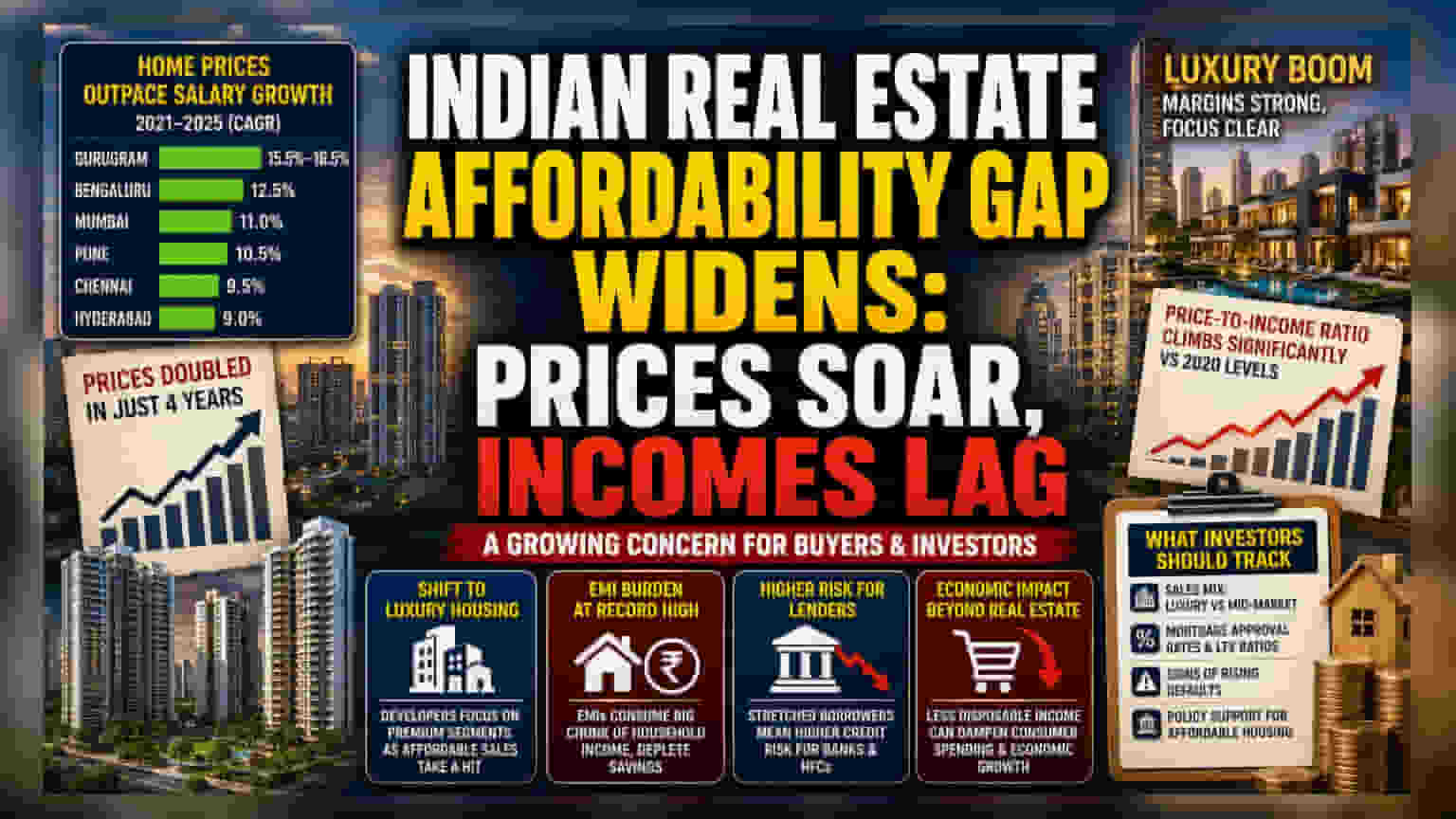


Home prices in India are rising significantly faster than household incomes, making homeownership difficult for many. This trend is shifting developer focus toward premium housing and creating potential risks for mass-market demand and housing finance.
What Happened
Recent industry data highlights a growing affordability gap in the Indian real estate market. In several major cities, residential property prices have been appreciating at a rate that far outpaces salary growth. Between 2021 and 2025, residential property prices in Gurugram recorded an annual growth of roughly 15.5% to 16.5%, causing prices to double in just four years. Similar, though slightly lower, growth trends have been observed in cities like Bengaluru, Mumbai, Pune, Chennai, and Hyderabad. This divergence means that buying a home has become increasingly difficult for the average household, with the price-to-income ratio in major cities climbing significantly compared to 2020 levels.
The Shift Toward Luxury Housing
This pricing trend has fundamentally changed what developers are building. Because affordability has become a hurdle for the mass market, real estate companies have pivoted toward premium and luxury housing projects. In regions like Gurugram, the share of affordable and mid-income housing sales has dropped sharply, as developers focus on segments where demand remains resilient despite higher price points. For investors, this represents a shift in business strategy. Companies that focus heavily on luxury and ultra-luxury segments may maintain strong margins, while those dependent on mass-market volume may face challenges if they cannot price their projects attractively.
Risks for Homebuyers and Lenders
The current market conditions present clear risks. The gap between income and home prices has forced many buyers to stretch their finances. Reports indicate that the Equated Monthly Installment (EMI) for an average home in key markets can now consume a large portion of a household's monthly income. This creates a reliance on family financial support and the depletion of liquid savings. For housing finance companies and banks, this trend suggests a potential increase in credit risk. If borrowers are already stretched to their limit, their ability to handle interest rate fluctuations or unexpected financial stress may be reduced.
Impact on the Real Estate Sector
While rising prices increase the asset value on developer balance sheets, the broader economic impact is worth noting. As a large segment of the population gets priced out of homeownership, the demand for mid-income housing may dampen. This could lead to a slowdown in project launches in the affordable segment. Furthermore, when household income is diverted toward high EMIs, discretionary spending across other sectors, such as consumer goods and retail, may see pressure. Investors should consider that sustained price escalation without matching income growth creates an unstable foundation for long-term volume growth in the real estate sector.
What Investors Should Track
Going forward, the key monitorable is the sustainability of demand at current price levels. Investors may track the sales mix of top developers to see if they are successfully maintaining margins through luxury projects or if they are struggling to move inventory in the mid-market segment. Additionally, updates on mortgage approval rates, loan-to-value ratios, and any signs of rising defaults in housing portfolios will be important for understanding the health of the housing finance sector. Finally, any policy interventions regarding affordable housing supply could influence the market dynamic in the coming quarters.