

India’s office market is facing a supply crunch in 2026 as demand for workspaces, led by Global Capability Centres (GCCs), continues to rise. With a 9% jump in annual rents and vacancy rates at record lows, landlords with green-certified, premium assets are gaining significant pricing power.
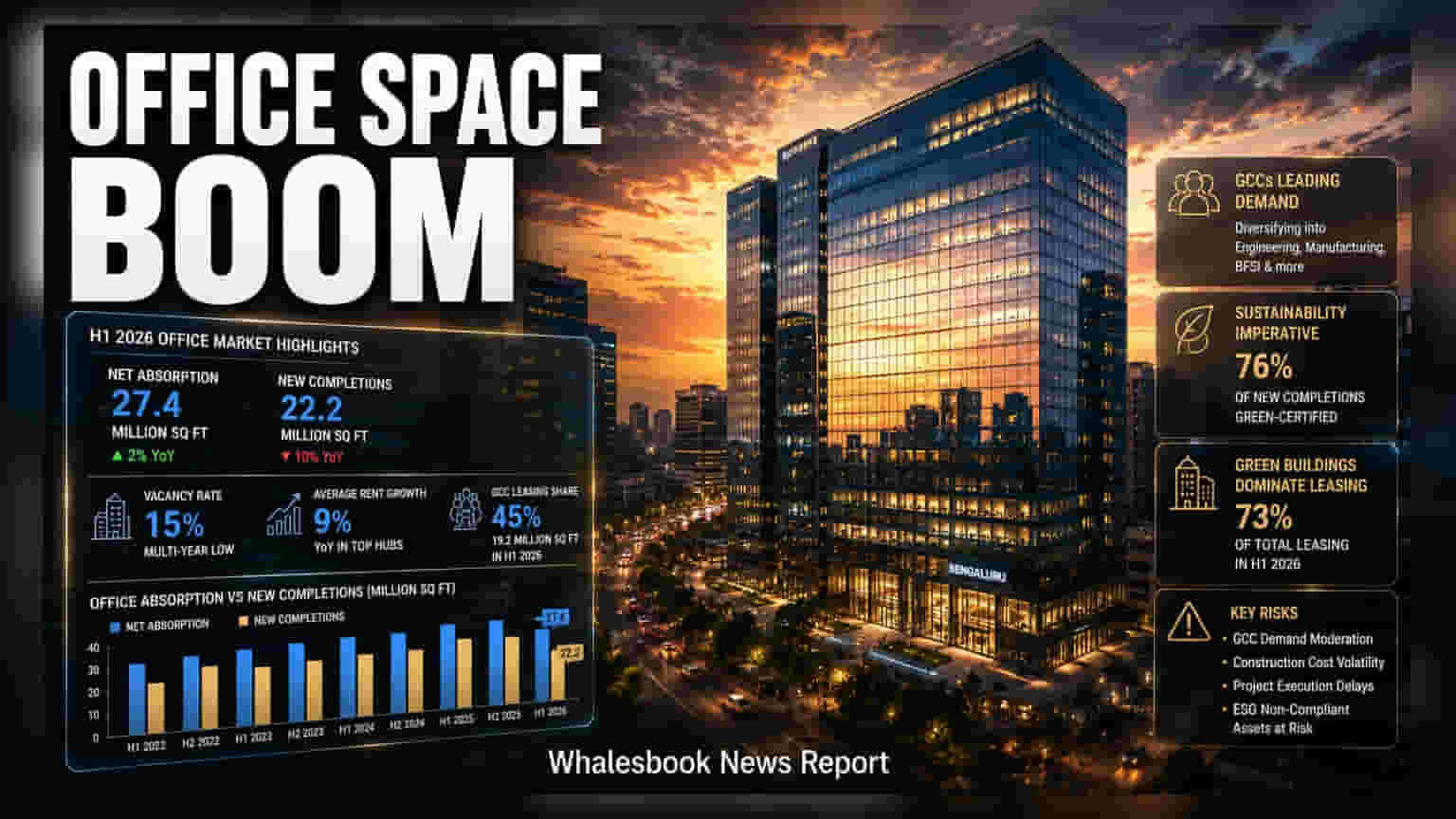
The Indian commercial real estate sector is witnessing a period of high demand that is currently outpacing new construction. Data for the first half of 2026 shows that net office space taken up by companies, known as absorption, reached 27.4 million sq ft, a 2% increase compared to the same period last year. Meanwhile, new office construction slowed down, with completions falling by 10% to 22.2 million sq ft.
This gap between high demand and limited new supply has pushed national office vacancy rates down to 15%, a multi-year low. For property owners and developers, this means increased pricing power, evidenced by a 9% annual rise in average rents across major hubs like Bengaluru and Hyderabad.
The Rise of GCCs and Business Diversification
Global Capability Centres (GCCs) have become the primary engine of this growth. In the first half of 2026, these centres accounted for 45% of total office leasing, with 19.2 million sq ft occupied. While these centres were traditionally led by global technology firms, the current cycle shows a healthy diversification into engineering, manufacturing, and the banking and financial services sectors. This shift is notable for investors, as it reduces the risk of over-reliance on a single industry, making the demand for office space more resilient to sector-specific slowdowns.
ESG Compliance as a New Necessity
Sustainability is no longer a luxury but a fundamental requirement for securing high-quality multinational tenants. In the first half of 2026, 76% of all new office completions were green-certified buildings, and these properties accounted for 73% of total leasing activity. This trend creates a clear divide in the market: developers who have invested in green-certified, high-quality campuses are likely to see stronger occupancy and better rent growth. Conversely, older buildings that do not meet these modern environmental, social, and governance (ESG) standards may face increasing difficulty in attracting top-tier tenants, potentially leading to higher vacancy risk for those owners.
Risks and Market Monitorables
While the current environment favors landlords, there are risks to monitor. The market’s heavy reliance on GCCs means that if global economic conditions lead multinational corporations to rethink their expansion strategies, demand could moderate. Additionally, developers face execution risks where volatile construction costs, such as steel and other raw materials, could delay the delivery of new, high-demand projects.
Investors and market participants should track how companies manage their rental portfolios, particularly in cities like Bengaluru, which remains the epicentre of this activity. Future updates on new project pipelines, the pace of rent growth, and the ability of developers to upgrade older portfolios to meet ESG standards will be key factors in determining the long-term sustainability of this trend.