

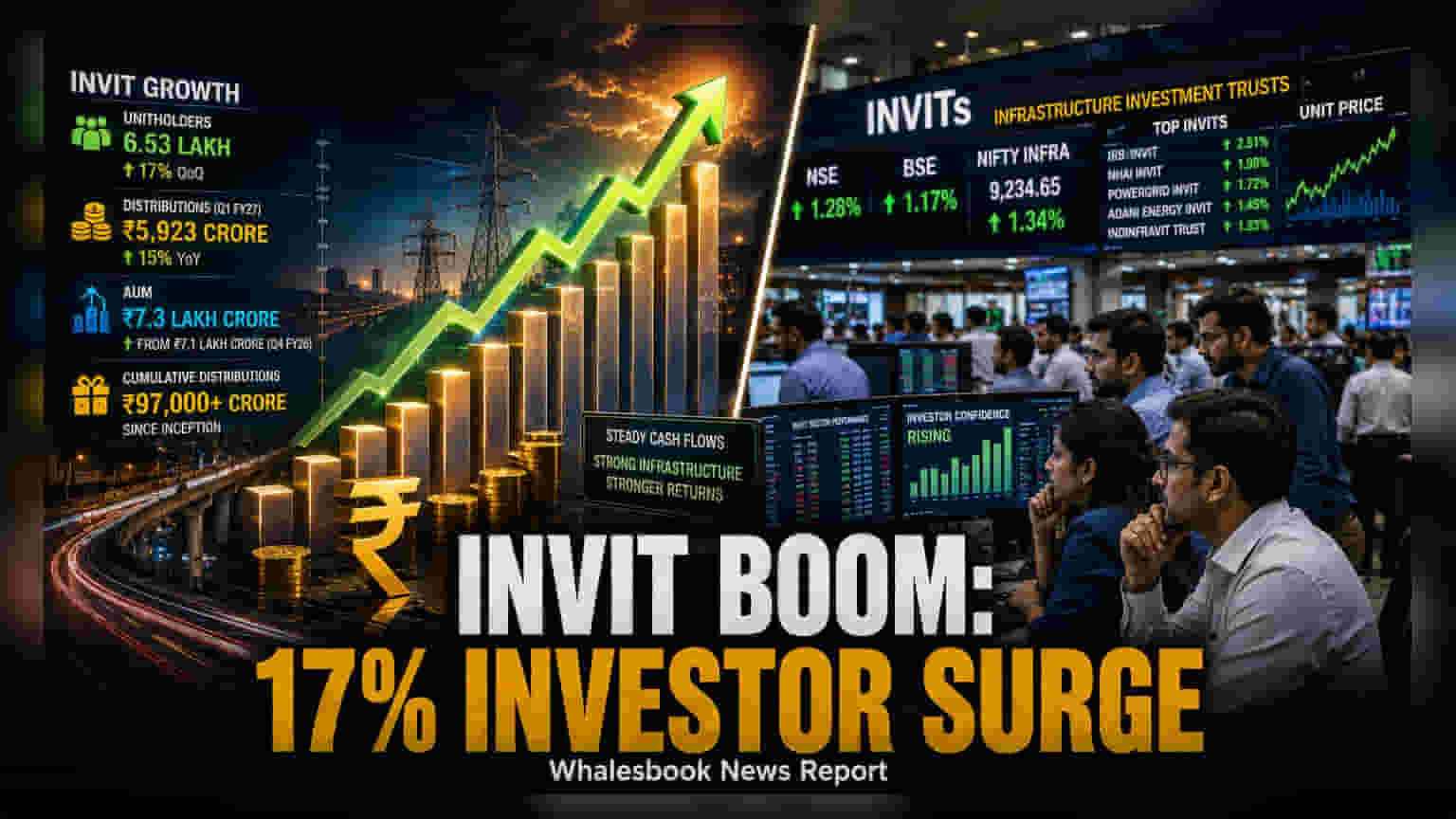
Infrastructure Investment Trusts (InvITs) grew their investor base by 17% to 6.53 lakh in Q1 FY27. Payouts to investors increased 15% year-on-year to ₹5,923 crore, reflecting steady income from infrastructure assets. Investors are increasingly looking at these vehicles for stable, regular returns despite potential risks from interest rate volatility.
The Indian infrastructure sector's specialized investment vehicles, known as Infrastructure Investment Trusts or InvITs, reported strong growth for the quarter ending June 2026. The unitholder base expanded by 17% to reach 6.53 lakh, up from 5.58 lakh in the previous quarter. This growth suggests that more retail and institutional investors are adopting these instruments as a way to access the infrastructure sector.
InvITs function by pooling money from various investors to own and manage large-scale infrastructure projects, such as toll roads and power transmission lines. The income generated from these assets—typically through user fees or long-term contracts—is then distributed to the unitholders, similar to dividends. In Q1 FY27, these distributions totalled ₹5,923 crore, marking a 15% increase over the ₹5,153 crore distributed in the same quarter of the previous fiscal year. Since their inception, these trusts have cumulatively distributed over ₹97,000 crore.
The sector's total value of managed assets, known as Assets Under Management (AUM), also rose to ₹7.3 lakh crore, compared to ₹7.1 lakh crore in the previous quarter. This expansion reflects a steady accumulation of infrastructure assets and growing confidence in the sector's ability to deliver consistent cash flows.
However, investors should consider the specific risks associated with these trusts. InvITs are sensitive to interest rate fluctuations. Because infrastructure projects often rely on substantial debt, rising interest rates can increase borrowing costs, which may reduce the cash available for distribution to unitholders. The stability of payouts also depends heavily on the underlying assets. For instance, InvITs holding toll roads are dependent on traffic volume and approved toll rate hikes, while those in the power sector depend on consistent demand and timely payments from power distribution companies.
Looking ahead, the market will likely track how these trusts manage their debt levels and asset performance. Investors may also monitor regulatory updates, as changes in policy or taxation can influence the attractiveness of these instruments compared to other fixed-income or dividend-yielding assets.