

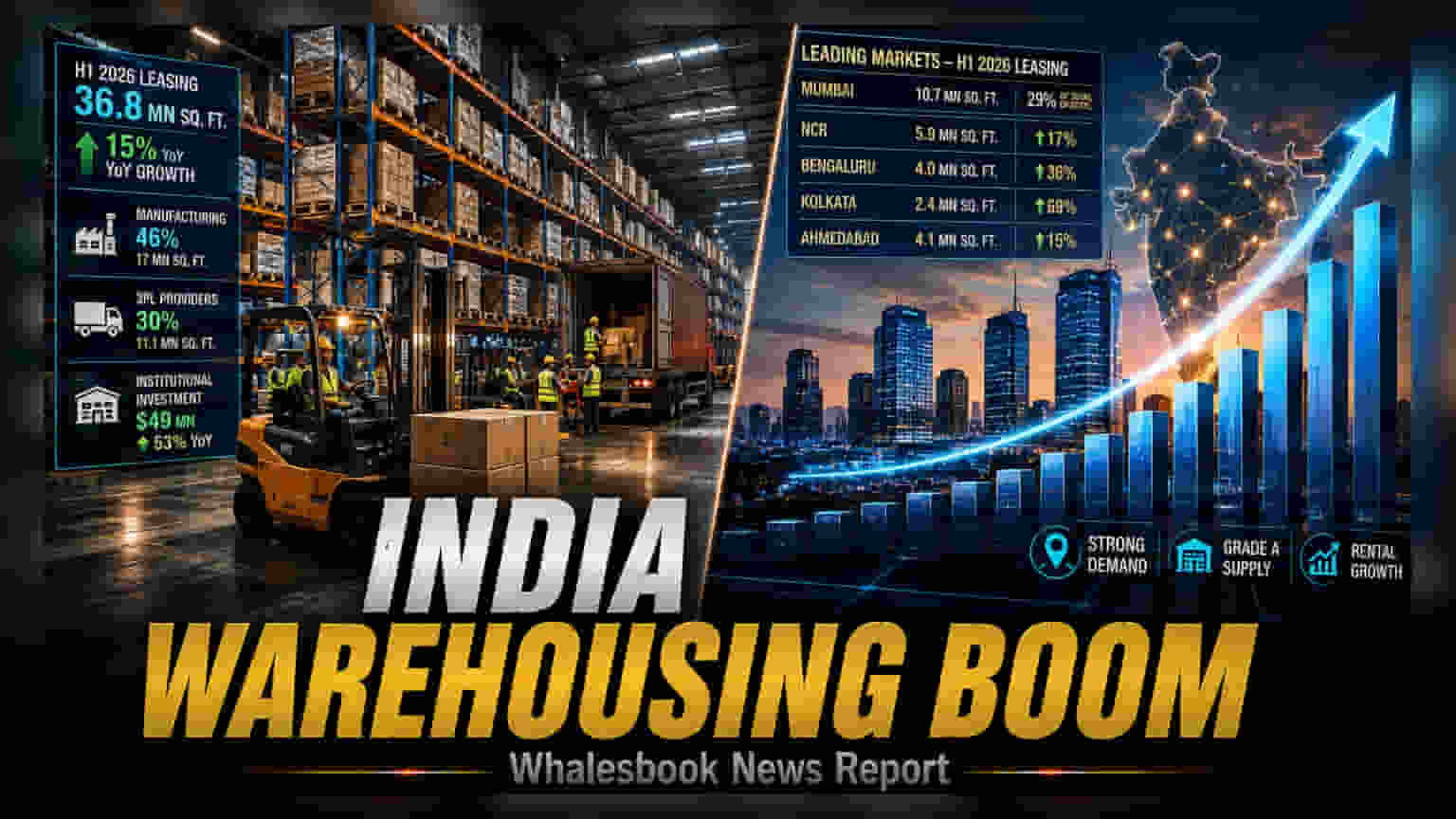
India's industrial and warehousing sector saw a 15% rise in leasing activity during the first half of 2026, reaching 36.8 million sq. ft. The growth was led by strong manufacturing and third-party logistics demand. While Mumbai hit record transaction volumes, investors should monitor regional disparities in vacancy rates and limited Grade A supply in certain markets.
India’s industrial and warehousing sector maintained positive momentum in the first half of 2026, with leasing activity reaching 36.8 million sq. ft. This reflects a 15% increase compared to the same period in 2025. The growth was driven largely by strong expansion in the manufacturing sector and a rising reliance on third-party logistics (3PL) providers for supply chain optimization.
Manufacturing companies remained the primary occupiers, accounting for 46% of total transactions with 17 million sq. ft. leased. Within this segment, the automotive, engineering, and electronics industries were key contributors. Meanwhile, 3PL providers accounted for 30% of total volume, leasing 11.1 million sq. ft., which indicates a continued shift toward outsourcing logistics operations to manage costs and scale.
Mumbai Leads with Record Activity
Mumbai emerged as the standout market, recording 10.7 million sq. ft. in transactions, its highest-ever half-yearly volume. This single market accounted for nearly 29% of the total leasing across India's eight major industrial hubs. Infrastructure advancements, such as the completion of the Western Dedicated Freight Corridor, have played a significant role in attracting occupiers to the region.
Other major markets also showed growth. The National Capital Region saw leasing rise by 17% to 5.9 million sq. ft., while Bengaluru recorded a 36% jump, reaching 4 million sq. ft. Kolkata saw the sharpest percentage growth at 69%, totaling 2.4 million sq. ft. Ahmedabad also maintained steady growth with a 15% rise, reaching 4.1 million sq. ft.
Regional Disparities and Operational Risks
While the overall trend is upward, the sector faces distinct regional challenges. In Chennai, the growth of leasing activity was constrained by the limited availability of Grade A warehouse space. Pune and Hyderabad saw a decline in new leasing volumes. Hyderabad, in particular, continues to grapple with high vacancy rates, which can impact rental growth and property attractiveness in the short term.
Rental values trended upward across most major markets, with Chennai registering the highest annual rental growth of 7%, reaching ₹25.7 per sq. ft. per month. Pune remained the most expensive market for industrial space, at ₹28.7 per sq. ft. per month.
Institutional investment in the warehousing sector also signaled long-term confidence, rising 53% year-on-year to $49 million in the first half of 2026. However, the sector’s performance remains sensitive to global economic factors, including elevated freight costs and geopolitical risks that can affect trade volumes.
For investors and stakeholders, the key monitorables moving forward will include the pace of infrastructure development, the ability of developers to provide high-quality Grade A space to meet demand in constrained markets like Chennai, and how vacancy levels evolve in cities like Hyderabad. Monitoring rental trends and the continued absorption capacity of the manufacturing and 3PL sectors will provide further clarity on the sustainability of this growth cycle.